You Won in Court. The Debtor Won't Pay. Now What?
The magistrate ruled in your favor. The case number is on file. But weeks have passed and no payment has arrived — because West Virginia Magistrate Courts do not collect judgments. That job falls entirely on you.
The court website has the forms, but no instructions. The Clerk's office accepts completed paperwork but cannot tell you which form to file or when. The Sheriff enforces writs but requires you to identify specific assets first. And every misstep — wrong form, wrong office, wrong sequence — costs you filing fees you may never recover.
The Judgment Collection Roadmap inside this guide turns the scattered statutes, forms, and procedures into a single chronological path. You start on Day 21 after judgment entry (when the mandatory appeal window closes) and follow each step through to recording a Satisfaction of Judgment — knowing exactly which office to visit, which form to file, which fee to pay, and what happens next.
What's Inside the Guide
- The 20-Day Appeal Window Checklist — confirms your judgment is final and enforceable before you spend a dollar on enforcement, with verification steps for motions to set aside, appeals, and late-appeal applications within the 90-day extended window
- Enforcement Tool Decision Matrix — maps the debtor's asset type (wages, bank accounts, personal property, real estate) to the exact court procedure, form number, and fee, so you pick the right tool on the first attempt instead of filing paperwork that comes back empty
- Wage Garnishment Walkthrough (Suggestee Executions) — Form SCA-C&M640NP line by line, the disposable-earnings formula that determines how much the employer withholds, the difference between private and government employers, and what to do when the employer objects or the debtor quits
- Bank Account Garnishment Procedure — how to request a Suggestion order, serve it on the financial institution, handle the $1,100 statutory exemption the debtor can claim, and collect when the bank holds accounts at multiple branches
- Personal Property Seizure via Writ of Execution — directing the County Sheriff to levy non-exempt goods, understanding upfront levy costs, property inventory requirements, the public auction process, and what happens when a third party claims ownership
- Real Estate Lien Recording — docketing a certified Abstract of Judgment with the Clerk of the County Commission under W. Va. Code §§ 38-3-4 through 38-3-7, how the lien attaches to the debtor's property across the county, and what it means when the debtor tries to sell or refinance
- West Virginia Exemption Reference — the $15,000 aggregate personal property protection, $1,100 bank account exemption, homestead exemption, tools-of-the-trade limits, and other protections that tell you what you cannot reach before you pay fees to try
- 2026 Post-Judgment Interest Calculator — applies the official 6.25% annual rate set by the Supreme Court of Appeals under W. Va. Code § 56-6-31, with a worked example showing principal, interest, recoverable costs, and partial-payment tracking
- Cost-Tracking Worksheet — logs every filing fee, service fee, and sheriff cost alongside the statutory authority for adding each one to the recoverable judgment balance, so you know your total outlay and total recovery at every stage
- Cross-County and Out-of-State Procedures — what changes when the debtor or their assets are in a different West Virginia county, and when domesticating the judgment in another state makes financial sense
- Satisfaction of Judgment and Case Closure — the mandatory release form, how to clear recorded liens across every county where you docketed an abstract, and why skipping this step exposes you to liability
Who This Guide Is For
- Landlords holding a judgment for unpaid rent or property damage who need to garnish wages or a bank account to recover the money
- Contractors and service providers with a breach-of-contract judgment the other side has ignored for weeks or months
- Individuals who won a judgment over a vehicle collision, unreturned deposit, or broken agreement — and got silence instead of a check
- Small business owners collecting on unpaid invoices, using West Virginia's right to pursue post-judgment collection without an attorney under W. Va. Code § 50-4-4a
This guide covers civil money judgments from West Virginia Magistrate Courts only. It does not cover criminal restitution, domestic relations, or Circuit Court equity actions. If the debtor files for bankruptcy, the guide explains what to do immediately and when to stop.
Why Free Forms and Free Advice Aren't Enough
The West Virginia Judiciary posts official forms on courtswv.gov — and they are genuinely free. But a downloadable PDF with blank fields and no context is not the same as knowing when to file it, where to deliver it, and what happens after you do. Form SCA-C&M640NP is four pages of blanks. The guide turns those blanks into a completed workflow with the statutory limits, the exact fee, and the next step after the employer responds.
The Magistrate Court Clerk is legally prohibited from recommending enforcement tools, helping you choose a form, or advising you on strategy. Clerks accept paperwork and collect fees — nothing more. The same is true of the Sheriff's office. They enforce the writ you give them, but they will not tell you which writ to request.
Online legal information sites frequently publish outdated or inaccurate West Virginia-specific details — including claiming a $20,000 jurisdictional cap from a bill that was never enacted. This guide is built from the current West Virginia Code, verified official court forms, and the Supreme Court of Appeals' 2026 administrative order on interest rates.
What You Get
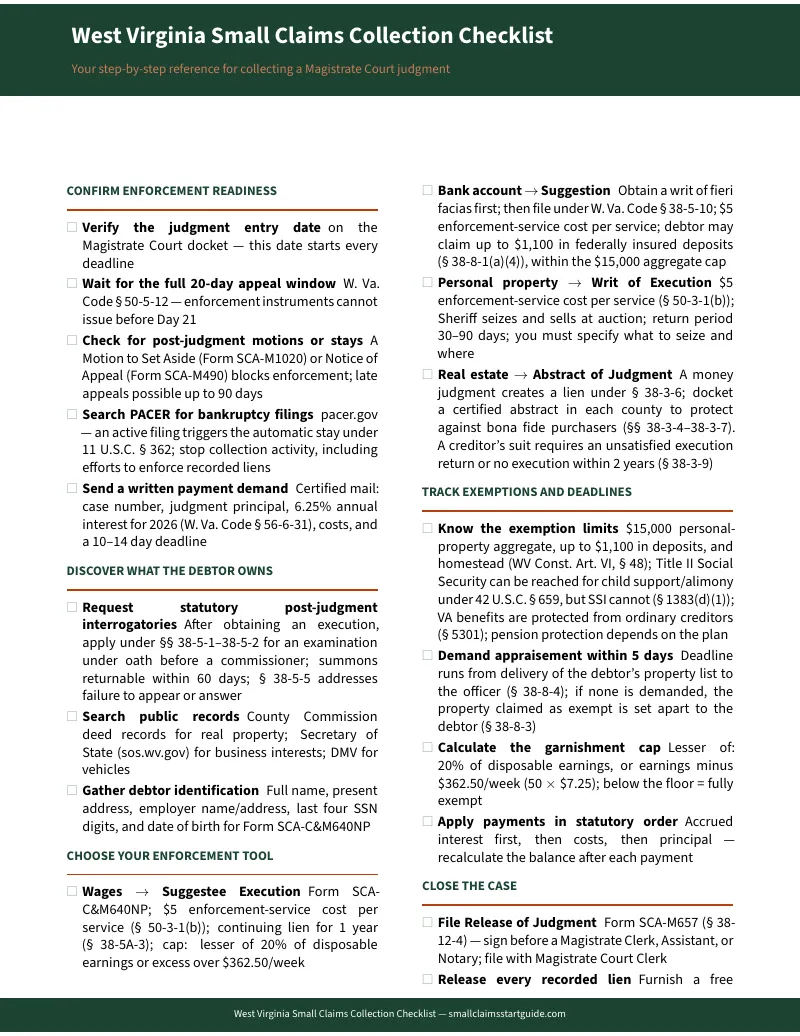
Your purchase includes 12 PDF downloads — the 45-page guide, a two-page 20-item collection checklist, and 10 fill-in printables (appeal-window checklist, decision matrix, interest calculator, payment ledger, exemption screen, sheriff-prep checklist, agency log, cost tracker, asset-discovery worksheet, and satisfaction-closing checklist) — with no recurring fees and no subscription. The checklist gives you the enforcement sequence at a glance. The guide and printables give you the procedure and the pages you write on.
Full refund, no time limit. If the guide does not help you, email [email protected] and we will refund your purchase — no deadline, no questions.
Get the West Virginia Judgment Collection Guide →
The guide costs a fraction of one filing fee — and it shows you which filing fees are worth paying before you spend them. For , you get the same procedural roadmap that would take hours to piece together from scattered statutes and form libraries.
Frequently Asked Questions
What if the rules change after I buy?
We update the guide when the rules change. Email us any time, even years later, and we'll send you the current edition free.