Won Your Case in Pennsylvania? Here Is How to Actually Get Paid — Court by Court, Form by Form, Without Wasting Money on Enforcement Tools the Debtor's Exemptions Will Block.
The judge ruled in your favor. You walked out of the Magisterial District Court or Philadelphia Municipal Court expecting something to happen next. Instead, nothing. No one from the courthouse contacted the other side. No payment showed up. And when you called the clerk's office, you learned something most people don't discover until this exact moment: Pennsylvania's minor courts enter judgments but do not collect them. Every step from here — waiting out the appeal window, figuring out what the debtor owns, choosing the right enforcement tool, filing the right forms with the right officer — is entirely on you.
You could start pulling individual forms from the Pennsylvania Courts website, guessing which one applies to your court, and hoping the constable or sheriff will explain the rest when you show up. Or you could follow a judgment enforcement system built specifically for creditors navigating Pennsylvania's three overlapping court systems.
The Three-Court Enforcement System
This is not a national overview that mentions Pennsylvania in passing. It is a procedural guide built exclusively for creditors holding money judgments from Pennsylvania's Magisterial District Courts (66 counties), the Philadelphia Municipal Court, and the Court of Common Pleas — the three forums where your enforcement paperwork will actually land.
That distinction matters because Pennsylvania's post-judgment system is genuinely unusual. Other states let you enforce a small claims judgment with one set of forms in one court. In Pennsylvania, personal property execution runs through your local MDJ or PMC with constables and bailiffs, while real estate liens require a completely separate filing at the county Prothonotary in the Court of Common Pleas. And the forms, fees, officers, and deadlines are different in each system.
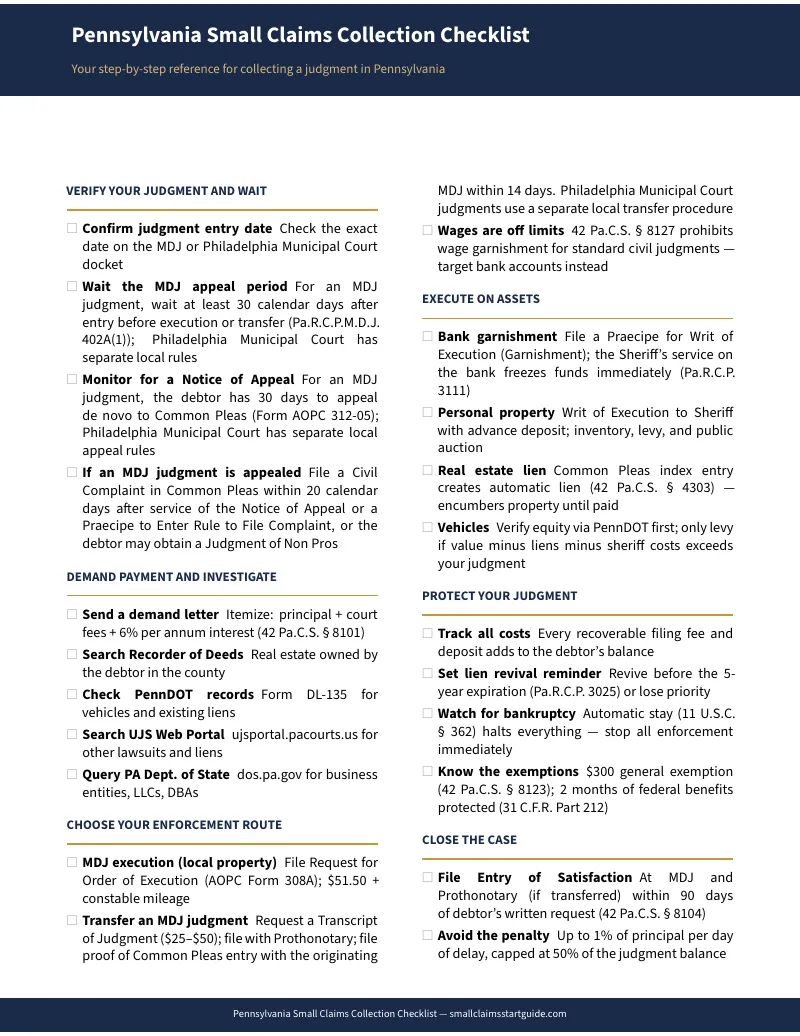
Every chapter follows the mandatory enforcement sequence: confirming the 30-day appeal stay has expired, discovering what the debtor owns, executing against personal property and bank accounts through your originating court, filing a transcript with the Prothonotary to create a real estate lien, handling exemptions, calculating interest, and closing the case with a proper Satisfaction of Judgment.
What's Inside
- 30-day appeal stay countdown — confirms whether the mandatory waiting period has expired and whether the debtor has filed a de novo appeal to the Court of Common Pleas under Pa. R.C.P.M.D.J. 1002, so you don't waste filing fees on an order of execution the clerk will reject
- Debtor asset discovery walkthrough — practical techniques for locating bank accounts, employer details, vehicles, and real property through supplementary proceedings and public records, without violating Pennsylvania privacy law
- MDJ execution workflow — step-by-step completion of AOPC Form 305ABL (Request for Order of Execution), coordinating with a certified constable or county sheriff, the 60-day validity window under Pa. R.C.P.M.D.J. 405(A), and what to do when the constable returns with nothing
- Philadelphia Municipal Court workflow — filing a Praecipe for Writ of Execution through the FJD Claims portal, PMC Bailiff service, and the Philadelphia Sheriff's Civil Division fee schedule
- Bank account garnishment instructions — how to draft Interrogatories to Garnishee, serve the writ on the debtor's bank, handle the bank's answers, and navigate the automatic federal protection for two months of direct-deposited Social Security, SSI, and VA benefits under 31 CFR Part 212
- The wage garnishment prohibition explained — why 42 Pa.C.S. § 8127 blocks standard wage garnishment in Pennsylvania and the narrow exception for residential landlords recovering physical lease damages (capped at 10% of net wages above the poverty line)
- Real estate lien via the Prothonotary — requesting a certified transcript from the minor court clerk and filing it with the Court of Common Pleas Prothonotary under Pa. R.C.P.M.D.J. 402(D), creating a binding lien good for five years and renewable for up to 20
- Exemptions reference — the $300 statutory personal property exemption under 42 Pa.C.S. § 8123, federal benefit protections, and what a constable or sheriff cannot seize, so you can assess enforcement viability before you spend money on deposits
- Interest and cost recovery — how 6% annual simple interest accrues automatically under 42 Pa.C.S. § 8101 and how every constable deposit and filing fee gets added to the debtor's judgment balance
- Satisfaction of Judgment procedure — the mandatory process for recording payment under 42 Pa.C.S. § 8104, including the 90-day deadline after written request and the statutory penalty of up to 1% of the principal per day of delay for failing to record satisfaction
- Printable worksheets — Enforcement Route Decision Worksheet, Officer Fee and Cost Recovery Ledger, Asset Discovery Checklist, Post-Judgment Interest Calculator, Judgment Lifecycle and Deadline Tracker, and Satisfaction of Judgment Compliance Checklist
Who This Guide Is For
- An individual who won a money judgment in a Magisterial District Court or Philadelphia Municipal Court and has not been paid — whether the underlying dispute involved a security deposit, unpaid invoice, property damage, or a contractor who took a deposit and disappeared
- A sole proprietor, small landlord, or small business owner holding a judgment against a customer, vendor, tenant, or contractor
- A family member or administrative helper organizing enforcement paperwork on behalf of the named judgment creditor
- Anyone who called the court clerk, was told the court does not collect, and now needs to figure out what to file and in what order
Who This Guide Is Not For
- People who haven't filed yet — if you need to bring a case, the Pennsylvania Small Claims Filing Guide covers the complaint, service of process, and hearing
- Defendants — if you've been served with a lawsuit or a post-judgment writ, the Pennsylvania Small Claims Response Guide covers your deadlines and options
- Claims over $12,000 — Court of Common Pleas judgments follow different enforcement rules
- Creditors seeking wage garnishment for a consumer debt — Pennsylvania law prohibits this for standard civil claims; the guide explains the ban and the alternatives
Why Not Just Use the Free Court Forms?
You should download AOPC Form 305ABL and the other execution forms from the Pennsylvania Courts website — they are public documents. But here is what the court website gives you: individual blank PDFs with zero instructions explaining what to write in the "Property to be Levied" field, no guidance on how to coordinate service with a certified constable, no explanation of the different procedures for Philadelphia versus every other county, and no workflow connecting the forms into a sequence.
Court clerks will accept your filing and take your fee, but they are legally prohibited from telling you which enforcement tool to use, how to fill in the forms, or whether the debtor's assets are exempt. The court does not provide legal advice — that boundary is printed on the forms themselves.
National guides like Nolo's Everybody's Guide to Small Claims Court cover the trial process in depth but dedicate minimal space to post-judgment enforcement. Worse, national resources routinely claim that creditors can garnish 25% of disposable wages — which is flatly illegal in Pennsylvania for standard civil consumer debts under 42 Pa.C.S. § 8127. Following generic online advice wastes time and court fees on paperwork the clerk will reject.
This guide fills the gap. It takes Pennsylvania's scattered enforcement forms, rules, and deadlines across three court systems and arranges them into a single collection workflow — from the day the 30-day appeal stay expires to the day you record the Satisfaction of Judgment.
Satisfaction Guarantee
Full refund, no time limit. If the guide doesn't help you navigate the collection process, email [email protected] and we'll refund your purchase — no questions, no deadline.
Important Disclaimer
This guide is published by an independent educational publisher. It is not affiliated with, endorsed by, or connected to the Unified Judicial System of Pennsylvania, any Magisterial District Court, the Philadelphia Municipal Court, the Administrative Office of Pennsylvania Courts, or any government agency. It provides procedural information, organizational checklists, and document completion instructions for self-represented judgment creditors. It does not contain legal advice, merits evaluation, or outcome predictions.
Frequently Asked Questions
What if the rules change after I buy?
We update the guide when the rules change. Email us any time, even years later, and we'll send you the current edition free.