You Were Just Served in Pennsylvania. Now What?
Someone filed a civil complaint against you in a Magisterial District Court — or you got a summons from Philadelphia Municipal Court. You are holding a document with a hearing date, a dollar amount, and warnings about default judgments. Your first instinct is to search online. Here is what you will find: a 440-page national book that does not mention Pennsylvania's dual court system, Etsy kits selling "Answer to Complaint" templates for a court that does not require written answers, and scattered government websites that mix plaintiff instructions with defendant rules until you cannot tell which deadline applies to you.
Here is the fact that most of those resources miss: Pennsylvania's Magisterial District Courts do not require a formal written answer. The Court of Common Pleas does, under Pa.R.C.P. 1026. But at the minor court level, the rules are different — and following the wrong court's procedure is one of the most common mistakes defendants make.
The Defendant's Dual-Court Navigator
Pennsylvania is the only state with two entirely separate small claims court systems running side by side: 66 counties use Magisterial District Courts under Pa.R.C.P.M.D.J. Rules 301–381, while Philadelphia has its own Municipal Court with different forms, different procedures, and different local rules. Most resources treat Pennsylvania as one system. This guide treats it as the two systems it actually is.
We call it the Defendant's Dual-Court Navigator — a single document that replaces hours of research across fragmented court websites, county directories, and outdated forum threads with one clear path from served papers to resolved case, for whichever court your case is in.
What's Inside
- Civil Complaint Decoder — a section-by-section walkthrough of Form AOPC 308A, plus the printable Complaint Review Worksheet so you extract the docket number, the magisterial district designation, the hearing date, the itemized dollar amount, and why each element matters for your response deadlines
- Dual-Court Procedure Map — side-by-side comparison of Magisterial District Court (written Notice of Intent to Defend) and Philadelphia Municipal Court (Notice of Defense form mailed to the claimant), with the exact procedure for each court so you never follow the wrong one
- Response Options Decision Guide — dispute the claim at the hearing, settle before the hearing and file a proper discontinuance, pay in full, request installment payments under Rule 323, file a counterclaim at least five days before the hearing, or challenge venue — with the forms, fees, and exact deadlines for each path, plus the printable Response Route Decision Checklist
- Rule 207 Business Representation Pack — if a corporation, LLC, or partnership needs a non-lawyer officer or employee to appear in court, the guide walks through the case-specific written authorization and personal-knowledge verification required under Pa.R.C.P.M.D.J. Rule 207, and warns about the attorney requirement if the case is appealed to Common Pleas
- Rule 321 Evidence Preparation System — Pennsylvania's minor courts allow bills, repair estimates, and cancelled checks into evidence without expert testimony. The guide shows you how to organize contracts, payment records, photos, and communications into a clear presentation for the hearing, and the printable Evidence Binder Index logs what you have, what you still need, and the three identical sets
- Post-Decision Roadmap — the 30-day appeal window to the Court of Common Pleas for a de novo trial, how the MDJ supersedeas works once you file, installment payment requests, and Pennsylvania's wage protection under 42 Pa.C.S. § 8127, plus the printable Post-Decision Action Tracker
- Printable kit — a 22-item Response Checklist, Hearing Day Preparation Checklist, and Settlement Agreement Template, ready to print and write on as your hearing date approaches
Who This Guide Is For
This guide serves Pennsylvania defendants in four common dispute categories:
- Homeowners sued by contractors over unpaid invoices, disputed change orders, or claims for defective or unfinished work
- Tenants and landlords in security deposit disputes, property damage claims, or unpaid rent cases
- Small business owners (sole proprietors, LLCs, corporations) sued by customers over service disputes or contract disagreements — with the Rule 207 business representation procedures they need
- Private vehicle sellers and buyers in post-sale disputes involving mechanical defects, misrepresentation, or title issues
Not for debt-collection defendants. If you were sued by a debt buyer, collection agency, or credit card issuer, your case involves specialized consumer protection laws. The guide directs these defendants to free legal aid resources — including PALawHELP.org, Community Legal Services of Philadelphia, and MidPenn Legal Services — rather than covering territory that requires specialized representation.
Why Not Just Use the Court Website?
Pennsylvania's Unified Judicial System portal at pacourts.us publishes the court rules, blank forms, and county directories. We link to it. But it was built to serve plaintiffs, defendants, and practitioners across every case type the courts handle, which means the information a served defendant needs is scattered across multiple PDFs, rule chapters, and county-specific pages.
Free legal aid through PALawHELP.org and the PA Legal Aid Network provides excellent coverage — when you qualify. Financial eligibility typically requires a household income below 125% to 200% of the Federal Poverty Guidelines, which excludes most middle-income homeowners, landlords, and small business owners.
This guide does not replace those resources. It organizes them. It takes the defendant-specific rules from across Pennsylvania's dual court system, strips out everything that applies only to plaintiffs, and arranges what remains into the order you actually need it: served papers first, court identification second, response options third, evidence prep fourth, hearing day fifth, post-decision sixth.
Compare that to buying a generic marketplace template that includes a formal "Answer to Complaint" — a document from Court of Common Pleas procedure that no Magisterial District Court clerk expects and that can mislead a defendant into skipping the actual step the court requires.
Full Refund, No Time Limit
If the guide does not help you prepare for your case, email [email protected] for a full refund. No time limit, no questions, no forms to fill out.
The Free Checklist Gets You Started
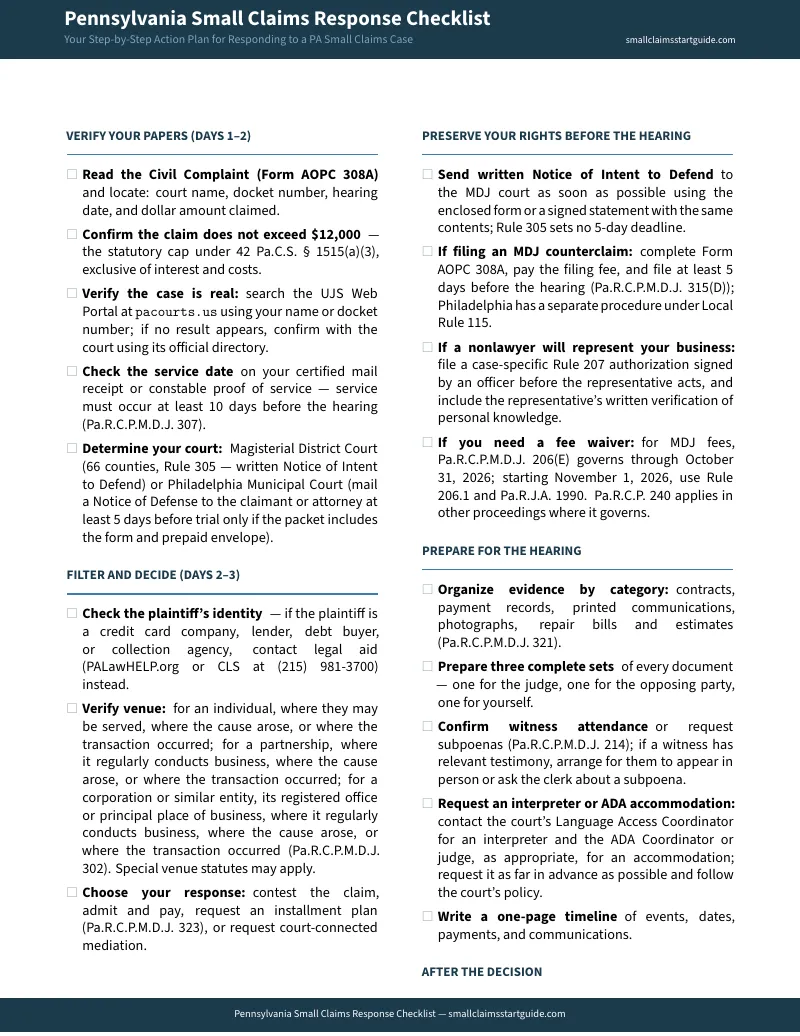
Download the free Pennsylvania Small Claims Response Checklist — a quick-start summary covering your key procedural steps: verifying the papers, identifying your court, choosing a response, preserving your rights, preparing evidence, and understanding post-decision options. It covers what to do. The full guide covers how — with step-by-step instructions, dual-court procedural distinctions, Rule 207 business representation procedures, evidence organization methods, and a printable checklist you can work through as your hearing date approaches.
The full Responding to a Small Claims Case in Pennsylvania guide is available for — a one-time download, not a subscription.