You know you're owed the money. You don't know which courthouse handles your claim.
Pennsylvania is the only state that runs two completely separate small claims systems side by side. Outside Philadelphia, you file a Civil Complaint with a Magisterial District Judge — one of over five hundred courts spread across sixty-six counties. In Philadelphia, you file a Statement of Claim through the Municipal Court Civil Division, which uses its own forms, its own fee schedule, and its own e-filing portal. Search online and you'll find the UJS forms page, a county law library kit that only applies to one county, a handful of Reddit threads debating whether you need "MDJS 301A" or "AOPC 308A," and an automated service happy to charge you ninety dollars on top of the court filing fee to submit your paperwork.
The Pennsylvania Dual-Forum Filing System puts both court paths into a single sequence: identify your forum, verify the defendant's legal entity, file the right form with the right fee, track certified mail or arrange constable service, prepare your evidence for the hearing, and understand what happens after the judge rules — including how de novo appeals to the Court of Common Pleas work.
What's inside
Forum Selection Decision Map — because filing in the wrong court wastes your fee and costs you weeks. The sixty-six counties outside Philadelphia use Magisterial District Courts. Philadelphia uses its own Municipal Court with a separate e-filing system (ClaimIt). Both handle claims up to $12,000, but the forms, fees, and procedures are different. The guide maps your claim to the correct forum and the correct district office so you file once.
Entity Verification Walkthrough — because suing "Mike's Contracting" instead of "Michael R. Brennan LLC" gives you a judgment you cannot enforce. Step-by-step instructions for searching the Pennsylvania Department of State Business One-Stop Shop, identifying registered agents, and naming the correct legal entity — individual, DBA, LLC, or corporation — on your complaint form.
Line-by-Line Form Completion Guide — because the statewide Civil Complaint (AOPC Form 308A) is not the same as Philadelphia's Statement of Claim, and if you've been searching for "MDJS 301A" you've been looking for a docketing code that isn't the public form. The guide covers every field that trips people up: defendant naming, venue selection, claim amount calculation, and how to submit the In Forma Pauperis petition if you qualify for a fee waiver.
Certified Mail and Constable Service Tracker — because when the court's certified mail comes back "unclaimed" or the green card never arrives, most people assume the case is dead. It is not. The guide walks you through the transition from USPS certified mail to local constable or sheriff personal service, covers what USPS Form 3811 is and what to do when it goes missing, and includes a tracking log so nothing falls through the cracks.
Hearing-Day Evidence Binder Builder — because the Magisterial District Judge will not scroll through photos on your phone. The guide shows you how to assemble three matching printed evidence sets — one for the judge, one for the defendant, one for you — organised chronologically with contracts, invoices, photographs, text messages, repair estimates, and receipts. It covers how to structure everything to overcome common hearsay objections.
Scenario-Specific Chapters — because a tenant recovering a security deposit under 68 P.S. § 250.512 faces a different filing path and potential double damages than a freelancer chasing an unpaid invoice or a homeowner suing a contractor. The guide includes dedicated chapters for security deposits, contractor disputes, unpaid invoices, consumer refunds, and neighbour property damage.
De Novo Appeal Preparation Guide — because an appeal from a Magisterial District Judge to the Court of Common Pleas is a completely fresh trial. None of the evidence or testimony from the first hearing carries over. The guide explains the thirty-day appeal window, what de novo means in practice, and how to prepare as if you are going to court for the first time.
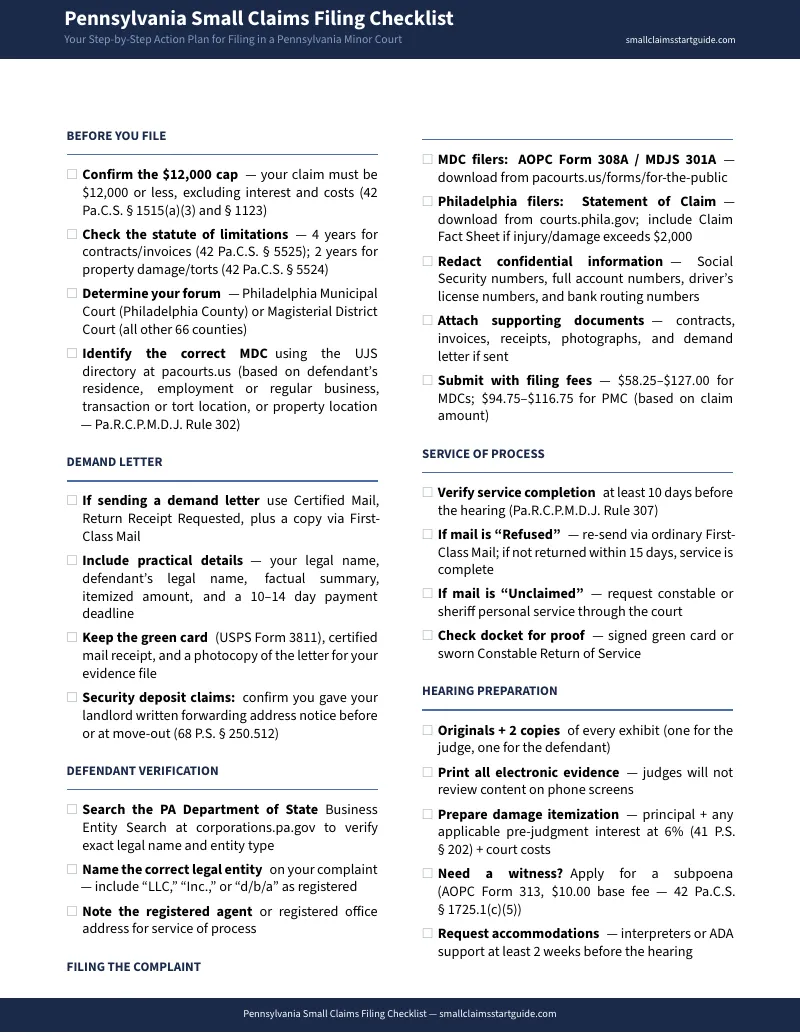
Deadline Calendar and Filing Checklist — because missing one date can mean starting over. A printable checklist and timeline cover the statute of limitations for your claim type (four years for contracts, two years for torts), the filing-to-hearing sequence, and the post-judgment enforcement window.
Eight Standalone Printable Worksheets — a forum selection worksheet, defendant entity verification worksheet, demand letter template, certified mail and constable service tracking log, evidence binder checklist, damage itemisation worksheet, deadline calendar, and filing fee calculator. Print whichever ones you need and fill them in as you go. Each one works on its own without the guide open in front of you.
Who this is for
- Tenants owed a security deposit — your landlord's thirty-day window under 68 P.S. § 250.512 has passed and you've heard nothing, or the deductions don't add up
- Homeowners with a contractor dispute — the contractor took your deposit and disappeared, or the work is unfinished and they've stopped returning calls
- Sole traders and freelancers with unpaid invoices — a client owes you for completed work and has gone silent
- Small landlords owed rent or facing property damage — your former tenant left owing money or left damage beyond normal wear and tear
- Buyers refused a refund — you paid for something that was never delivered or didn't match the description
- Anyone in Pennsylvania owed $12,000 or less who wants to handle it without hiring a lawyer
Why not just use the free court resources?
You should use them — and the guide links to every one. The UJS portal at pacourts.us publishes the official forms. PALawHELP.org explains your rights. County law library kits cover the local procedures. Legal aid organisations like MidPenn Legal Services and Community Legal Services of Philadelphia answer questions during business hours.
The problem is fragmentation. The UJS portal gives you the raw PDF without line-by-line completion instructions. The Philadelphia Municipal Court website only covers Philadelphia. County law library kits only cover one county and create confusion if you use them outside that jurisdiction. Search engines lead you to "MDJS 301A" when the actual form you need is AOPC Form 308A. None of them explain what to do when certified mail fails and you need to switch to constable service. And none of them put the whole process — from the demand letter through the hearing and de novo appeal — in a single chronological sequence.
The guide takes all of that and puts it in order, with checklists — so you're not jumping between five websites trying to figure out what comes next.
What this is not
This guide is an independently published organisational tool. It is not affiliated with, endorsed by, or produced by the Pennsylvania Unified Judicial System, any Magisterial District Court, Philadelphia Municipal Court, or any government agency. It does not give legal advice, predict case outcomes, or assess the merits of your claim. If you need legal advice, speak to a lawyer. If you need free help, the guide lists legal aid organisations and court self-help resources in your area.
Satisfaction guarantee
Full refund, no time limit. If the guide doesn't help, email [email protected] and you'll get your money back.
Start your claim tonight
Download the guide, identify your court, and begin preparing your filing. The free checklist covers the essentials — the limits, the forms, the fees, and the service steps. The full Pennsylvania Small Claims Filing Guide covers everything from the demand letter through post-judgment collection, with printable checklists and a deadline calendar.
Get the Pennsylvania Filing Guide →
The checklist is free. The full guide costs less than the filing fee.