You were served. The hearing date is on the paper. The clock is already running.
Someone has filed a small claims complaint against you in a Montana Justice Court, and the document sitting on your counter has a hearing date, a case number, and a dollar amount. You have a handful of deadlines that overlap — 10 days to request removal for a jury trial, 72 hours before the hearing to serve a counterclaim, and the hearing itself within 40 days of the filing — and no clear explanation of which ones apply to you or what happens if you miss them.
The Montana Department of Justice brochure is a single-page summary. The courts.mt.gov forms page gives you blank PDFs. Neither tells you what to do first, how to calculate your deadlines from your service date, or how to organise your evidence so the Justice of the Peace can actually follow your side of the story. SoloSuit's Montana page is written for debt-collection lawsuits in general civil court — a completely different procedure with different deadlines. And a lawyer costs $150 to $350 an hour for a case that maxes out at $7,000.
The Montana Small Claims Defendant Response System
This is the step-by-step workflow for someone who has been served with an ordinary small claims complaint in Montana — a contractor dispute, a security deposit claim, a customer refund demand, a vehicle sale disagreement — and needs to know what the papers mean, what their options are, and how to show up prepared.
The guide puts the entire defendant response process in order, from the moment you read the served papers to the day after the judge rules. It is not legal advice. It does not predict outcomes or coach arguments. It organises the procedure into a sequence of concrete steps, each with the statutory rule behind it and a worksheet to keep it on track.
Served Paper Decoder
The first confusion is identifying what you were served. A Small Claims Complaint/Order and Notice to Defendant is not the same as a general civil summons (which requires a written answer within 20 days) or an eviction notice (which is a possessory action, not a money claim). The guide breaks down the document field by field — case number, court name, hearing date, plaintiff's demand, service date — so you know exactly what you are dealing with and which deadlines are yours.
Deadline Tracker Log
Montana small claims defendants face four overlapping time windows, all calculated from different starting points. The 10-day removal clock starts from service. The 72-hour counterclaim deadline counts backward from the hearing. The hearing itself must be within 40 days of filing. Miss the hearing entirely and the court enters a default judgment for the full amount claimed. The Deadline Tracker Log records every window from your service date and hearing date so nothing slips.
Procedural Options Decision Tree
You have four paths, and the right one depends on your situation. Dispute the claim by appearing and presenting your evidence. Admit all or part of the claim and negotiate terms. File a counterclaim for up to $6,500 if the plaintiff owes you money from the same transaction. Or request removal to General Civil Division within 10 days of service for a jury trial under formal rules of procedure. The decision tree walks through each option with the requirements, the statutory basis, and the trade-offs.
Counterclaim Service Log
If the plaintiff owes you money — the contractor damaged your property while doing the work, the landlord withheld your deposit without a proper itemised statement, the buyer broke the item before complaining — you can counterclaim up to $6,500 using the official Small Claims Counterclaim form from courts.mt.gov. The form must be served on the plaintiff at least 72 hours before the hearing. The log tracks filing, the 72-hour cutoff, process-server attempts, and return of service so the counterclaim is not barred from the hearing.
Evidence and Receipt Ledger
Justices of the Peace expect printed, labelled evidence — not a phone screen, not a shoebox of receipts. Three copies of everything: one for the judge, one for the plaintiff, one for yourself. The ledger covers contracts, invoices, receipts, text message printouts, photographs, repair estimates, bank statements, and witness contact information, organised in chronological order and tabbed for quick reference.
Hearing Day Checklist
What the courtroom looks like, the order of testimony, how to address the Justice of the Peace, what to bring, what happens if the plaintiff does not show up, and how the no-lawyer rule works. Under MCA § 25-35-505(2), an attorney may only appear if all parties are represented — if the plaintiff has no lawyer, you cannot bring one either.
Post-Decision Options
Either party may appeal to District Court within 10 calendar days of judgment — but only on questions of law, not to re-argue the facts. If a default judgment was entered because you missed the hearing, the guide covers the process for a motion to set it aside. And if the plaintiff won and pursues collection, the guide explains what enforcement tools they can use and what your options are.
Who This Is For
- Homeowners sued by a contractor over a disputed invoice for work that was incomplete, defective, or never matched the estimate.
- Tenants sued by a former landlord for property damage, cleaning fees, or unpaid rent — especially if you believe the security deposit was wrongfully withheld.
- Small business owners sued by a customer over a refund, a service complaint, or a product dispute.
- Private vehicle sellers sued by a buyer claiming undisclosed defects in an as-is sale.
- Anyone served with an ordinary small claims lawsuit in Montana involving a dispute up to $7,000 who wants to respond prepared.
Not for debt-collection defence. If you were sued by a lender, debt buyer, or collection agency, that is a different procedure with different deadlines. The guide points you to free legal aid through the Montana Legal Services Association (MLSA) at 1-800-666-6899 and MontanaLawHelp.org.
Why Not Just Use the Free Resources?
The Montana DOJ brochure and the Judicial Branch forms page are real, authoritative, and free. Use them. The guide does not replace them — it organises them. The brochure is a single-page summary that does not walk you through deadlines step by step. The forms page gives you blank PDFs with no instructions on when or how to file them. County court websites vary — Carbon County requires plaintiffs to send a certified demand letter before filing; Park County charges a $20 per-party appearance fee on hearing day that is not listed on the state site. The guide pulls the statewide rules and the county variations into one sequence, with worksheets that turn statutory deadlines into dates on your calendar.
Your Download Includes
- The Response Guide — the complete step-by-step walkthrough from served papers to post-decision options
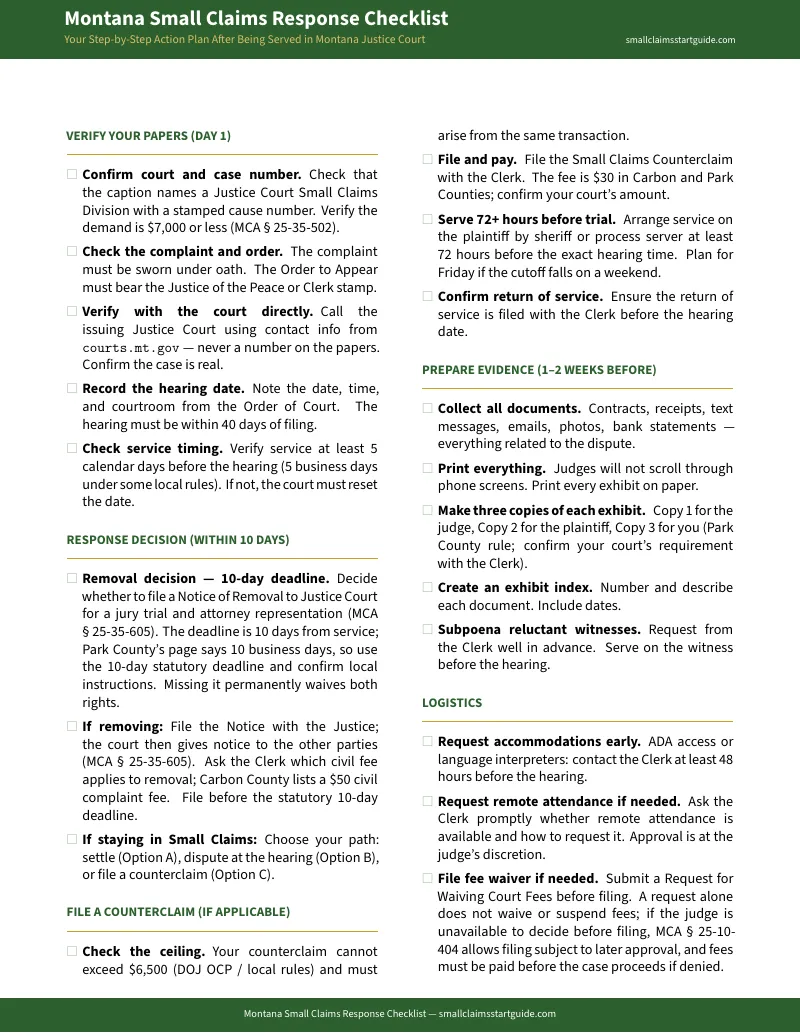
- The Response Checklist — a two-page quick-reference summary of deadlines, options, evidence, and hearing steps
- Printable Worksheets — Served Paper Decoder, Deadline Tracker Log, Procedural Options Decision Tree, Counterclaim Service Log, Evidence and Receipt Ledger, Hearing Day Checklist, and Settlement Agreement Template
Full refund, no time limit. Email [email protected].
Already have the free checklist? The checklist covers what to do. The full guide covers how — with step-by-step instructions, statutory references, and seven printable worksheets that turn the process into a sequence you can follow tonight.
Get the Montana Response Guide →
Frequently Asked Questions
What if the rules change after I buy?
We update the guide when the rules change. Email us any time, even years later, and we'll send you the current edition free.