You are owed money. The other side will not pay. Now what?
You have sent the texts, left the voicemails, maybe even written a formal letter. The contractor who pocketed your deposit and disappeared, the client ignoring your invoice, the landlord sitting on your tenancy deposit, the seller who will not refund a faulty appliance — they are all banking on the same thing: that you will not actually take them to court.
Northern Ireland's County Court exists so you can prove them wrong, without a solicitor and without spending hundreds in legal fees. But try searching for help online and you will run into the same problem everyone else does: almost everything describes the English system. Money Claim Online, Form N1, a £10,000 limit, the County Court at Money Claims Centre in Salford — none of that applies in Northern Ireland. File English paperwork at the Civil Processing Centre in Belfast and it comes straight back.
The NI Filing Sequence System
This guide is a complete procedural walkthrough for Northern Ireland's small claims process — not a collection of tips, not legal advice, not an English guide with "Northern Ireland" swapped into the title. It is the step-by-step system that takes you from "I am owed money" to "I have a decree from the County Court," covering every form, fee, deadline, and decision point along the way.
Where government websites give you the pieces scattered across dozens of pages, this guide gives you the sequence. You read it once, front to back, and know exactly what to do at every stage — using the correct Northern Ireland forms, through the correct central processing office, with the correct terminology.
What is inside
- Limit and time-limit check — confirm your claim is within the £5,000 small claims ceiling and has not exceeded the six-year limitation period under the Limitation (Northern Ireland) Order 1989. The guide covers both liquidated claims (a fixed sum like an unpaid invoice) and unliquidated claims (where you need to estimate the loss), with a worked example showing how to verify a specific deadline.
- Demand letter walkthrough — what your letter before action must contain, the 14-day minimum response window, and why District Judges want to see evidence that you tried to resolve the dispute before filing. Includes the correct format for recorded delivery and tracked postal proof.
- Respondent naming and address verification — the exact format for naming individuals, sole traders ("Jane Smith trading as JS Decorating"), partnerships, and limited companies (with Companies House verification). Getting this wrong means the Civil Processing Centre cannot validly serve your claim — and you have wasted a non-refundable court fee.
- Filing on Small Claims Online and on paper, section by section — the nidirect portal account setup, identity verification, and each field of the online application, plus the paper Form 125 alternative for anyone who prefers it. The guide walks through the application the way the system presents it, so you can draft your answers offline before you log in.
- Court fees and fee exemption — the full fee schedule effective 1 April 2026 (£49 for claims up to £300 through to £244 for claims up to £5,000), who qualifies for fee exemption or remission, and how to submit Form ER1 alongside your application.
- Service and the 21-day response window — how the Civil Processing Centre serves your claim on the respondent by ordinary pre-paid post, what the respondent's four options are (settle, accept, dispute, or ignore), and how to track the statutory 21-day response period with the printable Deadline and Service Tracker.
- Default decrees — if the respondent does not file a response within 21 days, the guide explains exactly how to apply for a default decree, including the Certificate of Service and what the CPC checks before issuing it.
- Evidence bundles, witnesses, and expert reports — how to organise invoices, contracts, photographs, text messages, and quotes into a chronological, page-numbered hearing bundle that District Judges expect. Covers the 14-day pre-hearing rule for expert evidence and the printable Evidence Bundle Checklist.
- The hearing — what actually happens in the courtroom, from arrival and registration to the informal hearing sequence, cross-examination, and the decree. Includes the Hearing Preparation Checklist covering the 14-day countdown and what to bring on the morning.
- Enforcement through the EJO — the single most common surprise: winning a decree does not mean the court collects your money. If the respondent will not pay, you apply to the Enforcement of Judgments Office at Laganside House. The guide covers EJO search applications, Attachment of Earnings Orders, Instalment Orders, and seizure of goods, with their fees and timelines. A worked example calculates enforcement costs for a £1,500 decree.
Who this is for
- A homeowner whose builder or contractor took a deposit and abandoned the job or left defective work
- A tenant owed a deposit that the landlord will not return
- A sole trader, freelancer, or small business owner chasing an unpaid invoice
- A consumer refused a refund for a faulty product, a used car with undisclosed defects, or a cancelled service
- A neighbour with a damage bill after a boundary wall collapse, fallen tree, or contractor trespass
- Anyone in Northern Ireland owed money by another person, business, or organisation — up to £5,000
If you have been served with a small claim (you are the respondent), this guide is not for you — see the Northern Ireland Small Claims Response Guide instead.
Why not piece it together from free sources?
You absolutely can. Every court form is free on justice-ni.gov.uk. The nidirect website publishes overview articles. Court staff at the Civil Processing Centre answer administrative questions. None of that is paywalled.
The problem is not access — it is assembly. The nidirect articles explain what the rules require but do not walk you through structuring your claim details, organising evidence for the hearing, or calculating statutory interest. Advice NI and Citizens Advice Bureau advisers face heavy demand and appointment waiting times can miss your court deadlines. Court registry staff are legally prohibited from reviewing your evidence, advising on your claim wording, or telling you what to write on the forms.
And the biggest trap is not even Northern Irish. Most "small claims UK" content describes the English system — County Court, Money Claim Online, Form N1. Some results describe the Republic of Ireland's District Court and its €2,000 limit. Use English or Irish procedures in a Northern Ireland court and your filing is rejected. This guide covers the Northern Ireland system only, with the correct NI forms, terminology, and County Court Rules.
What you get
Your purchase includes 9 downloadable PDFs:
- guide.pdf — 13 chapters, 48 pages, covering every stage from checking the limit through enforcement, with worked examples, fee tables, section-by-section filing instructions, and five common scenarios (tenant deposit, unpaid invoice, faulty vehicle, contractor deposit, neighbour damage).
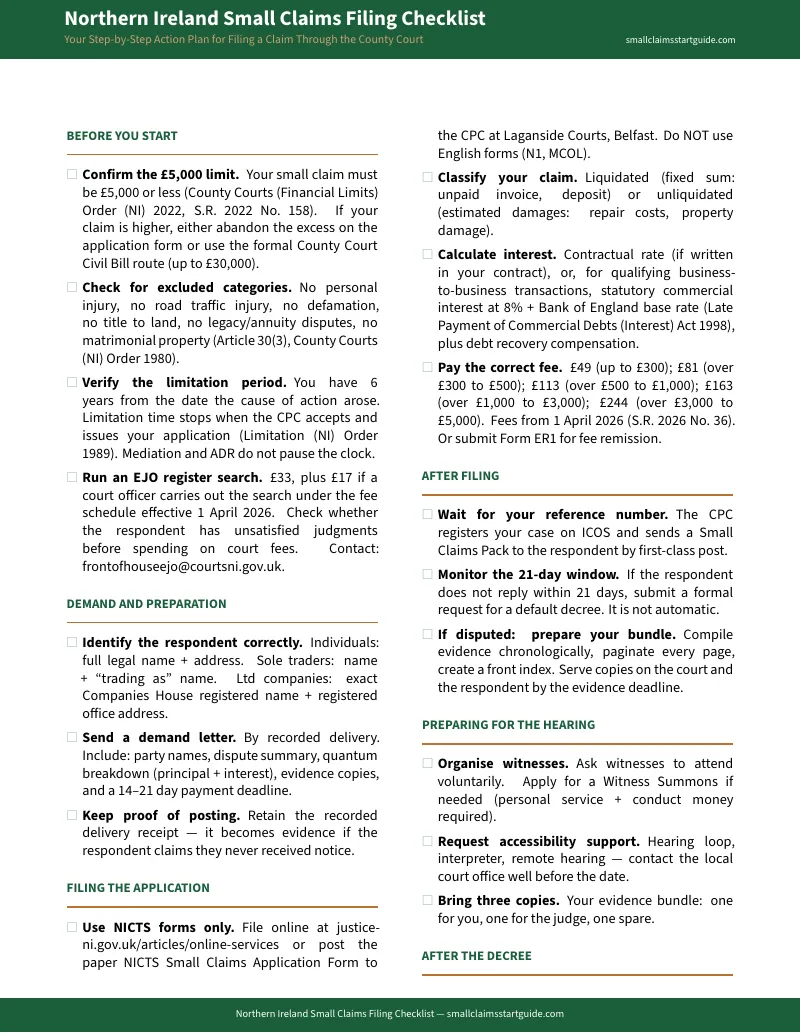
- checklist.pdf — a two-page reference sheet with the key steps, forms, fees, deadlines, and service milestones.
- deadline-and-service-tracker.pdf — a printable timeline worksheet for every statutory date from the demand letter through enforcement.
- evidence-bundle-checklist.pdf — a structured checklist for assembling, paginating, and serving your hearing evidence.
- hearing-preparation-checklist.pdf — a 14-day countdown covering evidence exchange, witness preparation, and what to bring on the hearing morning.
- demand-letter-template.pdf — a fill-in framework for your letter before action with the required elements and a sending log.
- interest-calculation-worksheet.pdf — a step-by-step form for calculating contractual or statutory interest to add to your application.
- communication-log.pdf — a tracker for every call, email, or letter to and from the CPC, the EJO, or other official bodies.
- post-decree-action-planner.pdf — an enforcement decision worksheet covering the Notice of Intent, EJO application, enforcement methods, and cost tracking.
All files are yours to keep permanently. No subscription, no login, no expiry.
The guarantee
Full refund, no time limit. If the guide does not help you navigate the process, email [email protected] and you will get every penny back. No forms, no waiting period, no questions.
Get the Northern Ireland Small Claims Guide →
Or download the free filing checklist first — it covers the key milestones, the current fee schedule, and links to every official form you will need.