You won the judgment. The debtor is not paying. Now what?
You went through the entire claim process — the pre-action letter, the court forms, the fees, the hearing. A district judge ordered the other side to pay. Then silence. No cheque. No bank transfer. No response to your letters. And when you call HMCTS, they tell you the court does not collect debts — enforcement is your responsibility.
The system is not broken. It is designed this way. England and Wales gives judgment creditors six powerful enforcement tools — but it leaves you to figure out which one to use, which forms to file, how much each one costs, and in what order. GOV.UK publishes blank forms. The EX50 schedule lists fees without context. Citizens Advice explains the options but stops before the operational detail. Court staff cannot advise you on which method to choose.
The Enforcement Route Planner
This guide does what no government page, charity website, or solicitor's marketing article does: it puts every enforcement method, form, fee, and deadline in one document, in the order the steps actually happen. It is a procedural roadmap — not a template pack, not a tip sheet, not legal advice.
At its core is an asset-to-method decision framework. Before you spend a penny on court fees, you work through the pre-enforcement checklist to identify what the debtor owns. Then the framework matches their asset profile to the enforcement tool most likely to recover your money. Employed with a known employer? Attachment of Earnings via Form N337. Known bank account? Third-Party Debt Order via Form N349. Property owner? Charging Order via Form N379. No idea what they have? Start with an Order to Obtain Information via Form N316, which compels the debtor to attend court and disclose their finances under oath.
What is inside
- Pre-enforcement checklist and Asset Intelligence Worksheet — confirm the 14-day payment window has closed, check for Breathing Space or insolvency bars, run Companies House and Land Registry searches, and map what you know about the debtor before paying any application fee.
- Six enforcement methods, form by form — Orders to Obtain Information (N316), Warrants of Control (N323), High Court Transfer (N293A), Attachment of Earnings (N337), Third-Party Debt Orders (N349), and Charging Orders (N379). Each method gets its own chapter covering who it works for, the complete filing procedure, what happens after you file, and what to do when it does not work.
- Personal service instructions for CPR Part 71 — the Order to Obtain Information requires you to serve the debtor personally. The guide walks you through the service mechanics, the conduct money offer under CPR Rule 71.4, drafting the affidavit of service, and what happens if the debtor ignores the order (including committal proceedings).
- High Court transfer decision framework — when to transfer from County Court to High Court (debts above £600), who cannot transfer (Consumer Credit Act agreements), the N293A process, the writ fee, and how HCEO compliance fees and enforcement fees are recovered from the debtor.
- Breathing Space, insolvency, and stay navigation — what legally freezes enforcement, how long each pause lasts, how to check the registers, and how to respond when a debtor applies to suspend your warrant or vary payment terms via Form N245.
- Interest calculation and Judgment Accounting Ledger — post-judgment interest at 8% simple per annum on CCJs of £5,000 or more under the County Courts (Interest on Judgment Debts) Order 1991 (no statutory interest on CCJs under £5,000 unless the judgment awards it, and none on CCA 1974 County Court judgments), the payment allocation rules (costs first, then interest, then principal), and a running ledger until the balance reaches zero.
- Closing the case properly — filing Form N443 for a Certificate of Satisfaction, the one-month cancellation window for the CCJ entry on the Register of Judgments, releasing Land Registry entries if you registered a charging order, and withdrawing active warrants and writs.
- Cross-border enforcement — what happens when the debtor or their assets are in Scotland, Northern Ireland, or outside the UK, and which reciprocal enforcement regimes apply after Brexit.
Who this is for
- An individual who won a money claim through HMCTS and has not been paid — whether the debtor is ignoring the judgment entirely or has defaulted on an instalment arrangement
- A sole trader, freelancer, or small business owner chasing an unpaid invoice that became a CCJ
- A private landlord owed rent arrears or deposit money under a County Court order
- A creditor whose County Court Bailiff came back with "no goods found" and needs to know what to try next
- Anyone holding a County Court Judgment in England or Wales who wants to understand every available enforcement option before spending more money on court fees
If you have not yet filed your claim (you do not have a judgment yet), see the County Court Money Claim Filing Guide instead. If you have been served with a claim, see the Money Claim Response Guide.
Why not piece it together from free sources?
Every court form is free on GOV.UK. Citizens Advice publishes helpful overview articles. Advicenow has solid explainers on individual enforcement methods. None of that is paywalled.
The problem is not access. It is sequence and operational detail. GOV.UK publishes each form on its own page without connecting them into a workflow. It does not tell you that an N316 application must go to the hearing centre local to the debtor, while an N323 can go through the CNBC. It does not explain how to execute personal service, swear an affidavit, or calculate whether a High Court transfer makes financial sense for your particular debt. Citizens Advice explains the concepts but stops short of the form-by-form procedure. Law firm articles describe each option — and then quote you £250 plus VAT to file one application.
This guide does the assembly work once. One document, read front to back, every enforcement method in order from asset discovery through case closure.
What you get
Your purchase includes eight downloadable PDFs:
- The full guide — 14 chapters covering every stage from pre-enforcement checks through closing the case, with decision matrices, fee tables, form walkthroughs, and cross-border enforcement rules.
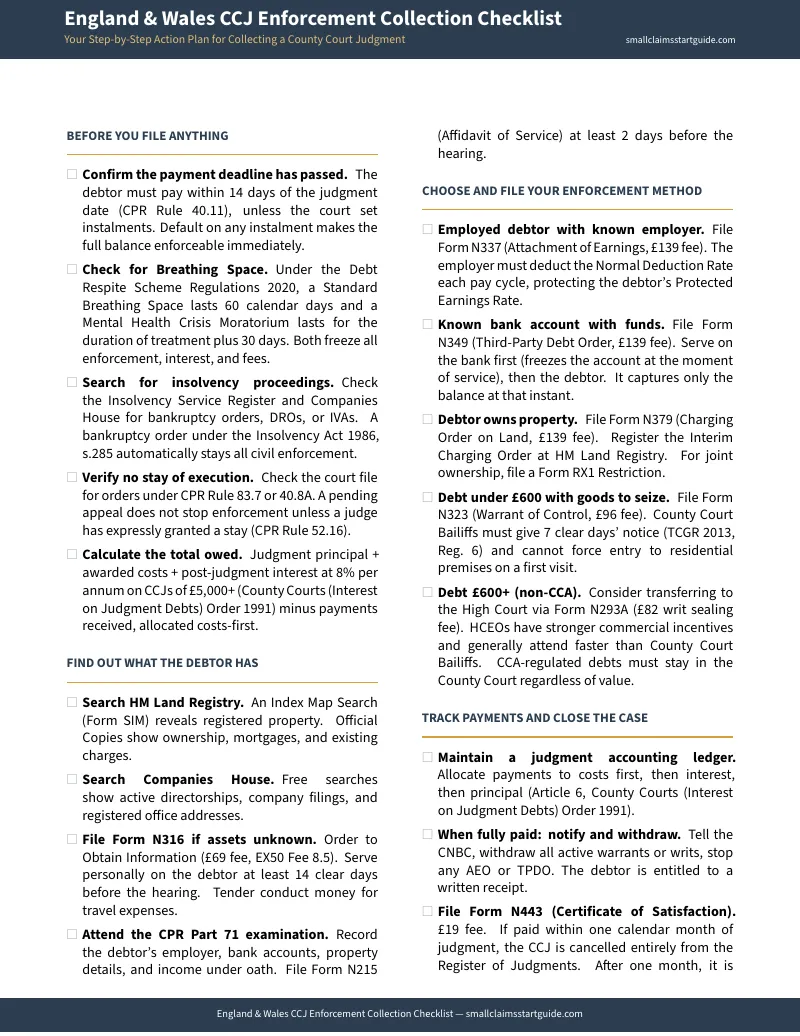
- The enforcement checklist — a two-page reference sheet with 20 action items, current fees, and deadlines for each enforcement method.
- Asset Intelligence Worksheet — record employer, bank, property, vehicles, companies, and the searches you have already run.
- Enforcement Method Decision Matrix — tick what you know about the debtor and write the form, fee, and filing date you will use first.
- Judgment Accounting Ledger — track costs, interest, payments, and the running balance in the statutory allocation order.
- Application and Service Tracker — log every form, fee, service date, and result, including CPR Part 71 personal service.
- Enforcement Pause and Stay Log — record Breathing Space, insolvency, stays, and N245 variation deadlines.
- Satisfaction and Closure Checklist — withdraw live enforcement, file Form N443, and release any Land Registry entry.
All eight are yours to keep permanently. No subscription, no login, no expiry.
The guarantee
Full refund, no time limit. If the guide does not help you navigate the enforcement process, email [email protected] and you will get every penny back. No forms, no waiting period, no questions.
Get the CCJ Enforcement Guide →
Or download the free enforcement checklist first — it covers the key enforcement options, current court fees, and the pre-filing checks you need to complete before spending money on any application.