A Court Envelope Just Arrived. What You Do in the Next 14 Days Decides Everything.
Someone has filed a money claim against you in the County Court. The Claim Form says you owe money, gives a deadline to respond, and warns that a judgment can be entered against you if you do nothing. That judgment — a CCJ — stays on your credit record for six years. It can block a mortgage, a tenancy application, a business loan.
The court's own website tells you to "respond within 14 days." It does not tell you that the clock started running before you opened the envelope, that the deadline depends on which of three court systems is handling your claim, or that filing a one-page Acknowledgment of Service can double your response time to 28 days. The official forms are free to download, but they arrive blank — no annotations, no examples, no guidance on which boxes matter and which ones the court barely reads.
This is the County Court Response System — a single document that puts the defendant's entire procedure in order, from the moment the papers arrive to the hearing and beyond.
What makes this different from the free GOV.UK pages
Court forms are free. Citizens Advice articles are free. The HMCTS helpline is free. This guide does not pretend otherwise.
What free resources do not do is put your steps in order. GOV.UK explains each form on a separate page. Citizens Advice covers the principles but not the operational detail — which portal to use, what "specific denials" means when you are drafting a defence on Form N9B, how to calculate the deemed date of service when your claim was issued online. Court staff can tell you administrative facts but are legally prohibited from giving legal advice on what to write in your forms.
The guide stitches the scattered rules into a single chronological workflow. One document, one read-through, no tabs left open.
What Is Inside
- Claim Paper Decoder — how to read the Claim Form (N1), confirm whether the claim is specified or unspecified, and identify which court system is handling it: Online Civil Money Claims (MC prefix), Money Claim Online (eight-character alphanumeric), or the Civil National Business Centre (paper)
- Deadline Calculator with Worked Examples — the deemed-service rules under CPR Part 6, the 14-day response window, how to extend it to 28 days by filing an Acknowledgment of Service, and three worked examples so you can calculate your own dates with confidence
- Response Route Decision Map — a structured decision framework covering your four options: pay the claim in full, admit and propose instalments (Form N9A/N9C), file a defence disputing the claim (Form N9B/N9D), or file a defence with a counterclaim under CPR Part 20
- Defence Drafting Guide — what CPR Part 16 requires in a defence: specific denials, your version of events, and the common mistakes that leave a defence vulnerable to being struck out or treated as a bare denial
- Counterclaim Procedure — when a counterclaim makes strategic sense, the additional court fee, and how it changes the shape of the hearing
- Default Judgment and Set-Aside — what happens if you miss the deadline, how default judgments are entered, the Form N244 application to set one aside (court fee £321 on notice, or £126 by consent), and the test the court applies
- Mandatory Mediation Kit — how the automatic referral works under Practice Direction 51ZE, what happens in the one-hour telephone mediation session with HMCTS, and the cost sanctions the judge can impose for unreasonable failure to attend
- Hearing Preparation — what the informal hearing looks like, how to present your evidence, what the District Judge can order, and the rules on costs recovery on the Small Claims Track
- After the Decision — CCJ registration and removal, the satisfaction process, appeal routes, and how a judgment affects your credit record
You also get a two-page response checklist and six worksheets: the Deadline Calculator Worksheet, Response Route Decision Map, Defence Drafting Framework, Evidence Bundle Checklist, Mediation Preparation Sheet, and Court Communication Log.
Who This Guide Is For
- A homeowner served with a claim by a builder or contractor over a disputed invoice or allegedly incomplete work
- A former tenant facing a claim for rent arrears, or a former landlord facing a claim over a withheld deposit
- A sole trader or small business owner sued by a customer or supplier
- A private seller served with a claim after a car sale, eBay transaction, or personal property dispute
- Anyone who has already missed the response deadline and received a default judgment they need to challenge
Not for debt-collection lawsuits. If you have been served with a claim by a bank, credit card company, debt purchaser (such as Lowell or Cabot), or a collection agency, that is a regulated consumer credit matter with different rules and free specialist help. The guide explains how to identify these claims and directs you to free debt advice services including StepChange, National Debtline, and Citizens Advice.
Why Not Just Ignore It
The claimant does not need your cooperation to get a judgment. If you do not respond within the deadline, they apply for a default judgment — a court order saying you owe the money — without a hearing. That judgment registers as a CCJ on your credit record for six years. It can be enforced by bailiffs (now called enforcement agents), deductions from your wages, or a charging order on your property.
Even if you believe the claim is baseless, doing nothing hands the claimant a win by default. Responding — even to admit part of the claim and propose instalments — keeps control in your hands.
How the Free Checklist and Full Guide Work Together
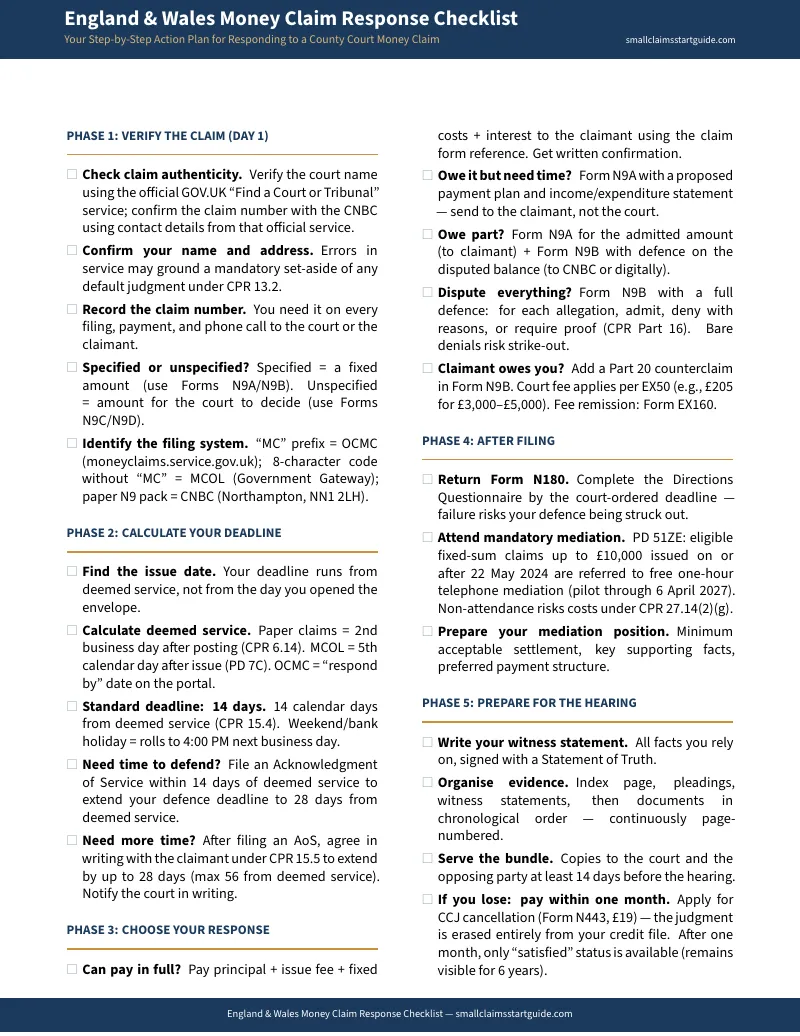
The free checklist is a two-page summary: the response deadline, the four response options, the documents you need, and a hearing preparation tick-list. It tells you what to do.
The full guide tells you how. It walks through each step with worked examples, explains the CPR rules behind the deadlines, shows you what to write in each form, and prepares you for mediation and the hearing. If you are comfortable navigating the process with just the checklist, you do not need the guide. If you want the detail behind each step, the guide has it.
Satisfaction Guarantee
Full refund, no time limit. If the guide does not help, email [email protected] and you will get your money back.