You are owed money. The other side will not pay. Now what?
You have sent the emails, left the voicemails, maybe even written a formal letter. The contractor who took your deposit and vanished, the client who keeps "forgetting" your invoice, the landlord sitting on your tenancy deposit — they are betting you will not actually take them to court.
The County Court system in England and Wales exists precisely so you can prove them wrong, without a solicitor and without spending thousands on legal fees. But between GOV.UK, Citizens Advice, scattered practice directions, and outdated PDFs, nobody puts the entire filing procedure in one place, in the order the steps actually happen.
The County Court Filing Roadmap
This guide is a complete procedural walkthrough — not a collection of tips, not a template pack, not legal advice. It is the step-by-step roadmap that takes you from "I am owed money" to "I have a County Court Judgment," covering every form, fee, deadline, and decision point along the way.
Where free resources give you the pieces, this guide gives you the sequence. You read it once, front to back, and know exactly what to do at every stage.
What is inside
- Time limit check and pre-action letter — confirm your claim is within the six-year Limitation Act window, identify which pre-action protocol applies (PDPAC or the stricter Debt Pre-Action Protocol), and draft a letter that satisfies the court's requirements so your claim is not penalised before it starts.
- Defendant naming matrix — the exact legal name format for sole traders ("John Smith trading as Smith Plumbing"), partnerships, and limited companies. Getting this wrong produces a judgment you cannot enforce — and fixing it after filing costs time and money.
- Portal selection decision matrix — Online Civil Money Claims (OCMC), legacy Money Claim Online (MCOL), or paper Form N1 to the Civil National Business Centre. Each route has different claim limits, supported claim types, and quirks. The guide tells you which one fits your claim and walks you through the screens or fields.
- Complete EX50 fee table and Help with Fees eligibility — every issue fee and hearing fee for claims from under £300 up to £10,000, plus how to check whether you qualify for a fee remission under the EX160 scheme. No surprises at the payment screen.
- Service and deadline tracker — deemed dates for postal and electronic service, the 14-day acknowledgment window, the 28-day defence deadline, and what to do when the defendant does not respond (default judgment). The printable Service and Deadline Calendar keeps every date visible.
- Directions questionnaire and mediation preparation — a field-by-field walkthrough of Form N180, plus how to prepare for the mandatory one-hour telephone mediation session through the Small Claims Mediation Service. The court can impose sanctions for non-attendance, so this section covers exactly what to expect and how to use the session productively.
- Evidence bundle construction — how to assemble, index, paginate, and serve a CPR Part 27 compliant court bundle for the District Judge. Includes the printable Evidence Bundle Index so your evidence arrives organised, not in a loose folder.
- The hearing and judgment — what the informal small claims hearing looks like, how to present your case without legal jargon, what the judge is actually looking for, and what a judgment means in practice (including what to do if the other side still does not pay).
Who this is for
- A homeowner whose builder or contractor took a deposit and abandoned the job
- A tenant whose landlord is withholding a deposit outside the statutory protection scheme
- A sole trader, freelancer, or micro-business owner chasing an unpaid invoice
- A consumer refused a refund for faulty goods or a cancelled service under the Consumer Rights Act 2015
- Anyone in England or Wales owed money by another person, business, or organisation — up to £10,000
If you have been served with a claim (you are the defendant), this guide is not for you — see the Money Claim Response Guide instead.
Why not piece it together from free sources?
You absolutely can. Every court form is free on GOV.UK. Citizens Advice publishes solid explainers. Advicenow walks through pre-action protocols. None of that is paywalled.
The problem is not access — it is assembly. GOV.UK describes each form on its own page without connecting them into a sequence. Citizens Advice explains the principles but stops short of the operational detail: which of the two pre-action protocols applies to your specific dispute, what the Particulars of Claim field on the claim form actually needs, how to calculate statutory interest under Section 69 of the County Courts Act 1984. Court staff at the CNBC are legally prohibited from advising on your claim wording or recommending a filing route.
This guide does the assembly work once so you do not have to hold twenty browser tabs open and cross-reference practice directions. One document, read front to back, every step in order.
What you get
Your purchase includes eight downloadable PDFs:
- The full guide — 14 chapters covering every stage from time limits through judgment, with decision matrices, fee tables, and form walkthroughs.
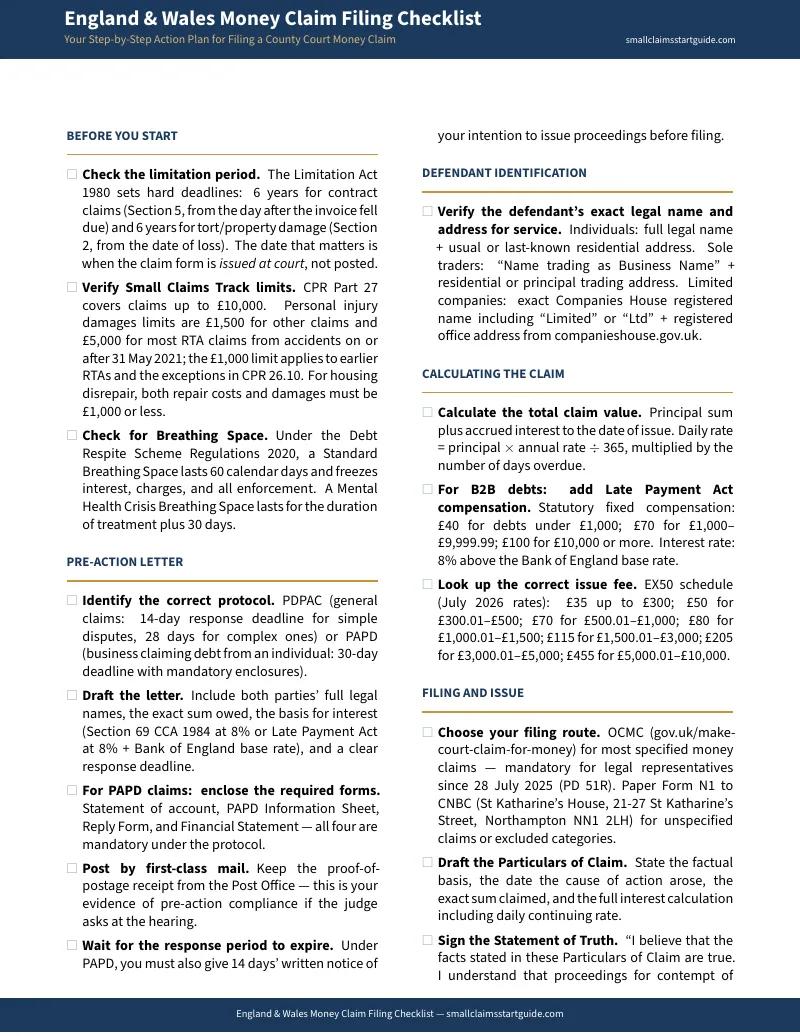
- The filing checklist — a two-page reference sheet with the key deadlines, forms, fees, and service steps.
- Pre-Action Letter Tracker — record the protocol, posting date, response deadline, and what the defendant said.
- Claim Value Calculator — work the principal, interest, Late Payment Act compensation, and EX50 issue fee before you file.
- Service and Deadline Calendar — fill in issue, deemed service, response windows, mediation, hearing, and post-judgment dates as they happen.
- Court Fee Log — track every fee paid so you can recover them if you win.
- Hearing Preparation Checklist — a 14-day countdown for the bundle, fee, witnesses, and travel.
- Evidence Bundle Index — the front page of your court bundle: tab, description, date, and page range.
Both are yours to keep permanently. No subscription, no login, no expiry.
The guarantee
Full refund, no time limit. If the guide does not help you navigate the process, email [email protected] and you will get every penny back. No forms, no waiting period, no questions.
Get the County Court Money Claim Guide →
Or download the free filing checklist first — it covers the key milestones, the current EX50 fee table, and links to every official form you will need.