You are owed money. The other side will not pay. Now you have to figure out a French-first court system — in English.
The contractor took your deposit and disappeared. The invoice has been outstanding for months. The seller will not honour the refund. You sent the formal notice — the mise en demeure — and the deadline passed. Nothing happened.
Now you are staring at a government portal where the fields are in French, the forms reference statutes you have never heard of, and the procedural rules are scattered across four different websites. You could pay a lawyer to draft a demand letter for C$379 or more — except lawyers are not even allowed in the hearing room. Or you could figure it out yourself, but where do you start?
The Quebec Claim Filing System: every step, in English, in the order you need it
The Making a Small Claim in Quebec guide is a chronological filing system that takes you from "does my claim even belong in this court?" to "what do I bring to the hearing?" — in the same order you will actually follow. Not a collection of government pamphlets stitched together. Not a translation of French legal jargon. A complete English-language workflow, with every form, fee, deadline, and portal instruction in its proper place.
The difference between this guide and what the government websites give you is structure. Justice Québec, the Court of Québec, Éducaloi, and the GNJQ portal publish every piece of information you need — scattered across separate sites, in legislative order rather than chronological order, and mostly in French first. The guide puts those same authoritative rules into a workflow you can follow without a law degree or a translator.
What you get
- Jurisdiction and prescription pre-flight — a checklist that confirms your claim is under the C$15,000 ceiling, falls within the three-year prescription period, and belongs in the Small Claims Division rather than the Tribunal administratif du logement or the Superior Court. You verify before you pay the filing fee, not after.
- The formal notice (mise en demeure), done properly — what to include, what payment deadline to set, and how to send it by registered mail so you have the delivery proof the court expects. Most disputes settle here. If yours does not, the notice becomes your first exhibit.
- REQ business search instructions — how to look up the correct legal entity name on the Registre des entreprises du Québec so you sue the company, not just its trade name. Suing the wrong name means the judgment is unenforceable. A quick search prevents a mistake that could cost you the entire case.
- Bilingual GNJQ portal walkthrough — the guide maps every field on the Greffe numérique judiciaire du Québec filing portal from French to English, with step-by-step instructions for creating an account, filling in the application, uploading exhibits, and paying the filing fee online. The portal rejects submissions silently when something is wrong; the guide tells you the exact requirements before you hit submit.
- 2026 indexed fee table explained — the three filing fee tiers (C$121 / C$223 / C$241 for natural persons, higher for corporations), the notice of execution fee, and which expenses are recoverable if you win. No more guessing what the court will charge.
- Service and notification tracking — how the clerk notifies the defendant by registered mail, when you need a bailiff instead, and a printable tracking log for recording service dates and proof of delivery. The defendant has 20 days to respond once served; the guide watches the calendar for you.
- The 30-day evidence rule — all documents, exhibits, and affidavits must be filed with the court registry at least 30 days before the hearing date. The guide includes an evidence folder organizer with exhibit numbering, a witness statement template, and a chronological timeline builder so nothing is missing when the deadline arrives.
- Mediation and hearing preparation — for claims of C$5,000 or less, mediation is mandatory and free. For all claims, the guide explains what to expect in the hearing room, how to present your evidence to the judge, and what court decorum rules apply when you are representing yourself.
- Judgment, payment, and enforcement directions — what happens after the decision, the payment period, and when to move to execution if the other side still does not pay.
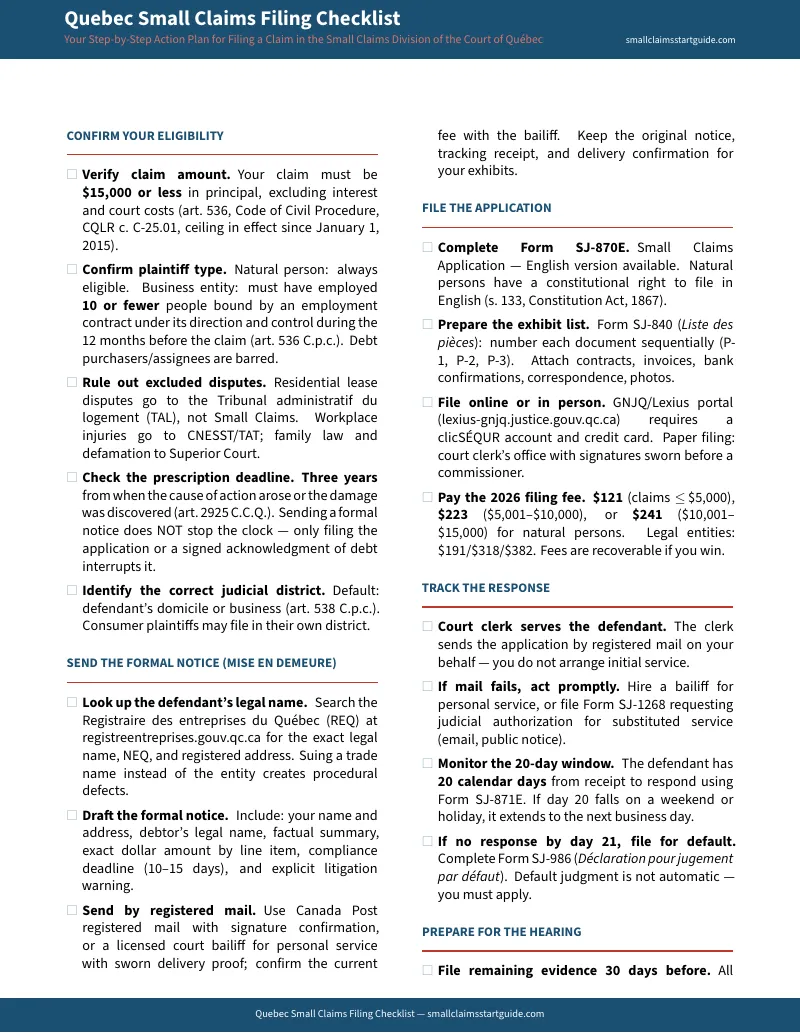
Plus: the Quebec Small Claims Filing Checklist
Every form, fee, and deadline on two pages, in the order you need them — from the pre-filing jurisdiction check through service and the hearing. Print it, pin it above your desk, and check items off as you go. The checklist comes free with the guide or as a standalone download. The paid kit also includes seven printable worksheets: the Jurisdiction and Prescription Screener, Formal Notice Planner, REQ Business Entity Lookup Worksheet, Service and Notification Tracker, Evidence Organization Checklist, Hearing Preparation Checklist, and the Deadline Calendar.
Who this is for
- A homeowner whose contractor took the deposit and left the job unfinished
- A sole trader or small business with an unpaid invoice (corporations with 10 or fewer employees can file)
- A buyer refused a refund for defective goods or a product with hidden defects (vices cachés)
- A consumer whose merchant or service provider will not honour a warranty or return a deposit
- A neighbour with a property-damage bill — fallen trees, fence damage, water diversion — that the other side will not pay
- Anyone in Quebec who speaks English and needs to navigate a French-first court system
Who this is not for
If you have been served with a small claims application and need to contest it, see the Quebec Small Claims Contesting Guide. If you already won a judgment and the other side has not paid, see the Quebec Judgment Enforcement Guide.
If your dispute is a residential lease matter — unpaid rent, security deposits, lease cancellations — the Tribunal administratif du logement (TAL) has exclusive jurisdiction. The Small Claims Division will dismiss a rental claim immediately. The guide explains this in the first chapter so you do not waste the filing fee.
If your claim exceeds C$15,000, you must either waive the excess or file in a higher court. The guide explains both options.
Why not just use the free court website?
The court website is authoritative. It is also spread across four separate government domains, organised in legislative order rather than filing order, and missing every practical tool a first-time English-speaking filer actually needs: the bilingual GNJQ portal walkthrough, the formal notice planner, the evidence folder organizer, the service tracker, and the deadline calendar.
Éducaloi explains concepts clearly but deliberately avoids step-by-step filing workflows. The Centres de justice de proximité offer free appointments but cannot draft documents or fill out forms. The Young Bar Association publishes a French-first guide with limited English material.
The court website tells you what the rules are. The guide shows you how to follow them, in English, in the order you will follow them, with the paperwork tools built in.
Can I file in English in Quebec?
Yes. Natural persons have the constitutional right to file court pleadings in English under Section 133 of the Constitution Act, 1867. The Bill 96 requirement for legal persons to attach certified French translations was stayed by the Superior Court in August 2022 (Mitchell v. Procureur général du Québec) and remains suspended. The guide explains exactly which forms are available in English and walks you through the French-language fields on the GNJQ portal.
What this guide will not do
This is an independently published navigation guide — not a law firm, not affiliated with any court, and not a substitute for legal advice. It does not predict whether your case will succeed, draft legal arguments, or file anything on your behalf. It provides step-by-step procedural instructions so you can file and serve your own claim without paying a professional to do it.
For legal advice on the merits of your case, the guide lists free resources: the Centres de justice de proximité, the Young Bar Association's free consultation service, and Éducaloi's plain-language legal information site.
Current as of October 2026
The guide reflects the C$15,000 jurisdiction ceiling, the 2026 indexed judicial fee schedule (Tariff of judicial fees, CQLR c. C-25.01, r. 13), the 30-day pre-hearing evidence deadline (effective March 11, 2021), and the mandatory mediation rules for claims of C$5,000 or less. Every statutory reference is dated so you can verify it yourself.
Full refund, no time limit
If the guide is not what you expected, email [email protected] for a full refund. No window, no questions.
Get the Quebec Small Claims Filing Guide →
The checklist is free. Download it now and see what the full guide builds on — or get the complete guide and start filing today.
Frequently Asked Questions
What if the rules change after I buy?
We update the guide when the rules change. Email us any time, even years later, and we'll send you the current edition free.