
You have been served. You have 20 days to respond — and the portal is in French.
A bailiff knocked on your door, or a registered letter arrived. The papers say demande aux petites créances and reference statutes you have never read. You have 20 calendar days to file your response. Miss the deadline and the claimant can ask for a default judgment — the court rules against you without a hearing, without your evidence, without your side of the story.
The government website lists the rules, but they are scattered across four separate portals, written in legislative order rather than the order you actually need them. The online response form is French-first. Court clerks can explain procedures but are legally prohibited from helping you write your response. And in the Small Claims Division, lawyers cannot represent you at the hearing — you are on your own.
The Quebec Defence Filing System: your response, in English, in the order you need it
The Contesting a Small Claim in Quebec guide is a chronological defence system that takes you from "what do these papers mean?" to "what do I bring to the hearing?" — in the exact sequence you will follow. Not a patchwork of government brochures. Not a translation of French legalese. A complete English-language workflow for someone who has been served with a small claim in Quebec and needs to respond before the 20-day clock runs out.
The difference between this guide and the free government sites is structure. Justice Québec, the Court of Québec, Éducaloi, and the GNJQ portal publish every piece of information you need — across separate domains, in legislative order, and primarily in French. The guide puts those same authoritative rules into a workflow you can follow without a law degree or a translator.
What you get
- Service verification and deadline calculator — a worksheet that logs the exact date you were served, calculates your 20-day response deadline, your 10-day exhibit submission window, and your 30-day pre-hearing evidence deadline. Three separate deadlines, each with different consequences if missed, all tracked in one place.
- Response options explained — the guide walks through every option available to a defendant: dispute the entire claim, admit all or part of it, propose a settlement or payment plan, or file a counterclaim (demande reconventionnelle) if the claimant owes you money. Each option is explained with its procedure, its consequences, and the form fields it triggers on Form SJ-871E.
- Bilingual Form SJ-871E walkthrough — a side-by-side English translation of every field on the official French-first response form, with step-by-step instructions for completing it on the GNJQ portal. The portal rejects submissions silently when a field is wrong; the guide tells you exactly what each field requires before you submit.
- 2026 indexed response fee table — the court fee tiers for contesting (C$121 / C$223 / C$241 for individuals, higher for corporations), when fees are waived for social assistance and legal aid recipients, and which costs are recoverable if the judgment goes in your favour.
- Mandatory mediation preparation worksheet — for claims of C$5,000 or less, mediation is mandatory and free (up to three hours with an accredited mediator). Skip the session without an approved excuse and the case moves to arbitration or trial — and you may be ordered to pay the other side's costs. The worksheet helps you organize your facts, documents, and settlement position before the session starts.
- Evidence binder organizer and exhibit numbering system — a structured layout for organizing receipts, invoices, photographs, emails, contracts, and correspondence into a clean evidence binder with exhibit numbering. Includes a witness statement template and a chronological timeline builder so nothing is missing when the 30-day pre-hearing deadline arrives.
- Hearing day preparation — what to expect in the hearing room, how to present evidence to the judge, court decorum rules, and how to handle the fact that the claimant and witnesses may speak French. The guide explains your constitutional right to address the court in English and the practical reality of a bilingual proceeding.
- Default judgment and revocation — what to do if you missed the 20-day deadline and a default judgment was entered. The guide explains the Application for Revocation of Judgment (pourvoi en rétractation de jugement), the requirements, and the strict time limits.
- Post-decision options — what happens after the hearing, the payment period, and your next steps whether you won, lost, or partially won. When appropriate, the guide directs you to the Quebec Judgment Enforcement Guide for collection procedures.
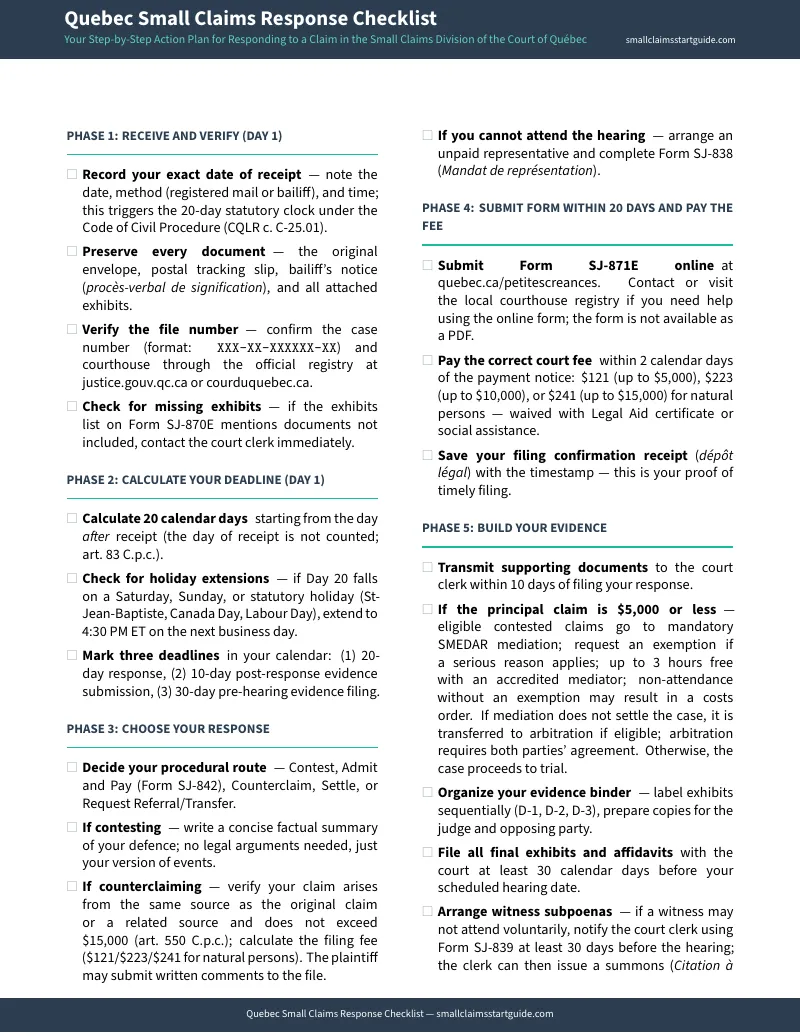
Plus: the Quebec Small Claims Response Checklist
Every deadline, form, and fee on two pages, in the order you need them — from the moment you are served through the hearing and after the decision. Print it, pin it above your desk, and check items off as you go. The checklist comes free with the guide or as a standalone download. The paid kit also includes six printable worksheets: the Service and Deadline Calculator, SJ-871E Form Prep Sheet, Mediation Preparation Worksheet, Evidence Binder Organizer, Hearing Preparation Sheet, and Case Summary Organizer.
Who this is for
- A homeowner served by a contractor claiming payment for renovation work you dispute
- A former tenant or landlord with a monetary claim — but only if the dispute has already been directed to Small Claims by the Tribunal administratif du logement (residential lease disputes go to the TAL, not Small Claims)
- A small business owner or sole trader sued by a customer over product quality, a refund, or a service agreement (corporations with 10 or fewer employees can appear in Small Claims)
- A private vehicle seller sued over alleged hidden defects (vices cachés) after a car sale
- A neighbour sued for property damage — water damage, fence disputes, fallen trees — who disagrees with the amount or the fault
- Anyone in Quebec who speaks English and needs to navigate a French-first court filing system as a defendant
Who this is not for
If you want to file a claim against someone, see the Quebec Small Claims Filing Guide. If you already have a judgment and need to collect, see the Quebec Judgment Enforcement Guide.
If your dispute is a residential lease matter — unpaid rent, damage deposits, lease cancellations — the Tribunal administratif du logement (TAL) has exclusive jurisdiction. The Small Claims Division will dismiss a lease dispute. The guide explains this boundary in the first chapter so you know immediately whether your case belongs here.
If you were sued by a lender, debt buyer, or collection agency over a consumer debt, you need specialized consumer-protection advice. The guide directs you to free legal aid and debt counselling services rather than treating your case as a standard small claim.
Why not just use the free court website?
The court website is authoritative. It is also spread across four government domains, organised in legislative order, and missing every practical tool a first-time English-speaking defendant actually needs: the bilingual SJ-871E field map, the deadline calculator, the evidence binder organizer, the mediation preparation worksheet, and the hearing checklist.
Éducaloi explains concepts clearly but deliberately avoids step-by-step response workflows. The Centres de justice de proximité offer free walk-in appointments but cannot draft documents, fill out forms, or review your evidence binder. The Young Bar Association's help line provides short telephone sessions with high call volume.
The court website tells you what the rules are. The guide shows you how to follow them, in English, in the order you will follow them, with the paperwork tools built in.
Can I respond in English in Quebec?
Yes. Form SJ-871E is published in English, and you have the constitutional right to file court documents in English under Section 133 of the Constitution Act, 1867. The GNJQ portal's interface is primarily in French, but the guide maps every field and drop-down menu so you can complete your filing without guessing at translations. At the hearing, you have the right to address the court in English — though the judge, claimant, and witnesses may speak French.
What this guide will not do
This is an independently published navigation guide — not a law firm, not affiliated with any court, and not a substitute for legal advice. It does not predict whether you will win, draft legal arguments, or file anything on your behalf. It provides step-by-step procedural instructions so you can respond to a claim, prepare your evidence, and represent yourself at the hearing.
For legal advice on the merits of your case, the guide lists free resources: the Centres de justice de proximité, the Young Bar Association's free consultation service, and Éducaloi's plain-language legal information site.
Current as of October 2026
The guide reflects the C$15,000 jurisdiction ceiling, the 2026 indexed judicial fee schedule, the 20-day response deadline, the 10-day exhibit submission window, the 30-day pre-hearing evidence rule (effective March 11, 2021), and the mandatory mediation rules for claims of C$5,000 or less (fully deployed across all judicial districts, November 2023 – March 2026). Every statutory reference is dated so you can verify it yourself.
Full refund, no time limit
If the guide is not what you expected, email [email protected] and you will receive a full refund. No window, no questions. The checklist is always free.
Frequently Asked Questions
What if the rules change after I buy?
We update the guide when the rules change. Email us any time, even years later, and we'll send you the current edition free.