You Won Your Case. The Court Won't Collect It for You.
The Small Claims Division ruled in your favour. The judge signed the judgment. And now the debtor is ignoring you — no payment, no phone call, no acknowledgment that they owe you anything.
You call the court registry. The clerk tells you they can accept your forms, but they cannot advise you, trace the debtor's assets, or tell you what to do next. You search online and find scattered French-language pages, Ontario procedures that do not apply in Quebec, and bailiff firms quoting retainers of $400 to $600 before they will lift a finger.
Meanwhile, your judgment sits there — legally enforceable but practically uncollected.
The Clerk-First Enforcement System
Most creditors do not know that Quebec's small claims system offers a direct wage garnishment route that bypasses bailiffs entirely. You file Form SJ-1103 with the court clerk, pay a $52 filing fee, and the clerk handles the rest — serving the employer, collecting pay-period deductions, and distributing them to you. No bailiff retainer. No uncertainty about professional fees.
The Enforcing a Small Claims Judgment in Quebec guide is built around this clerk-first approach. It starts with the lowest-cost enforcement tool and escalates only when the debtor's situation requires it — wage garnishment through the clerk, then bank and property seizures through a bailiff, then debtor examinations and legal hypothecs for harder cases.
Every step is in English, with bilingual translations for every French court form you will encounter.
What's Inside the Guide
- The waiting period, calculated for you — when enforcement can start (30 days for contested judgments, 10 days for default judgments), how Quebec counts days, and a worked example so you know the exact date you can file
- Asset investigation before you spend a dollar — how to search the Quebec Enterprise Register, the bankruptcy registry, and the land registry to find out what the debtor owns before committing to enforcement costs
- Clerk wage garnishment (Form SJ-1103) — the complete filing procedure for the lowest-cost enforcement route, including how much the employer must withhold (30% of net income under CCP Art. 694), what happens if the employer objects, and how to track remittances
- Bailiff-executed seizures — bank accounts, movable property, motor vehicles, and real estate, with the Execution Instructions (Art. 680 CCP) required for each, the regulated fee tariff, and what to expect at a public sale
- Post-judgment debtor examinations (Form SJ-137) — how to summon the debtor to court to declare income and assets under oath, what questions to ask, and what to do with the answers
- Legal hypothecs on real property — registering a charge at the land registry to secure your judgment against the debtor's house or lot, including registration requirements and the $15,000 small claims constraint
- Voluntary deposit — what happens when the debtor enrols in the court-supervised repayment programme, how to register your claim, and how distributions are calculated
- The 10-year prescription — how long your judgment lasts under CCQ Art. 2924, how filing a Notice of Execution resets the clock, and what the 2025 Supreme Court ruling (Mohawk Council of Kanesatake v. Sylvestre) means for your timeline
- Bilingual form directory — side-by-side English translations for forms SJ-1103, SJ-857-01, SJ-137 and others, so you know exactly what each field asks for
- Interest calculation and payment tracking — a ledger framework for statutory interest, partial payments, and costs, plus the acquittance procedure (Form SJ-842) to close your court file when the debt is fully paid
Who This Guide Is For
- You won a judgment in the Small Claims Division of the Court of Québec (claims up to $15,000) and the debtor has not paid
- You are an English speaker navigating a system that operates primarily in French
- You want to understand every enforcement option — and what each one costs — before spending money
- You have a default judgment and want to start collecting as soon as the 10-day window closes
Why Not Just Use the Free Resources?
Quebec's official websites provide the forms and a brief description of each enforcement mechanism. Éducaloi and JuridiQC offer plain-language overviews. These are useful starting points — and the guide links to every one of them.
What they do not provide is a single, ordered enforcement sequence in English. The court website scatters information across multiple French-language pages. Éducaloi explains that wage garnishment exists, but does not walk you through the SJ-1103 filing from start to finish. No free resource provides bilingual form translations, a decision framework for choosing between the clerk route and the bailiff route, or a payment ledger for tracking partial payments and statutory interest.
The guide puts all of it in one place — the procedure, the forms, the fees, the worked examples, and the English translations — so you are not patching together a strategy from a dozen disconnected tabs.
Satisfaction Guarantee
Full refund, no time limit. If the guide does not help you, email [email protected] and you will get your money back.
Start Collecting What You're Owed
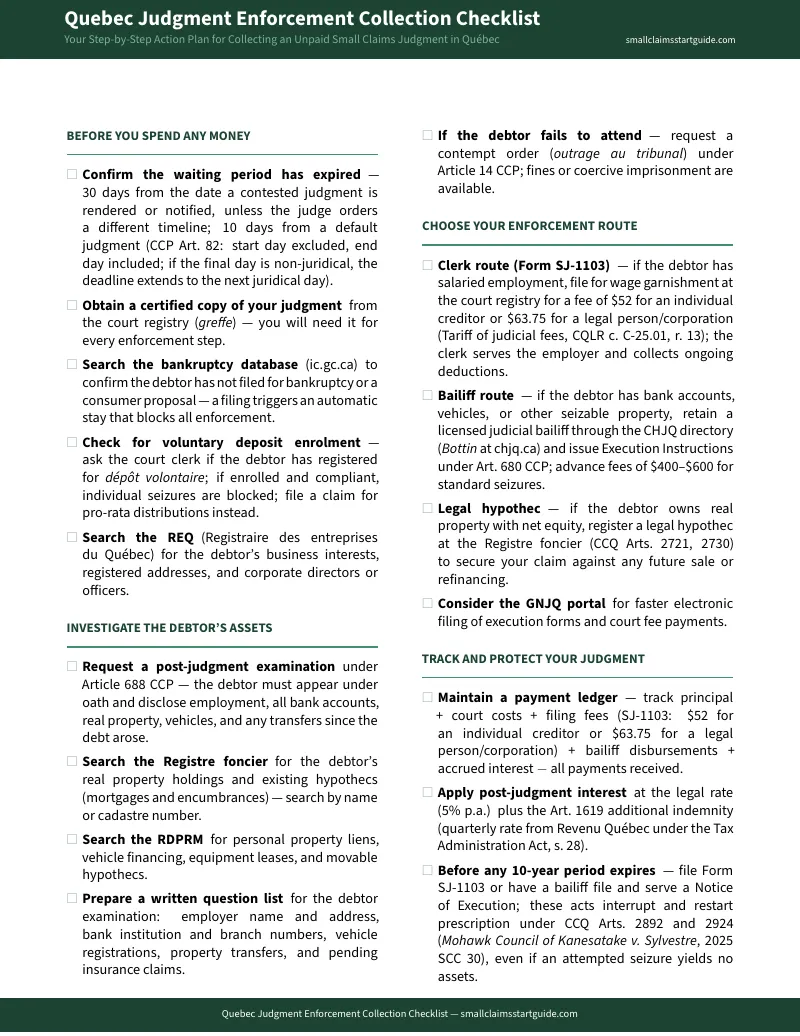
The free checklist gives you a one-page overview of the enforcement timeline, your route options, and the key deadlines. Download it now and see if this guide is right for your situation.
Ready for the full enforcement system? The complete guide covers every tool, every form, and every step from the day the waiting period ends to the day you close the file.
Frequently Asked Questions
What if the rules change after I buy?
We update the guide when the rules change. Email us any time, even years later, and we'll send you the current edition free.