
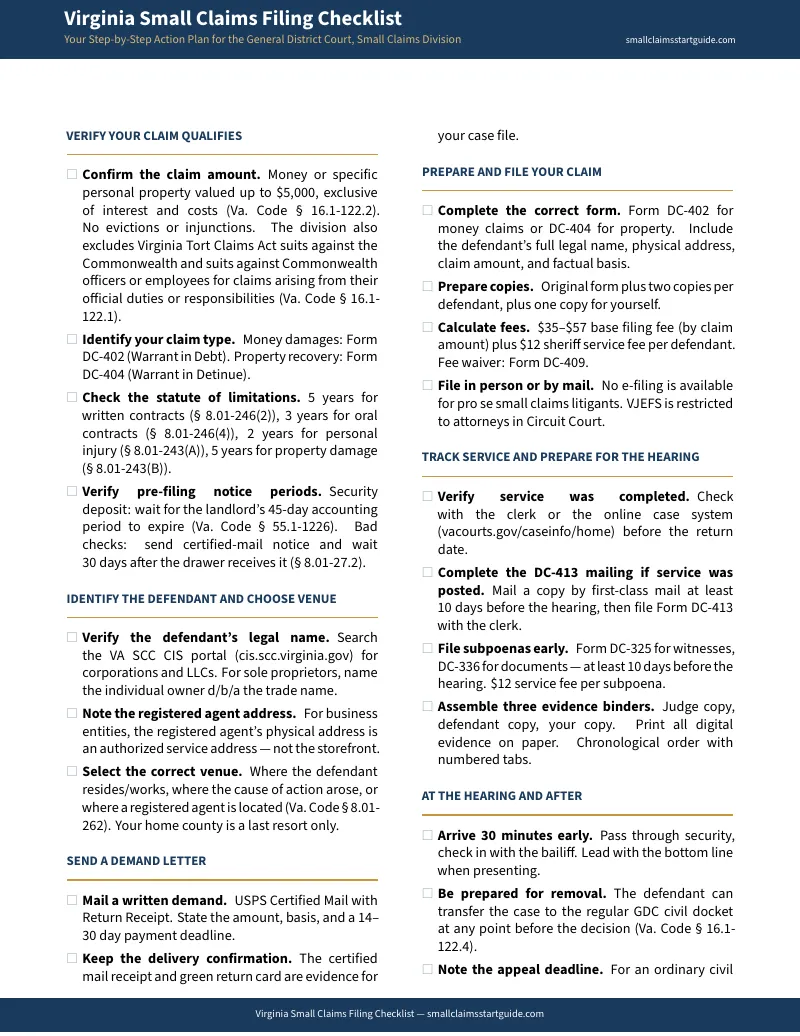
You found the court's website. Now you need someone to put the steps in order.
Your contractor took your deposit and stopped returning calls. Your landlord kept your security deposit for "damages" that were there when you moved in. A client owes you for work you finished months ago. You have already searched "how to file small claims in Virginia" and landed on the court self-help portal — a dozen pages organised by topic, not by the order you actually need to do things.
Virginia's Small Claims Division handles claims up to $5,000, attorneys are barred from the courtroom, and the filing fee starts around $52. The system is designed for people without lawyers. But the forms, service rules, and deadlines are scattered across separate PDF directories on vacourts.gov — and one missed step can delay your hearing by a month or kill your case before the judge hears a word.
The Virginia Small Claims Filing Workflow
The Virginia Small Claims Filing Guide takes the entire process — from checking whether your claim fits the $5,000 limit through to collecting after a judgment — and arranges it in one printable sequence with checklists and a deadline calendar. Every step references the exact form number, the fee, and the timeline.
This is not a 400-page national legal reference that buries Virginia in an appendix table. It is not a $99–$299 filing service that submits your paperwork but leaves you on your own at the hearing. It is a procedural workflow built for one state: what to do, in what order, by when.
What's Inside
Checking the Limit and the Clock
Virginia caps small claims at $5,000, exclusive of interest and court costs. But the dollar limit is only half the question — if your statute of limitations has run (three years for oral contracts, five for written ones), the claim is dead before you file. The guide walks through every limitation period and shows you how to calculate your deadline from the date the breach or injury happened.
The Demand Letter — Because It Sets the Tone
Virginia does not require a demand letter to file, but sending one demonstrates good faith and sometimes resolves the dispute without a courtroom. The guide covers what the letter should say, how to send it so you have proof of delivery, and how long to wait before filing.
Identifying the Defendant — The SCC CIS Lookup
The single most common reason a Virginia small claims judgment becomes unenforceable is naming the wrong party. If you sue "Mike's Plumbing" instead of the LLC registered with the State Corporation Commission, your judgment is worthless even if you win. The guide includes step-by-step instructions for searching the SCC Clerk's Information System (CIS) to find the exact legal name and registered agent of any Virginia business entity — before you fill out a single form field.
Filing Form DC-402 — Field by Field
Form DC-402 (Warrant in Debt — Small Claims Division) starts your case. The guide covers every field: how to format a corporate defendant name with its registered agent, how to describe the basis of your claim without triggering a motion for a Bill of Particulars, and how to calculate the filing fee ($35 to $57 depending on claim amount). It also covers Form DC-404 (Warrant in Detinue) for claims to recover specific personal property, and Form DC-409 for a filing-fee waiver if you qualify.
Serving the Defendant — Methods, Costs, and the Posted-Service Trap
Virginia offers personal service by the Sheriff ($12 per defendant), private process server, or posted service (tacking the warrant to the defendant's front door). Posted service is the one that catches people: if you post but forget to mail a secondary copy by first-class mail at least 10 days before the return date and file Form DC-413 (Certificate of Mailing Posted Service) with the clerk, your hearing gets continued — and you may not find out until you show up at the courthouse. The guide builds every service method into a tracking log with the mailing deadline calculated automatically.
The 3-Binder Evidence System
Small claims hearings run 10 to 15 minutes. You will not have time to dig through a folder looking for the right receipt. The guide shows you how to assemble three identical evidence binders — one for the judge, one for the defendant, one for you — with contracts, invoices, text messages, photographs, and repair estimates in chronological order, tabbed and ready to reference when the judge asks a question. Virginia litigants who use this system report that judges respond noticeably better to organised presentations.
The Hearing — What Actually Happens
What the courtroom looks like, how the judge runs the proceeding under relaxed evidence rules, what happens if the defendant does not show up (default judgment), how court-ordered mediation works in urban jurisdictions like Fairfax and Alexandria, and what to do if the defendant files a Notice of Removal to transfer your case to the regular General District Court docket.
After the Decision — Judgments Do Not Pay Themselves
Winning does not mean the defendant writes you a cheque. After the 10-day appeal window, you may need to enforce the judgment yourself. The guide covers Summons to Answer Interrogatories (Form DC-440) to locate assets, wage garnishments, bank account garnishments through Suggestion of Garnishment, and recording the judgment as a lien — so you know every enforcement tool available and which ones apply to your situation.
Printable Checklists and Deadline Calendar
Every step on one page — from the SCC entity search through post-judgment enforcement — with the form numbers, fees, and deadlines filled in. Print it, check off each step as you go, and know exactly where you are in the process at any point.
Who This Is For
- Tenants owed a security deposit. Your landlord had 45 days under the VRLTA (Va. Code § 55.1-1226) to return your deposit or send an itemised list of deductions. If they did neither, you may have a claim. The guide bridges the VRLTA timeline directly into the DC-402 court filing workflow.
- Homeowners with a contractor dispute. The contractor took your deposit and disappeared, or the work is defective. The guide covers how to search the SCC CIS to identify the correct business entity — because suing a trade name instead of the registered LLC makes your judgment unenforceable.
- Small landlords owed rent or damage costs. Your former tenant left owing rent or caused damage beyond normal wear and tear. The guide covers documenting damages with photographs and repair invoices and locating a former tenant for service.
- Sole traders and freelancers with unpaid invoices. A client stopped paying. The guide covers SCC registered agent lookups for corporate defendants and presenting an invoice trail that a judge can follow in 10 minutes.
- Buyers refused a refund. You paid for something that never arrived or was not what was described. The guide covers identifying a business's legal name, establishing venue, and calculating whether the filing fee is worth the claim amount.
- Anyone owed up to $5,000 in Virginia who wants to handle it themselves. If you would rather spend an evening with a step-by-step guide than an afternoon on hold with the court clerk — who is legally prohibited from helping you fill out the forms — this is for you.
Why Not Just Use the Free Court Resources?
You should use them — and the guide tells you exactly when and where. The Virginia Judicial System's Self-Help Portal at selfhelp.vacourts.gov publishes every form, fee schedule, and procedural overview you need. The official forms directory has Form DC-402, DC-404, DC-413, and their instruction sheets as free downloadable PDFs.
What the court's website does not do is put the information in the order you need it. The self-help pages are organised by topic — one page for limits, another for service, another for the hearing. The forms and their instruction sheets live in separate directories. The requirement to mail a secondary copy and file Form DC-413 when using posted service is buried in a separate PDF that most filers never find until after a continuance. And Virginia law prohibits court clerks from giving legal advice or helping you complete your forms.
The guide does the organisational work: every form, every fee, every deadline, in the order you encounter them, with the SCC entity lookup, the posted-service tracking log, and the 3-binder evidence system built in. It sits between the free information (which you still need) and a $99–$299 filing service (which submits your paperwork but does not prepare you for the courtroom).
What This Is Not
This guide explains the procedure. It does not give legal advice, predict outcomes, or tell you how to argue your case. It is not published by, affiliated with, or endorsed by the Virginia Judicial System, any General District Court, or any government agency. If you need legal advice, contact a lawyer. If you need free help, the guide lists Legal Aid organisations and court self-help resources for your area.
Satisfaction Guarantee
Full refund, no time limit. If the guide is not what you expected, email [email protected] and we will refund you — no questions, no deadline.
Get Started
Download the free Virginia Small Claims Filing Checklist — a one-page summary of the $5,000 limit, forms, fees, service steps, and deadlines. If you want the full guide with field-by-field form instructions, the SCC entity lookup walkthrough, the posted-service tracking log, and the 3-binder evidence system, get the complete Virginia Small Claims Filing Guide for .
Frequently Asked Questions
What if the rules change after I buy?
We update the guide when the rules change. Email us any time, even years later, and we'll send you the current edition free.