You Won the Case. The Debtor Won't Pay. Now What?
Winning a small claims judgment in Vermont feels like the finish line — until you realize the court will not collect a single dollar for you. The Superior Court, Civil Division signed an order saying the debtor owes you money. But enforcing that order? That is entirely on you.
Most creditors stall here. They wait for a payment that never comes, call the court clerk and learn that staff cannot advise them on next steps, then spend hours clicking between scattered court PDFs trying to piece together what Form 100-00506 has to do with Form 100-00511 and why the sheriff needs two copies of everything.
The Vermont Judgment Enforcement System
This guide is a complete procedural manual for collecting an unpaid small claims judgment in Vermont — structured as a sequential enforcement workflow that starts the day your 30-day post-judgment waiting period expires and ends when the case is formally closed.
It replaces the patchwork of separate court web pages, a legacy booklet that summarizes enforcement options in two paragraphs, and free tools that stop at linking you to blank forms. Court forms are free — and the guide links to every one of them. What you are paying for is the execution sequence: which forms to file together, in what order, with which supporting documents, and what the sheriff needs in the service packet.
What's Inside
- 30-day stay tracker and appeal monitor — a step-by-step timeline from judgment entry to the first day you can legally enforce, with the rules for time computation, appeal stays, and bankruptcy overrides
- Financial disclosure hearing playbook — how to file Motion Form 100-00279, prepare structured asset questions, serve the debtor through the county sheriff, and use the hearing to identify wages, bank accounts, and real property you did not know existed
- Wage garnishment workflow (Trustee Process) — Form 100-00506 filing instructions, the dual-packet sheriff service checklist (motion, employer disclosure, list of exemptions, certificate of service), and Vermont's disposable earnings formula so you know exactly how much the employer can withhold
- Bank account levy procedure — Form 100-00505 for non-wage trustee process, bank disclosure Form 100-00297, service timing, and how to handle multiple accounts or joint accounts where exemptions apply
- Writ of execution and property seizure — Form 100-00502, what the sheriff can and cannot seize, the public auction process, and the full list of Vermont property exemptions under 12 V.S.A. § 2740
- Real estate judgment lien — how to record a certified copy of the judgment at the town clerk's office ($15 per page under 32 V.S.A. § 1671), what the lien attaches to, and how it survives property transfers
- 12% interest calculator and payment ledger — a printable accounting worksheet for tracking Vermont's statutory post-judgment interest rate under 9 V.S.A. § 41a, partial payments, and recoverable enforcement costs ($65 per motion filing, sheriff service fees, recording fees)
- Satisfaction and renewal — the mandatory 21-day deadline to file Form 100-00290 when the debtor pays in full, and the 8-year renewal process to keep a judgment alive if collection takes longer than expected
Who This Guide Is For
- An individual who won a small claims judgment and the debtor has not paid after the 30-day waiting period
- A landlord owed money for unpaid rent, property damage, or a security deposit dispute — the guide covers how to locate the former tenant's current employer or bank
- A contractor or service provider holding a judgment against a client who refuses to pay an outstanding invoice
- A small business owner, LLC, or sole proprietor with an accounts receivable judgment who needs a structured collection workflow rather than hiring a collection attorney at $150–$400 per hour or surrendering 25–50% in contingency fees
- Anyone helping a family member, friend, or business partner navigate post-judgment enforcement as a non-lawyer — the guide is written for people doing the paperwork themselves
Not included: Pre-judgment filing (if you have not sued yet, see the Vermont Small Claims Filing Guide). Responding to a claim as a defendant (see the Vermont Small Claims Response Guide). Active debtor bankruptcies, out-of-state judgment domestication, and real property foreclosures — those require a licensed attorney.
Why Not Just Use the Court Website?
Vermont's judiciary site has the forms — Form 100-00506 for wage garnishment, Form 100-00505 for bank levies, Form 100-00279 for disclosure hearings, Form 100-00502 for writs of execution. But the forms are spread across separate pages with no guidance on which supporting documents (Form 100-00511 for exemptions, Form 100-00260 for proof of service) must accompany each motion. The court's legacy PDF booklet summarizes enforcement in general terms without providing the step-by-step filing, service, and follow-up instructions you need to actually do it.
The Odyssey e-filing system lets you submit forms digitally — but it does not tell you which forms to submit together or how to prepare the paper service packet the sheriff still requires. Court clerks can tell you where to file. They are legally barred from telling you what to file or in what order.
This guide closes that gap. You read it front to back, follow the steps in order, and use the right enforcement tool for your debtor's specific asset profile.
What You Get
- The Step-by-Step Guide — 45 pages covering every enforcement mechanism from the 30-day stay through case closure, with form checklists, fee tables, a disposable earnings calculator, and a payment tracking ledger (PDF, instant download)
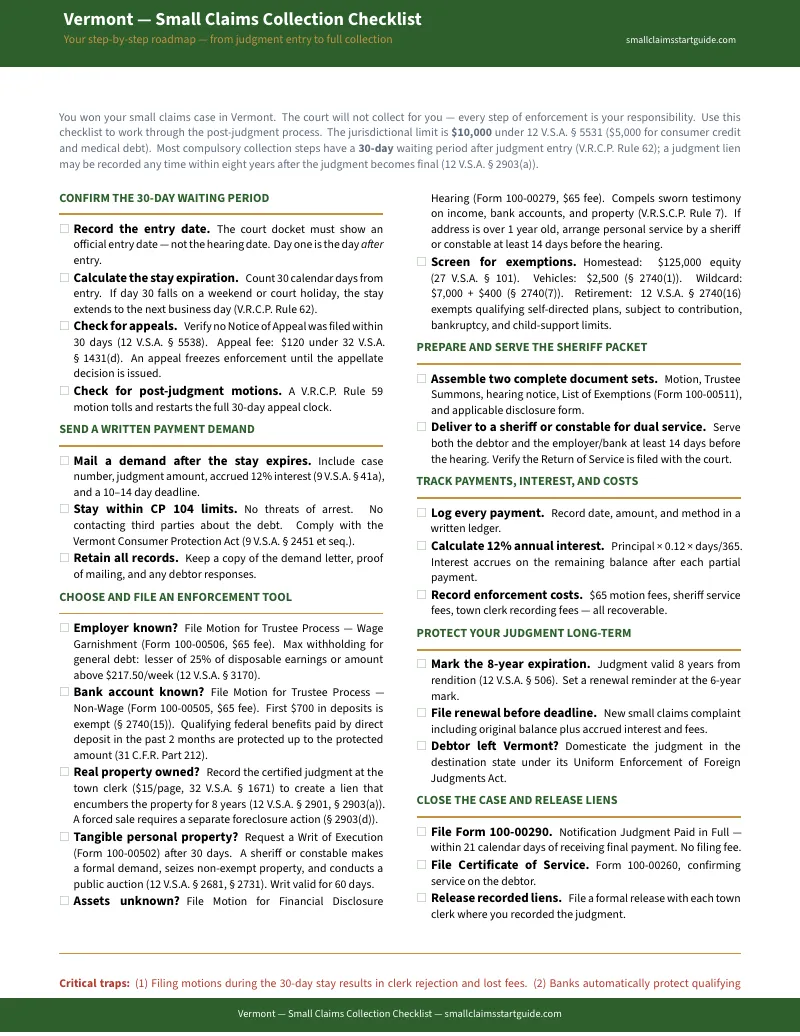
- The Collection Checklist — a quick-reference sheet of enforcement tools, required forms, filing fees, and deadlines (PDF)
- 6 Printable Worksheets — an enforcement timeline tracker, a payment and interest ledger, a sheriff service packet checklist for every motion type, an enforcement tool decision matrix, a financial disclosure hearing preparation worksheet, and a judgment renewal calendar (PDFs)
Full refund, no time limit. If the guide does not help, email [email protected] and you get your money back.
Get the Vermont Judgment Collection Guide →
Or download the free checklist below — no payment required — and see whether the full guide is worth it for your situation.
Frequently Asked Questions
What if the rules change after I buy?
We update the guide when the rules change. Email us any time, even years later, and we'll send you the current edition free.