
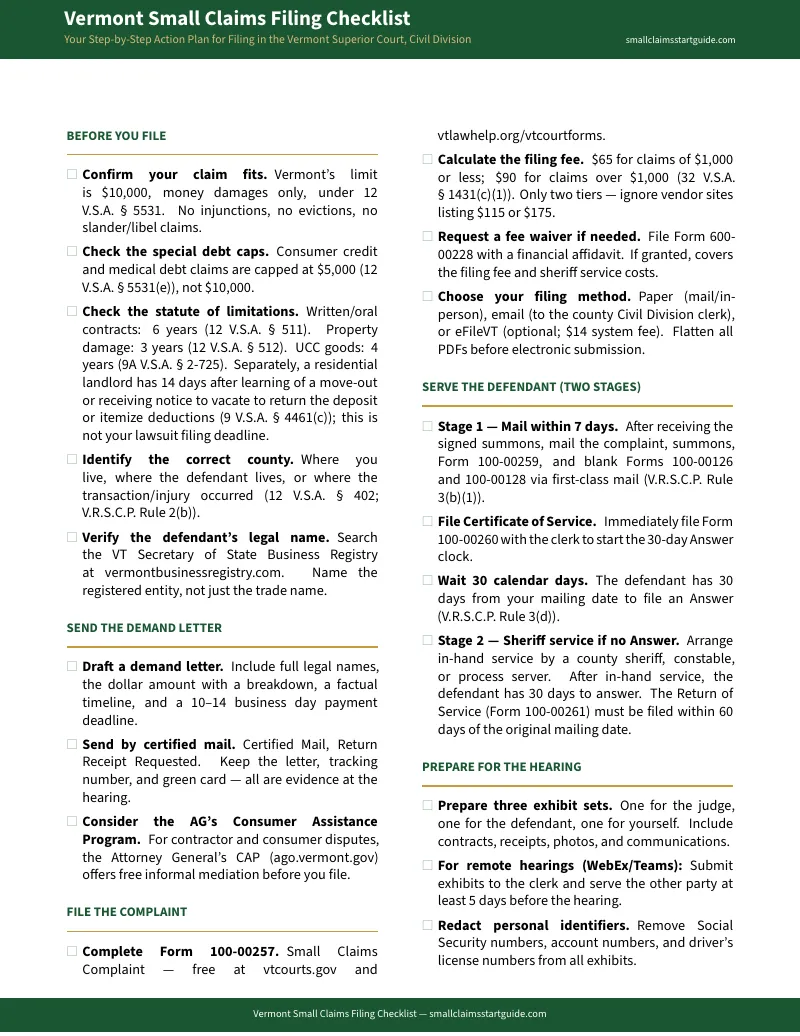
You know the court exists. You cannot figure out how to actually get your case through it.
Your contractor took your deposit and disappeared. Your landlord is sitting on your security deposit past the 14-day statutory deadline. A client owes you months of invoices and has gone silent. You searched "how to file small claims in Vermont" and found the information scattered across vtcourts.gov PDFs, VTLawHelp.org roadmaps, and a separate eFileVT portal — none of which explain the process in the order you need to follow it.
You do not need a legal textbook. You need to know which Superior Court to file in, which forms go in the filing packet, how much it costs, how to get the papers to the other side using Vermont's two-stage service sequence, and what to bring to a hearing. One missing form in the defendant's packet, one missed mailing window, and the court dismisses your case before you say a word.
The Vermont Two-Stage Filing Workflow
The Vermont Small Claims Filing Guide takes the entire Superior Court Civil Division process — from checking whether your claim fits the $10,000 limit through to understanding your options after the judge rules — and puts it in a single printable sequence. Every step names the statute, the form, the fee, and the deadline. No guesswork, no tab-juggling between five different court PDFs, no wondering what comes next.
This is not a 400-page legal reference and it is not a filing service that submits your paperwork but leaves you on your own at the hearing. It is a procedural workflow — the Two-Stage Filing Workflow — that walks you through what to do, in what order, by when, through Vermont's unique mail-first, sheriff-second service process that trips up nearly every first-time filer.
What's Inside
Checking the Limit and the Clock
Vermont's Superior Court Civil Division hears small claims up to $10,000 — but consumer credit and medical debt claims are capped at $5,000 under 12 V.S.A. § 5531 and 18 V.S.A. § 9481. Claims exceeding $3,500 let either party request special assignment to a judge. The guide walks through every limit, explains how the dual cap works, and shows you how to calculate your statute of limitations deadline — six years for written contracts, three years for property damage and personal injury.
The Demand Letter
For security-deposit claims, Vermont law gives the landlord 14 calendar days after the tenant vacates to return the deposit or provide an itemised list of deductions. Miss that deadline and the deductions are void — the tenant gets the whole deposit back. For contractor and invoice disputes, judges routinely look for evidence that you tried to resolve the matter before filing. The guide covers what the demand letter needs to say, how to send it so you have proof for court, and how long to wait before filing.
Filing the Complaint — Form 100-00257 and the Full Packet
The Small Claims Complaint (Form 100-00257, revised 03/2025) starts your case. But the filing packet includes more: you prepare the defendant's information packet — Form 100-00259, a blank Answer form (100-00126), and a blank Disclosure of Exempt Income form (100-00128). The section that saves the most time is the Statement of Claim drafting worksheet — a structured format that fits the form's space constraints and keeps your factual narrative clear for the clerk and the judge.
Court Fees and the Fee Waiver
Filing fees are $65 for claims of $1,000 or less, and $90 for claims over $1,000. The guide covers the full fee schedule, how to pay, and the full process for requesting a fee waiver using Form 600-00228. What most self-help resources leave out: if you file through eFileVT, an additional $14 per-case system fee applies — but pro se filers are not required to use eFileVT and can file by mail, in person, or by email to the county court clerk.
Serving the Defendant — Vermont's Two-Stage Process
This is where Vermont differs from most states. Stage one: within 7 days of receiving the summons from the clerk, you send the full defendant packet by first-class mail. Then you wait 30 days for the defendant to file an answer. If no answer arrives, stage two: you hire a sheriff or constable to personally serve the defendant, and the return of service must be filed within 60 days. Miss any window and the clerk can dismiss your case. The guide walks through each stage with a tracking log so you never lose count of the days.
Evidence Preparation
Bring organised evidence or risk losing a solid claim. The guide shows you how to assemble your documents — contracts, invoices, text messages, photographs, repair estimates — in chronological order with three copies: one for the judge, one for the defendant, one for yourself. For WebEx remote hearings, exhibits must reach the court and the other party 5 days before the hearing. The guide covers both in-person and remote evidence logistics.
The Hearing
What the courtroom or WebEx session looks like, how the judge runs the proceeding, how to present evidence without rambling, and what happens if the defendant does not show up — including how to file a Motion for Default Judgment using Form 100-00262.
After the Decision
Winning does not mean the defendant pays on the spot. The guide explains the 30-day appeal window, post-judgment interest at 12% per year, and provides a clear handoff to the collection phase. If the judgment remains unpaid, the sibling guide covers enforcement in full detail.
8 Printable Standalone Worksheets
Fillable PDFs you print and use throughout the case: a pre-filing eligibility checklist, a demand letter worksheet, a filing envelope assembly checklist, a two-stage service tracker log, a statement of claim drafting worksheet, a hearing day evidence binder checklist, an event-based milestone calendar, and a WebEx exhibit prep checklist. Each one corresponds to a phase of the filing process — fill them in as you go.
Who This Is For
- Tenants owed a security deposit. Your landlord had 14 calendar days after you moved out to return your deposit or provide an itemised list of deductions. If they missed that deadline, their deductions are void and you are entitled to the full deposit. The guide covers the statutory timeline and how to calculate your claim.
- Homeowners with a contractor dispute. The contractor took your deposit and vanished, or the work is defective and they will not come back. You may have already tried the Attorney General's Consumer Assistance Program at UVM. The guide covers sending a formal demand, naming the correct entity on your complaint, and presenting repair estimates as evidence.
- Small landlords owed rent or damage costs. Your former tenant left owing rent or caused damage beyond normal wear. The guide covers documenting damage and serving a former tenant who has moved away. Eviction proceedings are handled separately from small claims.
- Sole traders and freelancers with unpaid invoices. A client owes you for completed work. The guide covers filing as a sole proprietor or DBA, suing a business entity versus an individual, and presenting an invoice trail with the 6-year contract statute of limitations and 12% post-judgment interest.
- Neighbours with a property damage claim. A fallen tree, boundary damage, or pet damage. The guide covers documenting physical damage, obtaining repair estimates, and the 3-year property damage statute of limitations.
- Anyone owed money in Vermont who wants to handle it themselves. If your claim is $10,000 or less and you would rather spend an evening with a step-by-step guide than an afternoon navigating court PDFs, this is for you.
Why Not Just Use the Free Court Resources?
You should use them — and the guide tells you exactly when and where. The Vermont Judiciary publishes forms on vtcourts.gov, VTLawHelp.org offers an interactive Small Claims Roadmap, and the Access and Resource Center (802-879-1185) answers basic procedural questions by phone and email.
What none of those resources do is put the information in the order you need it. The official site publishes blank PDFs across separate pages — one for the complaint, another for service instructions, another for the fee schedule — and none of them link together into a step-by-step sequence. The interactive roadmap on VTLawHelp.org explains the general concept but does not track your mailing dates or tell you when to hire the sheriff. Court clerks can confirm fees and hearing dates but are legally prohibited from telling you how to complete your complaint or what evidence to bring.
The guide does the organisational work: every form, every fee, every deadline, in the order you encounter them, with the two-stage service process tracked on a printable log. It sits between the free information (which you still need) and an attorney (who charges $200–$400+ per hour to explain what the guide covers in an evening).
What This Is Not
This guide explains the procedure. It does not give legal advice, predict outcomes, or tell you how to argue your case. It is not published by, affiliated with, or endorsed by the Vermont Judiciary, any Superior Court, or any government agency. If you need legal advice, contact a lawyer. If you need free help, the guide lists the resources available through vtcourts.gov, VTLawHelp.org, Legal Services Vermont, and the Vermont Judiciary Access and Resource Center.
Satisfaction Guarantee
Full refund, no time limit. If the guide is not what you expected, email [email protected] and we will refund you — no questions, no deadline.
Frequently Asked Questions
What if the rules change after I buy?
We update the guide when the rules change. Email us any time, even years later, and we'll send you the current edition free.