You were served. Now what?
A notice of claim arrived — by certified mail or left at your door — and you have a court date you did not ask for. Maybe a former tenant says you owe them a security deposit. A customer says your work was defective. A contractor says you still owe the balance. A buyer says the car broke down.
You searched online and found a tangle of conflicting information: answer deadlines that do not apply to small claims, forms that do not exist for your court, and a 400-page national book that mentions New York in two paragraphs. The court's own website gives you the rules, but not the order to do things in.
The New York Small Claims Court Defence Organiser
The Responding to a Small Claims Case in New York guide puts the entire defendant process in one sequence — from the day you receive the papers through the hearing and whatever comes after the decision. It covers all four of New York's small claims court tiers, explains why there is no written answer to file, and walks you through every step you actually need to take.
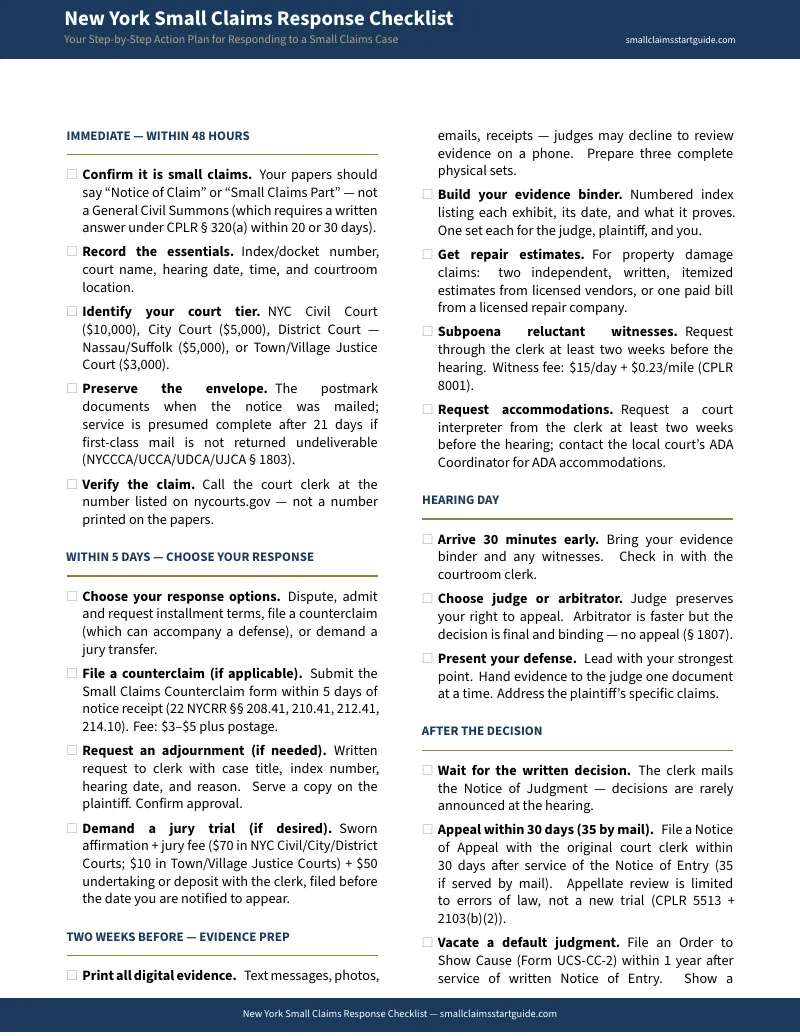
The guide comes with a printable checklist and six standalone worksheets: a notice of claim intake form, a response decision worksheet, an evidence binder index, a counterclaim filing tracker, a hearing day planner, and a post-decision action log — 8 printable PDFs in total.
What's Inside
Reading Your Court Papers
Your notice tells you who sued you, how much they want, and when you need to appear. But the format is different depending on whether you are in NYC Civil Court, a City Court upstate, a District Court on Long Island, or a Town or Village Justice Court. The guide explains what each part of the notice means and which court rules apply to your case.
Why You Don't File a Written Answer
In General Civil Court, defendants must file a formal written answer within 20 or 30 days. In the Small Claims Part, that rule does not apply. There is no form. There is no deadline to file paperwork. Your only procedural obligation is to show up at the hearing. The guide explains why this distinction matters and why hours spent searching for an "answer form" are wasted.
Your Four Options
You are not limited to showing up and hoping. You can dispute the claim entirely. You can admit part of the amount and contest the rest. You can settle — directly with the claimant or through a free Community Dispute Resolution Center mediator available in every New York county. Or you can file a counterclaim if the claimant actually owes you money. The guide covers each option, the steps involved, and when each makes sense.
Counterclaim Filing
If a contractor did not finish the job and then sued you, or a landlord kept your deposit and now claims you owe rent, you may be the party owed money. A counterclaim is a separate filing — not something you mention for the first time at the hearing. The guide walks through the clerk filing process, the fee (typically a few dollars plus postage), when to serve it to avoid giving the claimant grounds for an adjournment, and the dollar limits in each court tier.
Physical Evidence Binder
New York small claims judges and arbitrators will not look at evidence on your phone. Screenshots, text messages, contracts, photographs, invoices, and repair estimates all need to be printed in three matching sets — one for the judge or arbitrator, one for the claimant, and one for you. The guide shows you how to organise everything in chronological order, how to print and label text messages so they are readable, and how to structure the binder so the judge can follow your account without you explaining every page.
The Hearing
What happens when you walk in: the calendar call, whether your case is heard by a judge or a court-appointed arbitrator (and what consenting to arbitration means for your right to appeal), how to present your side clearly, how cross-examination works in an informal setting, and how to use your evidence binder effectively. The guide also covers adjournments and what happens if the claimant does not show up.
Default Judgments
If you miss the hearing, the court enters a default judgment for the full claimed amount — without hearing your side. The guide covers how to file an Order to Show Cause to vacate the default, the two requirements the court will evaluate (excusable default and meritorious defence), the timeline, and what to expect at the vacatur hearing.
After the Decision
If the judgment goes against you: the 30-day appeal window (35 days if served by mail), what an appeal reviews (errors of law, not the facts), and what enforcement actions the claimant can use. If you win: what happens to the claim and whether you need to take any further action.
Who It's For
- Homeowners sued by a contractor — organise your contract, change orders, photos, and replacement costs into an evidence binder and decide whether a counterclaim makes sense
- Tenants or landlords in a deposit dispute — understand General Obligations Law § 7-108, the 14-day return requirement, and how to present move-in/move-out records
- Small business owners named as defendants — know which employee can represent your LLC or corporation without an attorney, and how the Commercial Claims rules differ
- Private sellers sued over a vehicle sale — present your bill of sale, as-is disclosures, and DMV transfer records
- Anyone served with a small claims notice in New York who wants the steps in order without hiring a lawyer
What Free Resources Miss
The court's CourtHelp portal at nycourts.gov publishes the rules. The NYPIRG Small Claims Court Action Center takes phone calls. Legal aid organisations help with consumer debt cases. None of them do the following:
- Put a defendant's specific steps in one chronological sequence across all four court tiers
- Explain the difference between a General Civil summons (written answer required) and a Small Claims notice (appearance only) — a distinction that trips up thousands of defendants every year
- Walk you through physical evidence binder assembly with the three-copy rule judges enforce
- Cover counterclaim filing step by step, including deadlines that avoid triggering an adjournment
- Explain how to vacate a default judgment — the Order to Show Cause process, excusable default, and meritorious defence requirements
The guide does not replace those free resources — it references and links to all of them. It organises the full process so you are not piecing it together from five different websites the week before your hearing.
What This Is Not
This guide explains the procedure. It does not give legal advice, predict outcomes, or tell you how to argue your case. It is not affiliated with the New York State Unified Court System or any court. If you have been sued by a lender, debt buyer, or collection agency over a consumer debt, specialised legal aid is the right first step — the guide points you to those resources.
Guarantee
Full refund, no time limit. If the guide does not help, email [email protected] and we will refund you — no deadline, no questions.
Get Started
Download the free checklist to see the response steps at a glance, or get the full guide kit (8 PDFs) for the complete defendant walkthrough — court paper interpretation, evidence binder assembly, counterclaim filing, hearing preparation, post-decision options, and six printable worksheets you can fill in and bring to court.
The guide is — instant PDF download, printable, and backed by a full refund guarantee with no time limit.