Won Your Case in New Mexico? Here Is How to Actually Get Paid — Step by Step, Writ by Writ, Without Missing the Rules That Trip Up Most Creditors.
The judge ruled in your favor. You expected a check, or at least a timeline. Instead you got silence. No one from the court called the debtor. No payment appeared. And when you phoned the clerk's office, they told you something most people don't realize until this exact moment: New Mexico's courts enter judgments but do not collect them. Everything that happens next — finding the debtor's assets, filing writs, serving garnishment papers, recording property liens — is on you.
You could start pulling individual court forms from nmcourts.gov, guessing which one to file first, and hoping you don't spend fees on an enforcement tool the debtor's exemptions will block. Or you could follow a judgment enforcement system that puts every NM-specific step, form, and deadline in the order they actually need to happen.
The Judgment Enforcement System
This is not a national overview that skims wage garnishment in two paragraphs. It is a procedural guide built exclusively for creditors holding money judgments from New Mexico's Magistrate Courts and Bernalillo County Metropolitan Court — the two lower court systems that handle civil claims up to $10,000.
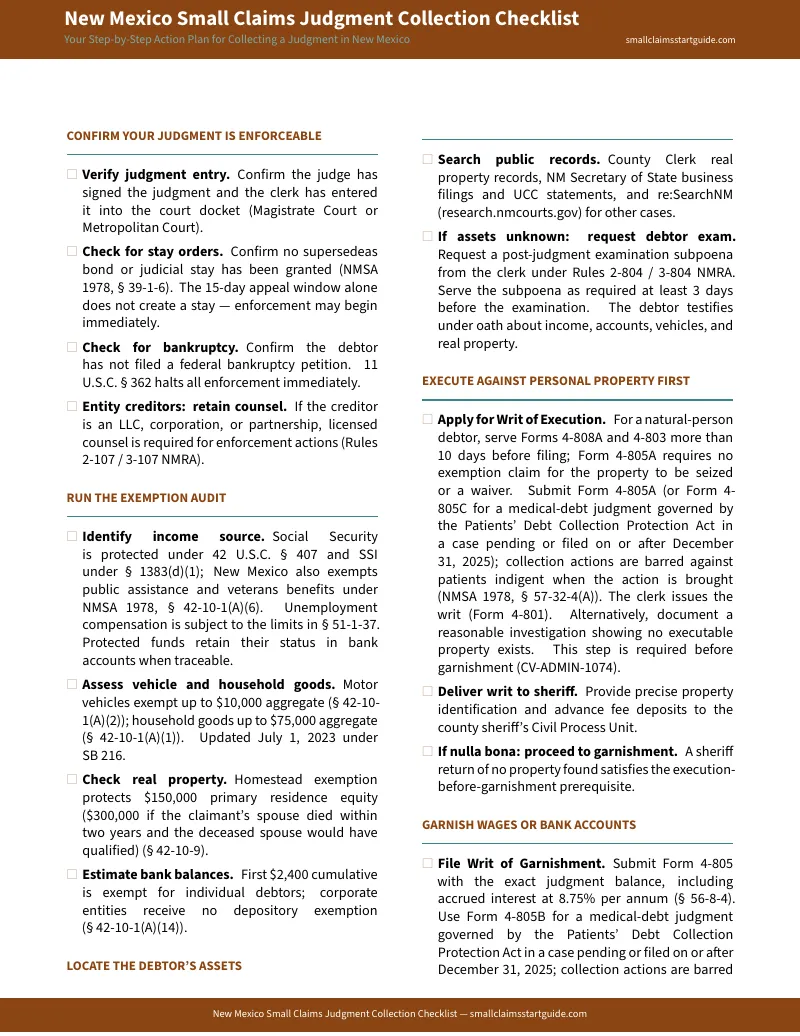
Every chapter follows the mandatory enforcement sequence: confirming you are clear to enforce (no supersedeas bond, no bankruptcy stay), discovering what the debtor owns, executing against personal property first, pivoting to wage or bank garnishment when execution returns empty, recording transcript liens against real estate, handling exemption disputes, calculating statutory interest on every filing, and closing the case with a proper Satisfaction of Judgment.
What's Inside
- Enforcement readiness checklist — confirms whether the appeal window, a supersedeas bond, or a bankruptcy stay blocks you from filing, so you don't waste a writ application on a case the clerk will reject
- Debtor asset discovery walkthrough — public record sources (County Clerk, Secretary of State, re:SearchNM) and the formal post-judgment examination subpoena under Rules 2-804 and 3-804 NMRA, including how to draft questions that surface bank accounts and employer names
- Execution and garnishment sequence — New Mexico requires you to pursue a Writ of Execution (Form 4-801) against personal property before applying for wage or bank garnishment (Form 4-805). The guide explains both steps, the sheriff's role, and exactly what to do when the writ comes back nulla bona
- Wage and bank garnishment instructions — field-level guidance for Form 4-805 and 4-805.1, the garnishee's obligations, how disposable earnings are calculated, the debtor's right to claim exemptions (Form 4-809), and your right to dispute those claims (Form 4-810A)
- Real property transcript lien — how to request a Transcript of Judgment from the court clerk and record it with the County Clerk under NMSA § 39-1-6, creating a lien that attaches for up to 14 years and must be cleared before the debtor can sell or refinance
- Exemption reference with 2023 thresholds — current statutory caps including the $10,000 motor vehicle exemption and $75,000 household goods exemption, so you can assess whether enforcement is worth the filing fees before you spend them
- Statutory interest calculator — worked examples at both the 8.75% default rate (NMSA § 56-8-4(A)) and the 15% tort rate (§ 56-8-4(B)), plus the Judgment Balance Ledger and Judgment Payment Tracking Log that allocate partial payments to interest, costs, then principal
- Satisfaction of Judgment procedure — how to prepare and file Form 4-706 when the debt is fully paid, release a recorded transcript lien, and handle escrow payoff requests from title companies during real estate closings
- Six printable worksheets — Debtor Solvency Checklist, Enforcement Cost Tracker, Judgment Balance Ledger, Judgment Payment Tracking Log, Post-Judgment Enforcement Timeline, and Agency Communication Log, each named in the guide and designed to fill in by hand
Who This Guide Is For
- An individual who won a Magistrate Court or Metropolitan Court judgment and has not been paid — whether it was a security deposit, an unpaid invoice, property damage, or a contractor who took a deposit and disappeared
- A sole proprietor or small business owner holding a money judgment against a customer, vendor, or former tenant
- A family member or administrative helper organizing enforcement paperwork on behalf of the named judgment creditor
- Anyone holding a judgment who tried calling the clerk, was told the court does not collect, and now needs to figure out what to file and in what order
Who This Guide Is Not For
- People who haven't filed yet — if you need to bring a case, the New Mexico Small Claims Filing Guide covers the complaint, service of process, and hearing
- Defendants — if you've been served with a lawsuit or a post-judgment writ, the New Mexico Small Claims Response Guide covers your deadlines and options
- Claims over $10,000 — District Court judgments follow different enforcement rules
- Debtor in active bankruptcy — the federal automatic stay halts all collection; the guide explains this boundary and when to consult a licensed attorney
Why Not Just Use the Free Court Forms?
You should download the official forms from nmcourts.gov — Form 4-801, Form 4-805, and the rest are public documents. But here is what the court website gives you: individual blank PDFs in an unindexed directory, with no instructions explaining which form to file first, no guidance on the execution-before-garnishment rule that gets applications dismissed, no interest calculation formula for the balance lines on Form 4-805.1, and no workflow connecting the forms into a sequence.
The Bernalillo County Metropolitan Court Self-Help Center (Room 210, 401 Lomas NW) provides helpful administrative guidance — but staff cannot legally calculate your interest, advise on collection strategy, or tell you which enforcement tool to use. Outside Bernalillo County, the 43 rural Magistrate Courts have no self-help centers at all.
National guides like Nolo's Everybody's Guide to Small Claims Court cover the trial process in depth but dedicate minimal space to post-judgment enforcement, don't cite NM-specific form numbers, and don't address the execution-first prerequisite or the post-2023 exemption thresholds.
This guide fills the gap. It takes New Mexico's scattered enforcement forms, rules, and deadlines and arranges them into a single collection workflow — from the day you confirm enforcement readiness to the day you file the Satisfaction of Judgment.
Satisfaction Guarantee
Full refund, no time limit. If the guide doesn't help you navigate the collection process, email [email protected] and we'll refund your purchase — no questions, no deadline.
Important Disclaimer
This guide is published by an independent educational publisher. It is not affiliated with, endorsed by, or connected to the New Mexico Judiciary, Bernalillo County Metropolitan Court, New Mexico Legal Aid, Law Access New Mexico, or any government agency. It provides procedural information, organizational checklists, and document completion instructions for self-represented judgment creditors. It does not contain legal advice, merits evaluation, or outcome predictions.
Frequently Asked Questions
What if the rules change after I buy?
We update the guide when the rules change. Email us any time, even years later, and we'll send you the current edition free.