Owed Money in New Mexico? File Your Small Claims Case Step by Step — Without Guessing Which Form, Which Court, or Which Deadline Comes First.
You tried asking nicely. You sent a follow-up. Maybe you even wrote a formal demand letter. The other side either ignored you or gave you the runaround. Now you're looking at small claims court and realizing that New Mexico splits these cases across Magistrate Courts in 32 counties plus a separate Metropolitan Court for Albuquerque, with a stack of forms labeled 4-201, 4-202, and 4-204 — and no clear guide telling you which ones you need or in what order.
You could spend a weekend navigating scattered court webpages, calling clerks who legally cannot tell you how to fill in your complaint, and hoping you don't make a mistake that gets your case thrown out before the judge ever hears it. Or you could open a procedural filing system that walks you through the entire sequence — from checking whether your claim qualifies to walking into your hearing with organized evidence.
The Filing Procedure System
This is not a generic legal overview that covers all 50 states in one book. It is a step-by-step procedural guide built exclusively for plaintiffs filing money claims up to $10,000 in New Mexico's Magistrate Courts and Bernalillo County Metropolitan Court.
Every chapter follows the order things actually need to happen: confirming your claim fits the court's rules, sending a demand letter, choosing the right court and form, paying the filing fee, serving the defendant properly, exchanging evidence before trial, and presenting your case at the hearing.
What's Inside
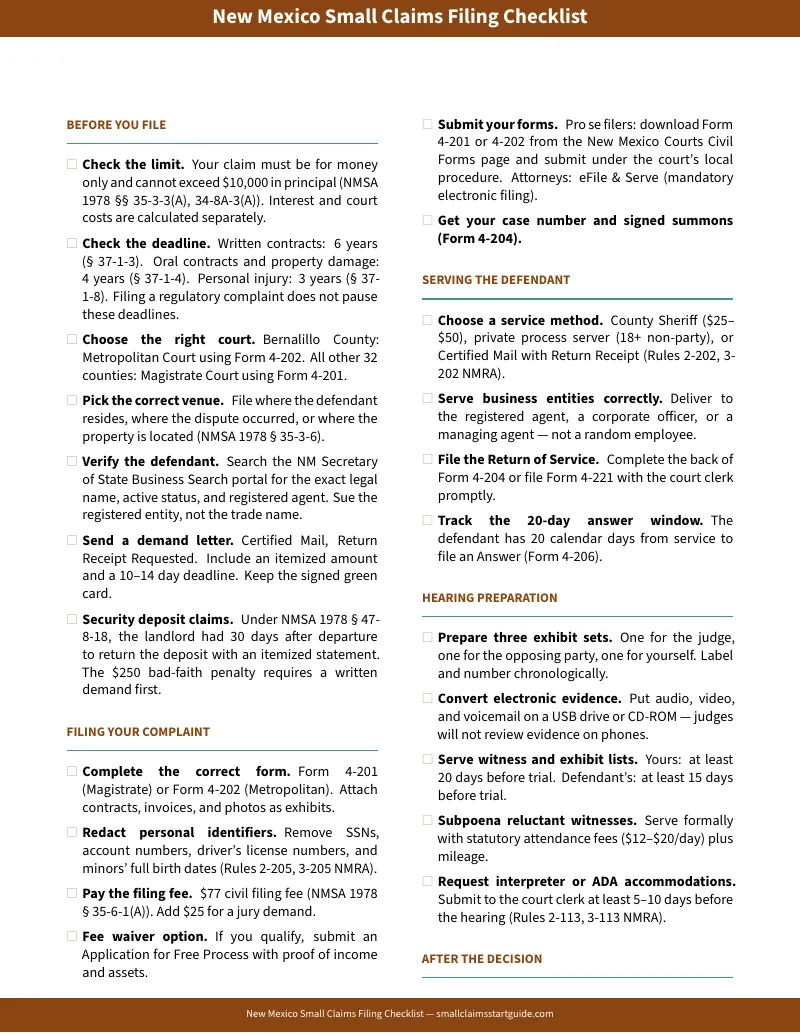
- Court and form router — a decision framework that tells you whether to file in Bernalillo County Metropolitan Court (Form 4-202) or your local Magistrate Court (Form 4-201), based on where the dispute happened and where the defendant lives
- Demand letter template — how to write an effective pre-suit demand with a clear deadline and the right statutory references, so the other side takes it seriously and you have documentation if the case goes to court
- Complaint drafting walkthrough — field-by-field instructions for completing Form 4-201 or 4-202, including how to calculate your damages, describe the dispute clearly, and identify business defendants correctly
- Service of process protocol — every valid method for delivering the Summons (Form 4-204) to the defendant: county sheriff, a disinterested adult process server, or certified mail with a signed green card, plus how to file the Return of Service so the court knows the defendant was properly notified
- Deadline calendar — a tracking worksheet covering the 20-day answer period, the 20-day and 15-day pre-trial witness and exhibit exchange deadlines, the 6-month prosecution limit, and applicable statutes of limitations for common claim types
- Evidence organizer — how to assemble contracts, invoices, receipts, photographs, text messages, and repair estimates into a courtroom-ready exhibit binder with labeled tabs the judge can follow
- Hearing-day walkthrough — what to expect in the courtroom, how to present your evidence, how to question witnesses, and how to handle a defendant's counterclaim
- Post-judgment roadmap — what happens after the judge rules, including the appeal window, when enforcement can begin, and how to transition to the companion collection guide if the defendant doesn't pay voluntarily
Who This Guide Is For
- A tenant whose landlord kept a security deposit without providing the required 30-day written accounting
- A homeowner whose contractor took a deposit and left the project unfinished
- A small landlord owed back rent or damage costs after a tenant moved out
- A freelancer or sole trader with an unpaid invoice that informal follow-ups haven't resolved
- A consumer who paid for goods or services that were never delivered, were defective, or came with an unhonored warranty
- A property owner with a damage claim against a neighbor over a boundary dispute, fallen tree, or shared infrastructure
Who This Guide Is Not For
- Defendants — if you've been served with a lawsuit, you need the New Mexico Small Claims Response Guide, which covers the 20-day answer deadline and Form 4-301
- Eviction filers — residential evictions follow a separate Forcible Entry and Unlawful Detainer procedure using Form 4-203, not the standard civil complaint process
- Claims over $10,000 — disputes above the jurisdictional limit must go to District Court, which has different procedural rules
- People collecting a judgment they already have — wage garnishment, property liens, and other enforcement tools are in the companion Collecting a Small Claims Judgment in New Mexico guide. New Mexico LLCs and corporations may appear in these courts through a non-attorney officer, member, or designated employee (NMSA § 35-3-7)
Why Not Just Use the Free Court Forms?
You should download the free forms from nmcourts.gov — Form 4-201, Form 4-202, and Form 4-204 are public documents and we encourage you to get them directly from the source. But here is what the court website gives you: a collection of blank PDFs scattered across different directory pages, with no instructions explaining which form you need, how to fill in the statement of claim, how to calculate your filing deadline, or how to serve the defendant once you've filed.
National guides like Nolo's Everybody's Guide to Small Claims Court cover all 50 states in aggregate charts but don't distinguish between New Mexico's Metropolitan Court procedures and Magistrate Court procedures, don't reference the actual NM Supreme Court form numbers, and don't address the state's specific service rules or pre-trial disclosure deadlines.
This guide fills that gap. It takes New Mexico's scattered forms, rules, and deadlines and arranges them into a single filing workflow you can follow from your first demand letter to your day in court.
Satisfaction Guarantee
Full refund, no time limit. If the guide doesn't help you navigate the filing process, email [email protected] and we'll refund your purchase — no questions, no deadline.
Important Disclaimer
This guide is published by an independent educational publisher. It is not affiliated with, endorsed by, or connected to the New Mexico Judiciary, Bernalillo County Metropolitan Court, New Mexico Legal Aid, or any government agency. It provides procedural information, organizational checklists, and document completion instructions for self-represented litigants. It does not contain legal advice, merits evaluation, or outcome predictions.
Frequently Asked Questions
What if the rules change after I buy?
We update the guide when the rules change. Email us any time, even years later, and we'll send you the current edition free.