You just got served. Now what?
Court papers arrive without warning. You open an envelope and see your name on Form CC 4:1 — a "Plaintiff's Claim and Notice to Defendant" from a Nebraska County Court. Someone is suing you for money, and there is a hearing date printed at the bottom.
The first thing most people do is search online. And the first thing they find is wrong.
Generic legal websites tell Nebraska defendants to file a written answer within 30 days. In Nebraska small claims court, that rule does not exist. Under Neb. Rev. Stat. § 25-2806, formal written answers are specifically prohibited. Following generic advice could cause you to miss the deadlines that actually matter — like the two-day pre-trial cutoff to file a counterclaim or transfer your case.
That is the kind of mistake this guide exists to prevent.
The Nebraska Response Roadmap
This is not a stack of downloaded court forms with no instructions. The Nebraska Response Roadmap is a structured procedural system that takes you from the moment you open those papers through the hearing and beyond — with every Nebraska-specific deadline, form number, and county court rule mapped out in sequence.
It works because it follows exactly one jurisdiction's rules. Not a fifty-state overview. Not a generic template. Nebraska County Court procedure, from Neb. Rev. Stat. § 25-2801 through the local courtroom evidence rules in Douglas and Lancaster Counties.
What's Inside
- Paper verification and case authentication — how to confirm your papers are a legitimate court summons, not an unfiled demand letter, and how to look up your case on the Nebraska JUSTICE system
- The "no written answer" clarification — exactly what § 25-2806 means for you, why online advice about 30-day answer deadlines is wrong for small claims, and what your actual obligations are
- Service of process audit — how to check whether you were served properly under Nebraska law (certified mail, sheriff, or publication), what defects look like, and how to challenge service without accidentally waiving your rights
- Counterclaim and setoff workflow — when to file Form CC 4:2, how to calculate the two-day pre-trial deadline, and how to serve it on the plaintiff by sheriff or certified mail
- Transfer decision framework — a cost-benefit analysis for moving your case to the regular County Court docket via Form CC 4:3 ($20 fee), where attorneys are permitted but so is your opponent's lawyer
- County-specific evidence preparation — the exact physical evidence rules for Nebraska county courts, including Douglas County's USB flash drive requirement (CC 4:20.D4), the three-copy printing rule, and how to subpoena witnesses with Form CC 4:6
- Hearing day walkthrough — what happens in the courtroom, how to present your side, how testimony and cross-examination work in small claims, and what the judge is looking for
- Post-decision orientation — your options after a ruling, whether you won or lost: the 30-day appeal window and $50 cost bond, filing Form CC 4:9 to set aside a default judgment, satisfying a judgment safely, and protecting your credit record
- Settlement negotiation roadmap — how to approach the plaintiff before the hearing, when settlement makes sense, and how to document an agreement so the claim is dismissed with prejudice
- Case Information and Deadline Tracker worksheet — a fill-in tool that calculates your two-day cutoffs, organizes your evidence list, and tracks every filing from receipt of papers through judgment satisfaction
Who This Is For
- A homeowner served by a contractor over a renovation dispute
- A tenant or former landlord in a security deposit fight
- A small business owner sued by a customer or vendor
- A private vehicle seller or buyer in a sale-gone-wrong dispute
- Anyone served with a Nebraska small claim who needs to understand the procedure before the hearing date arrives
Who This Is Not For
If you have been sued by a credit card company, debt buyer, or collection agency, you have specific consumer protections that go beyond small claims procedure. The guide includes referrals to Legal Aid of Nebraska (1-877-250-2016) and the NSBA Volunteer Lawyers Project for specialized debt defense.
If you are facing an eviction proceeding seeking physical possession of your home (Forcible Entry and Detainer), that case runs on a separate statutory track with different deadlines. This guide covers money claims only.
Why Not Just Use the Free Court Website?
The Nebraska Judicial Branch publishes accurate forms on nebraskajudicial.gov. The forms are free. You should download them.
What the court website does not do is put those forms into a procedural sequence. It does not tell you when to use Form CC 4:2 versus Form CC 4:3. It does not explain how to calculate the two-day pre-trial cutoff. It does not show you how to prepare digital evidence for Douglas County's USB-only rule. It does not walk you through the hearing step by step. And county court clerks are legally prohibited from advising you on any of those questions.
The guide organizes everything the court publishes — plus the local county rules and procedural workflows that are not on any single page — into a step-by-step system you can follow from the day you are served to the day the case is resolved.
Your Files
- guide.pdf — 50-page, 14-chapter guide covering every stage from receiving papers through post-judgment steps, with Nebraska-specific statutes, forms, and county court rules cited throughout
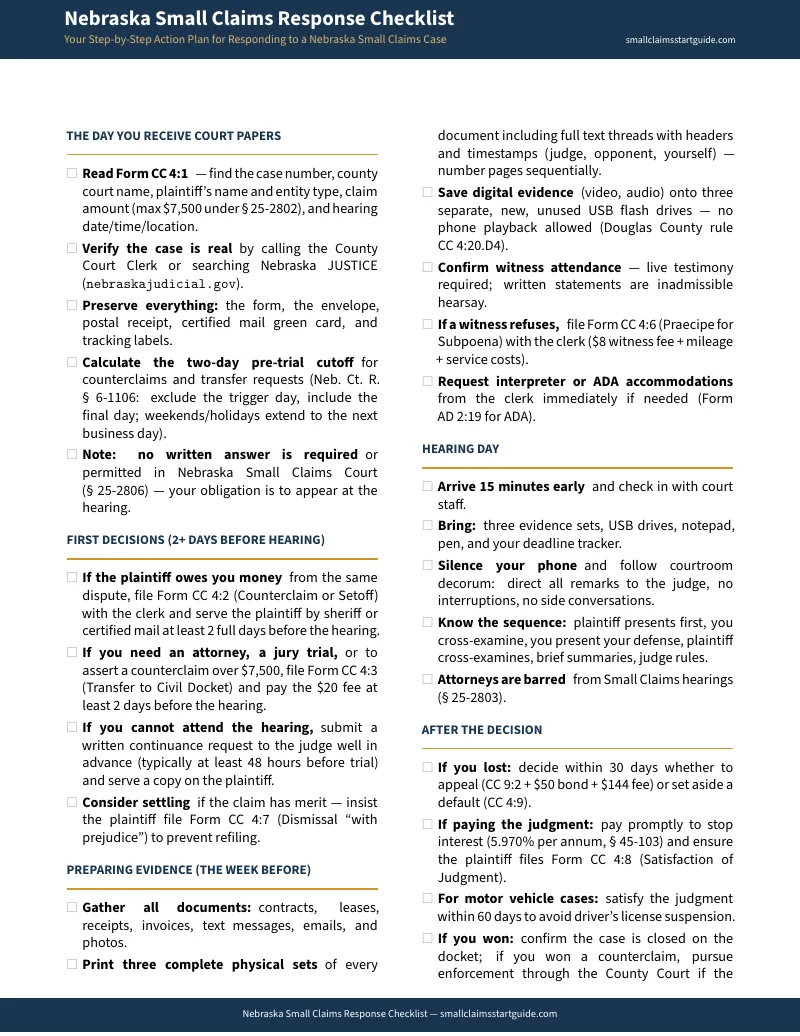
- checklist.pdf — 2-page printable checklist (25 items across 5 stages) for deadlines, evidence preparation, and filings
- case-information-and-deadline-tracker.pdf — fill-in sheet for case number, hearing date, and the two-day CC 4:2 / CC 4:3 cutoff
- evidence-preparation-checklist.pdf — exhibit index, three-copy printing, and Douglas County USB drive checklist
- hearing-day-preparation-sheet.pdf — what to bring, testimony outline, and courtroom sequence
- post-decision-action-log.pdf — 30-day appeal / set-aside clocks, payment, and Form CC 4:8 tracking
- settlement-negotiation-record.pdf — offer log plus CC 4:7 / CC 4:8 closing steps
- service-of-process-audit.pdf — how you were served and whether to raise a jurisdiction objection first
- counterclaim-planning-worksheet.pdf — draft Form CC 4:2 and the two-day file-and-serve steps
- transfer-decision-worksheet.pdf — Form CC 4:3 cost-benefit before you pay the $20 fee
Full refund, no time limit. If the guide does not accurately reflect Nebraska court rules and procedures, email [email protected] and we will refund every cent.
Get the Nebraska Response Guide →
Or download the free checklist first — a 2-page summary of your deadlines, options, and evidence preparation steps.
Frequently Asked Questions
What if the rules change after I buy?
We update the guide when the rules change. Email us any time, even years later, and we'll send you the current edition free.