You Won. They Haven't Paid. Now What?
You sat in that County Court, made your case without a lawyer — because Nebraska doesn't allow attorneys in small claims — and the judge ruled in your favor. But weeks later, the other side still hasn't handed over a dime. You called the County Court Clerk's office, and they told you they're legally prohibited from advising you on what to do next.
That's because Nebraska courts don't enforce judgments for you. They expect you to figure out garnishments, debtor examinations, liens and writs on your own — navigating between the County Court Clerk, the county sheriff, the Register of Deeds, and a set of statutes that were never written in plain English.
Meanwhile, every week that passes is another week the debtor could change jobs, move money, or let your judgment tick closer to the 5-year dormancy deadline where it loses its teeth entirely.
The Nebraska Judgment Collection Enforcement System
This guide replaces the confusion with a structured, step-by-step enforcement workflow built specifically for Nebraska County Court small claims judgments. It's not a generic 50-state overview that mentions garnishment exists — it walks you through exactly how to file one in your county, which official Nebraska Judicial Branch form to use, what it costs, and what to expect at each stage.
Where the state judiciary website gives you a master directory of hundreds of unrelated forms across civil, criminal and probate categories, the Enforcement System gives you the sequence: which office, which form number, which fee, which deadline — and what to do when the debtor claims everything is exempt.
What's Inside
- The 30-day appeal countdown — how to count the window under Neb. Rev. Stat. § 25-1912(1), confirm whether the debtor posted a supersedeas bond, and verify no court-ordered stay is blocking enforcement
- Debtor Examinations — how to file Form CC 3:26 to compel the debtor to appear under oath, disclose their employer, bank accounts and property, and bring financial records with a subpoena duces tecum (Form CC 4:6)
- Wage garnishment from filing to collection — the Garnishment Affidavit and Praecipe for Summons (Form CC 3:6), the Garnishment Interrogatories (Form CC 3:8P), the 25% disposable earnings cap, and the federal minimum wage floor that makes low-wage debtors garnishment-proof
- Bank account levies — how to garnish a debtor's checking or savings account, the federal benefits lookback rule that protects Social Security and disability deposits, and the Douglas County "D4" form packet (Form CC 3:8.20.D4) for Omaha-area filings
- Writ of Execution — seizing personal property through the county sheriff using a Praecipe for Execution (Form CC 3:9), including what the sheriff needs from you and how to identify non-exempt assets before you file
- Real property liens — transcribing a certified County Court judgment to the District Court Clerk under Neb. Rev. Stat. §§ 25-1303 and 24-516 so it attaches as a lien on the debtor's real property in that county
- The complete exemptions table — every protected asset class in Nebraska, from homestead and personal property exemptions to Social Security, SSI, disability, veterans benefits, retirement accounts, and wages below 30 times the federal minimum wage
- Interest, dormancy and cost recovery — calculating post-judgment interest under Neb. Rev. Stat. § 45-103, understanding the 5-year dormancy rule under § 25-1515, reviving a dormant judgment, and adding your recoverable enforcement costs to the balance
- Satisfaction of Judgment — closing the case on the court record with Form CC 4:8 so neither party carries an open judgment indefinitely
- Eight fillable worksheets — Enforcement Readiness Checklist, Post-Judgment Balance Ledger, Debtor Examination Question Checklist, Garnishment Filing Checklist, Cost-Benefit Calculator, Exemption Assessment Worksheet, Satisfaction of Judgment Filing Checklist, and Enforcement Action Log
Who This Guide Is For
- You won a judgment in a Nebraska County Court small claims case and the other side has not paid
- You want to enforce the judgment yourself — attorneys are banned from small claims proceedings, and hiring one to move the case to the regular docket often costs more than the judgment itself
- You need to understand which enforcement tool — garnishment, lien, seizure or examination — fits your debtor's situation before you spend money on filing fees and sheriff service costs
This guide is not for people who haven't been to court yet. If you need to file a claim, see the Nebraska Small Claims Filing Guide. If you've been served with a claim, see the Nebraska Small Claims Response Guide.
Why Not Just Use Free Resources?
Free information on Nebraska judgment collection exists — scattered across the state judiciary portal, county fee schedules, Justia statute pages, and Nolo overviews written for all 50 states at once. Here's what that actually looks like in practice:
- The Nebraska Judicial Branch website publishes official forms, but they're buried in a master directory of hundreds of civil, criminal and probate forms — you need to already know the form number to find the right one
- The state's form instructions (like Form CC 3:26a for debtor examinations) explain how to fill in the blanks, but don't tell you what questions to ask at the hearing or how to sequence enforcement tools
- National publishers like Nolo explain that garnishment exists, but legacy editions still cite obsolete Nebraska claim limits ($3,600 or $3,900) and don't cover the Douglas County "D4" localized form requirements
- Legal aid organizations in Nebraska serve low-income defendants — not creditors trying to collect on a judgment they already won
- County Court clerks will confirm your judgment is on file, but are legally prohibited from advising you which enforcement tool to use or helping you fill out forms
The result: creditors spend hours piecing together fragments from a dozen sources, often missing critical timing rules — like the 5-year dormancy deadline that can kill a judgment's enforceability — or wasting filing fees on a garnishment directed at a debtor whose income is fully exempt.
This guide puts every enforcement tool, deadline, fee, form reference and exemption in one organized workflow — so you can make an informed decision about how to proceed before you advance a single dollar in court costs.
Satisfaction Guarantee
The guide comes with a full refund, no time limit. If it's not what you expected, email [email protected] and you'll get your money back.
This is an independent guide — not a court document, not legal advice, and not affiliated with any Nebraska court, government agency or legal aid organization. It explains the procedure in plain language so you can navigate it yourself.
Get Started
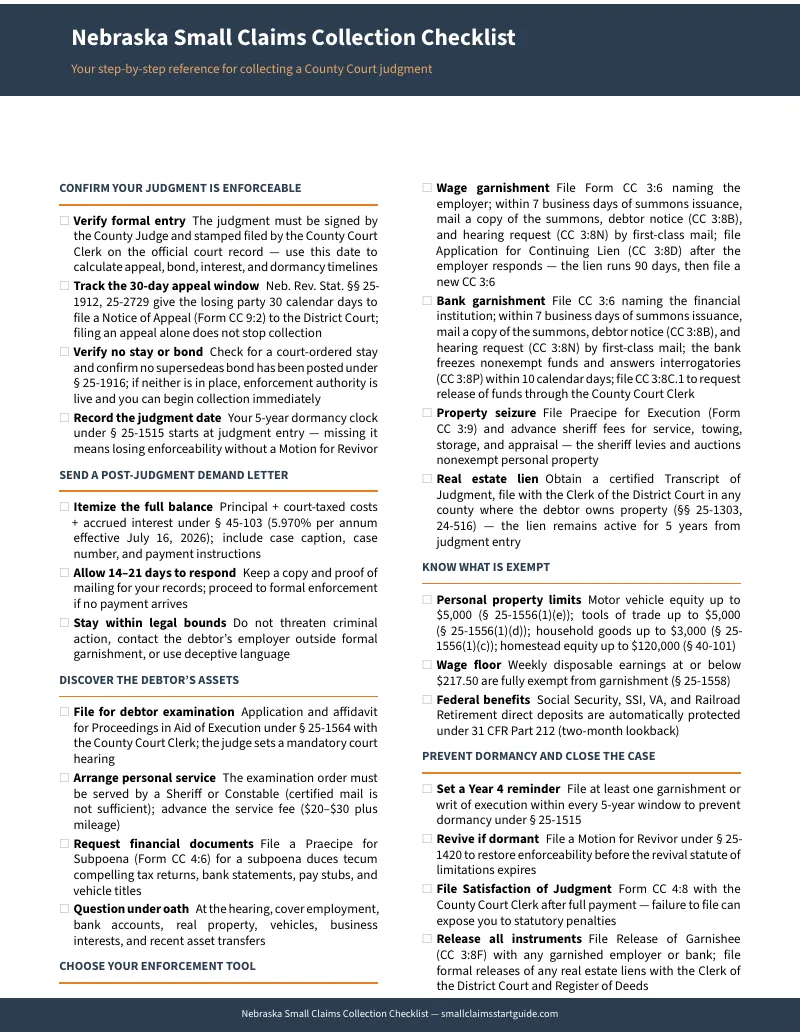
Download the free checklist to see the enforcement options at a glance. When you're ready for the full step-by-step system — every tool, every form, every deadline — get the complete guide.
Frequently Asked Questions
What if the rules change after I buy?
We update the guide when the rules change. Email us any time, even years later, and we'll send you the current edition free.