You won. Nobody is paying you.
The judge ruled in your favor. The 30 days passed. The debtor has not sent a check, answered your calls, or acknowledged the judgment exists. And the court clerk just handed you a stack of blank forms — DC-CV-060, DC-CV-065, DC-CV-032 — without explaining which one does what or where to start.
This is where most judgment winners get stuck. Not because they lack the right to collect, but because the District Court of Maryland does not collect for you. The court entered the judgment. Everything after that — finding assets, choosing the right writ, serving the paperwork, tracking payments, filing monthly reports — falls on you.
The Judgment Collection Engine
This guide replaces the guesswork with a structured enforcement system built specifically for the District Court of Maryland. It takes you from the moment the 30-day appeal window closes through every enforcement tool the court offers, in the order you use them, with the exact forms, fees, and deadlines at each step.
The difference between this and the free court materials is not information — it is organization. The Maryland Judiciary website has the blank forms. The People's Law Library explains the legal concepts. The Court Help Center answers basic questions. But none of them hand you a chronological execution sequence that connects the finality check to the asset discovery to the garnishment filing to the payment tracking to the satisfaction notice — with the calculation tools and compliance deadlines that keep your enforcement from being dismissed.
What You Get
- Finality verification checklist — confirm the 30-day appeal window has expired, verify no stay or motion for new trial is pending, and know exactly when you can start spending money on enforcement without wasting it
- Asset discovery walkthrough — how to file a Request for Order Directing Defendant to Appear for Examination (Form DC-CV-032) to compel the debtor to disclose their employer, bank accounts, and property under oath — because you cannot garnish what you cannot find
- Wage garnishment roadmap — Form DC-CV-065 field by field, from filing the request through receiving employer withholdings: the withholding formula (the lesser of 25% of disposable earnings or the amount above 30 times minimum wage), how to handle the employer's Answer, and the mandatory monthly creditor reports you must send to both the debtor and the employer within 15 days of each month-end under Maryland Rule 3-646 — because missing one report can get your entire garnishment dismissed
- Bank account garnishment roadmap — Form DC-CV-060 from filing through disbursement: how the automatic $500 deposit exemption works, what happens when the bank files a Confession of Assets (Form DC-CV-61), the 30-day exemption window, and how to file a Request for Judgment – Garnishment (Form DC-CV-062) to release the frozen funds to you
- Restricted information compliance guide — when and how to file Form MDJ-008 whenever your writ includes a bank account number, Social Security number, or other protected identifier — because omitting it is the single most common reason writs get rejected at the clerk's window
- Escalation procedures for non-responsive garnishees — what to do when a bank or employer ignores your served writ: the 30-day Answer deadline, how to move from an unanswered writ to a Motion for Judgment-Garnishment or a show-cause contempt filing
- Post-judgment interest and payment ledger — a printable tracking tool for the 10% annual statutory interest rate under CJP § 11-107, with space to credit partial payments against principal and interest and maintain the monthly accounting records that wage garnishment requires
- Real property lien instructions — how to request a Notice of Lien from the District Court and record it in the Circuit Court Land Records for the county where the debtor owns real estate, preserving your claim across the judgment's 12-year lifespan
- Judgment renewal and satisfaction protocol — how to renew before the 12-year window expires, and the mandatory 15-day deadline for filing a Notice of Satisfaction (Form DC-CV-031) once you receive full payment — because failing to file on time exposes you to court sanctions
Who This Is For
You have a money judgment from the District Court of Maryland — from a small claims case, a contract dispute, an unpaid invoice, a security deposit claim, or property damage — and the other side has not paid. You are willing to do the enforcement yourself, but you need every step laid out so you are not guessing which form to file, which office to visit, or what deadline you are about to miss.
This guide is for individual judgment holders, small-business owners collecting on unpaid invoices, and landlords pursuing former tenants. If you are defending against a claim, the Maryland Small Claims Response Guide covers that process. If you have not filed your case yet, the Maryland Small Claims Filing Guide starts at the beginning.
Why Not Just Use the Free Court Resources?
You should. The Maryland Judiciary's website, the Court Help Center, and the People's Law Library are genuine, accurate resources. This guide does not replace them — it sits beside them.
The problem is not that the information is hidden. It is that the pieces are scattered across different pages, different PDFs, and different phone calls, with no execution sequence connecting them. The court website gives you blank Form DC-CV-065. It does not tell you that you must also file Form MDJ-008 if you include the debtor's bank account number. It does not warn you that skipping one monthly creditor report can get your entire wage garnishment dismissed. It does not explain the difference between a Confession of Assets and a Request for Judgment – Garnishment, or that you need both to get frozen bank funds released.
The result without that workflow is predictable: creditors file the wrong form, serve it the wrong way, miss a compliance deadline, or wait four months without knowing that a 120-day inactivity rule is about to kill their writ. Each mistake costs a re-filing fee, weeks of delay, or a lost garnishment — and the debtor still has not paid.
Satisfaction Guarantee
Full refund, no time limit. If the guide does not help you move forward with collecting your judgment, email [email protected] and we will refund your purchase — no questions, no deadline.
Start Collecting
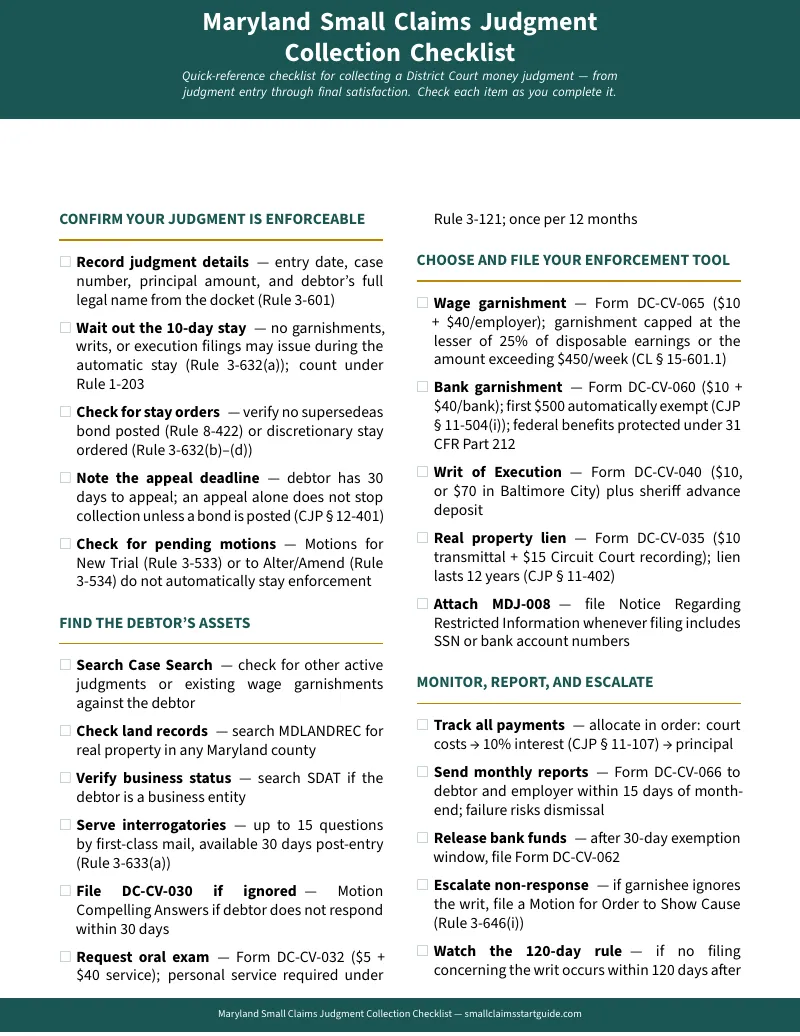
The free checklist gives you the overview — the waiting period, the enforcement options, the key forms, and the exemption thresholds on one page. It is a solid first step.
The full guide gives you the execution: 14 chapters, 49 pages, every form identified, every fee calculated, every deadline mapped, every compliance requirement spelled out — plus 6 printable worksheets and trackers you fill in as you go. It is the difference between knowing the tools exist and knowing how to use them in order.
Download includes the 49-page guide PDF, the 25-item collection checklist, the printable post-judgment interest and payment ledger, the enforcement decision worksheet, the garnishment filing checklist, the important dates tracker, the fee and form quick reference, and the monthly report worksheet — 8 PDFs total. Yours to keep permanently — .
Frequently Asked Questions
What if the rules change after I buy?
We update the guide when the rules change. Email us any time, even years later, and we'll send you the current edition free.