The form is free. Knowing what to do with it is the hard part.
You can download Form DC-CV-001 from mdcourts.gov in thirty seconds. But the form does not tell you which courthouse to file in when you live in Baltimore County and the defendant works in Baltimore City. It does not explain how to look up a business's Resident Agent on SDAT so your complaint names the right legal entity instead of a trade name that gets your case thrown out. It does not warn you that choosing the wrong service method means your hearing never happens.
The Maryland Judiciary posts instructional videos and the Court Help Center will answer basic questions, but neither one can fill out your forms, organize your evidence, or tell you whether your timeline works. The People's Law Library has solid legal explanations — in dense encyclopedia format that assumes you already know the system. And Nolo's national small claims guide costs more than this one and still cannot tell you the difference between a Rule 3-307 Notice of Intention to Defend and a counterclaim deadline.
What is missing is a single document that puts every Maryland-specific step in order — from checking the statute of limitations through collecting the judgment — with the forms, fees, and deadlines you actually need.
The Maryland Small Claims Filing Roadmap
This guide replaces the procedural guesswork with a chronological roadmap built for the District Court of Maryland. Every chapter covers one stage of the process, in the order you do it, with the exact form numbers, fee amounts, and legal rules that apply at each step.
The difference between this and the free court materials is organizational. The court gives you the pieces — blank forms, fee schedules, general overviews — and leaves you to assemble them. The guide puts every piece where it belongs, in the sequence that prevents the mistakes that cost money and time to fix.
What You Get
- Jurisdiction and venue check — how to verify your claim fits the $5,000 cap under § 4-405, which courthouse to file in based on where the defendant resides or works, and the critical distinction between Baltimore City and Baltimore County (filing in the wrong one means your service fails)
- Statute of limitations calculator — the 3-year general limit under CJP § 5-101, plus the specific windows for written contracts (3 years), oral contracts (3 years), and property damage claims — so you know whether you still have time before you spend the filing fee
- Demand letter walkthrough — when a pre-suit demand is required (security deposits under Real Property § 8-203), when it is strategically smart even if not required, what to include, and a fillable template you can adapt to your specific dispute
- Entity verification guide — step-by-step instructions for searching the Maryland SDAT database to find a business defendant's legal name and Resident Agent, so you name the right entity on your complaint and your service of process actually reaches someone authorized to accept it
- Form DC-CV-001 field-by-field walkthrough — every section of the complaint form explained in plain language: which boxes apply to your claim type, how to describe your cause of action, how to calculate the amount, and the common filling mistakes that lead to clerk rejections
- Filing and service roadmap — the $11 filing fee, the certified mail and Sheriff service options (roughly $40 per defendant), the e-filing path through MDEC (optional for pro se filers, requires notarized Form MDJ-004), and what proof of service you need to produce with Form DC-CV-002
- Evidence preparation system — an indexed binder structure for organizing contracts, receipts, photographs, and communications for your hearing, because the judge gives you roughly 15 to 30 minutes and scattered evidence costs you credibility
- Hearing preparation — what happens in the courtroom, how to present your case to the judge without formal rules of evidence, what the defendant's Notice of Intention to Defend means for your timeline (15 days in-state, 60 days out-of-state under Rule 3-307), and what to expect if they file a counterclaim
- Five claim-type walkthroughs — Maryland-specific guidance for security deposit claims (including treble damages under § 8-203), contractor disputes (MHIC Guaranty Fund vs. court filing), unpaid invoices, vehicle damage, and neighbor property disputes
- Deadline tracker and worksheets — printable tools that track your statute of limitations date, filing deadline, service completion, the 15-day NOID window, hearing date, and post-judgment motions — everything on one timeline so nothing slips
Who This Is For
You are owed money — by a contractor who took a deposit and disappeared, a landlord who kept your security deposit without cause, a customer or client who will not pay an invoice, a seller who delivered something broken, or a neighbor whose property damage has a dollar figure attached. The amount is $5,000 or less, and you do not want to hire a lawyer to recover it.
You are willing to do the work yourself. You just need every step laid out so you are not guessing which form to file, which courthouse to walk into, or how to serve someone who is avoiding you.
Why Not Just Use the Free Court Resources?
You should. The Maryland Judiciary's website, the Court Help Center (410-260-1392), and the People's Law Library are genuine, accurate resources. This guide does not replace them — it sits beside them.
What those resources do not provide is an execution sequence. The court website has the forms. The Help Center answers questions. The People's Law Library explains the law. But none of them hand you a chronological workflow that connects the demand letter to the complaint form to the service rules to the evidence binder to the hearing — with tracking tools that make sure you hit every deadline.
The result without that workflow is predictable: filers name a trade name instead of the legal entity and get their case dismissed. They choose the wrong service method and the defendant is never properly served. They show up to the hearing with a folder of unsorted receipts. Each mistake costs a re-filing fee, weeks of delay, or a lost case — and none of those costs are refundable.
Satisfaction Guarantee
Full refund, no time limit. If the guide does not help you move forward with your filing, email [email protected] and we will refund your purchase — no questions, no deadline.
Start Your Filing
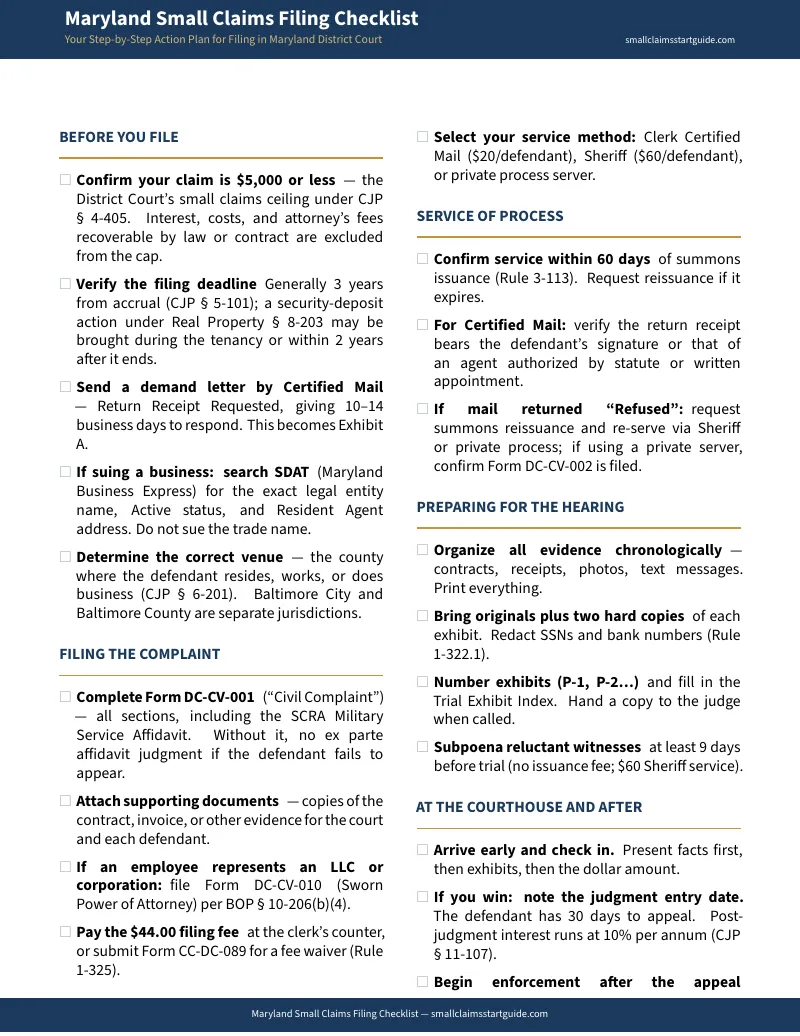
The free checklist gives you the overview — the $5,000 limit, the key forms, the fees, the deadlines, and the service options on one page. It is a solid first step.
The full guide gives you the execution: 13 chapters, 45 pages, every form identified, every fee calculated, every deadline mapped, every common claim type walked through. It is the difference between knowing the steps exist and knowing how to take them in order.
Download includes the 45-page guide PDF, the 20-item filing checklist, and six printable worksheets (deadline tracker, demand letter template, evidence binder index, service tracker, fee budget tracker, and entity verification checklist). Yours to keep permanently — .
Frequently Asked Questions
What if the rules change after I buy?
We update the guide when the rules change. Email us any time, even years later, and we'll send you the current edition free.