You won. The debtor has not paid. The court says collection is your problem.
You sat through the hearing, you presented your evidence, and the magistrate ruled in your favor. Then nothing happened. The debtor did not write a check, the clerk did not send a payment notice, and the court did not enforce its own order. You found the line printed on Form JDF 250 that most people miss: "THE COURT DOES NOT COLLECT ANY JUDGMENT."
So you searched online. You found a Reddit thread where someone says collecting a small claims judgment is "basically impossible." You found the Colorado Judicial Branch website with a list of forms — JDF 252A, JDF 252B, Form 7, Form 7A, Form 26, Form 27, Form 28, Form 29, Form 30, JDF 111 — spread across multiple pages with no clear sequence. You called the court clerk and were told they can accept filings but cannot tell you which one to file. You visited the Self-Help Center and the Sherlock explained the general options but could not pick a strategy for you. You are standing in the gap between "you won" and "you got paid," and nobody will walk you through it.
The Colorado Judgment Collection Workflow
The Collecting a Small Claims Judgment in Colorado guide is not a list of definitions or a 50-state summary with one paragraph on garnishments. It is a single-state enforcement workflow system: 14 chapters that follow the collection process from the day the judgment is entered to the day you file the Satisfaction of Judgment and close the case. Every chapter maps to an enforcement stage, every form is identified by its exact Colorado JDF or Form number, and every cross-office handoff — County Court Clerk to Sheriff to employer to bank to County Clerk and Recorder — is laid out in the order it happens.
The guide includes a named differentiator you will not find in any national book or generic legal template: the Enforcement Sequencing System. Instead of describing each collection tool in isolation, it maps the decision tree that determines which tool to use first based on what the debtor owns: wages, bank accounts, real property, or personal property. The wrong sequence wastes filing fees on tools that cannot work against your debtor's specific asset profile. The right sequence recovers money in the fewest steps and the lowest cost.
What's Inside
Appeal and Stay Verification
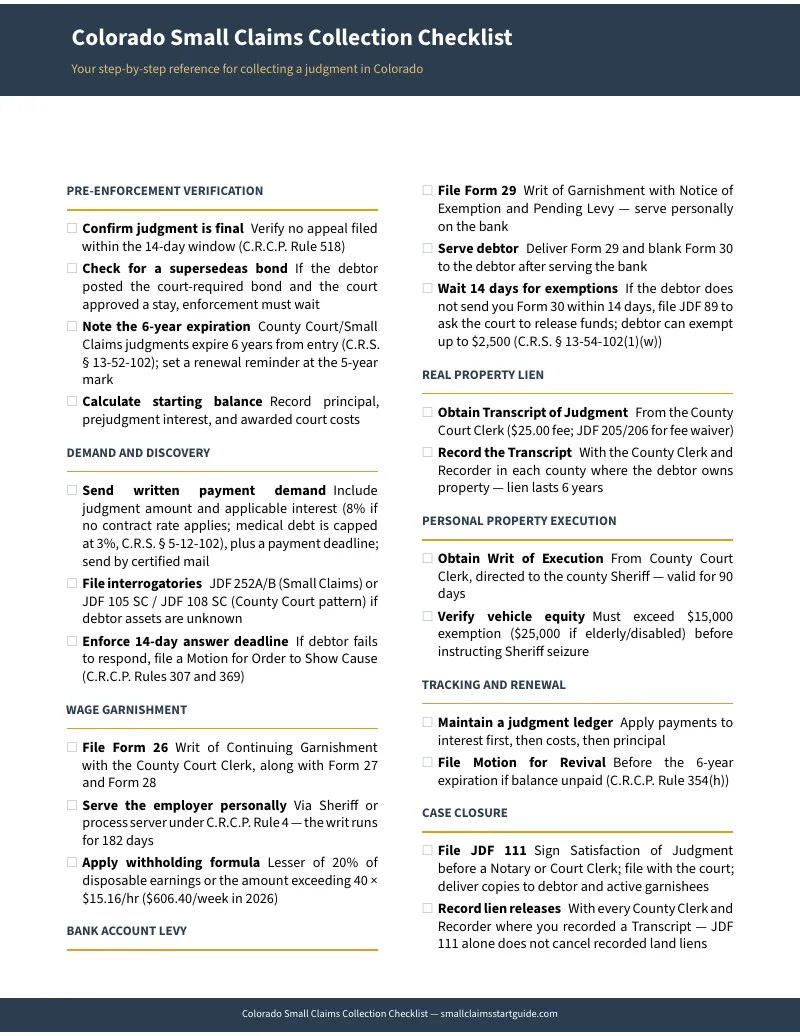
Before spending money on enforcement, you verify that no appeal or supersedeas bond blocks execution. The guide explains the 14-day appeal window under C.R.C.P. Rule 518, the bond requirement (125% of the total judgment), and why a filed appeal without a posted bond does not stop you from collecting. A worked dollar example shows the exact bond calculation so you know immediately whether the debtor has actually stayed your judgment.
Asset Discovery — Postjudgment Interrogatories
Colorado's dual-numbering system for interrogatory forms trips up even experienced filers. The guide maps all four forms — JDF 252A (Short Form), JDF 252B (Long Form), JDF 105 SC for individuals, JDF 108 SC for businesses — and explains which to use, how to file and serve them, and what the 14-day sworn-answer deadline means in practice. When the debtor ignores the interrogatories, the guide walks you through filing a Motion for Order to Show Cause, serving a Contempt Citation, and what happens at the hearing — including the narrow circumstances under which a judge may issue a civil bench warrant.
Wage Garnishment — Form 26, Form 27, Form 28
A Writ of Continuing Garnishment (Form 26) orders the debtor's employer to withhold nonexempt wages and send them to you for 182 consecutive days. The guide covers the full form suite, employer service requirements under C.R.C.P. Rule 4, and the Colorado withholding formula with 2026 dollar calculations: the lesser of 20% of disposable earnings or the amount exceeding 40 times the state minimum wage ($15.16/hour in 2026 — $606.40/week exempt baseline). Three worked examples show the calculation at different income levels. When the debtor files Form 28 to object, the guide explains the 7-day objection window and the mandatory 14-day summary hearing.
Bank Account Levy — Form 29 and Form 30
A Writ of Garnishment with Notice of Exemption and Pending Levy (Form 29) freezes the debtor's bank balance on the day the bank is served. The guide covers the service sequence — bank first, then the debtor — the mandatory $2,500 bank account exemption under C.R.S. § 13-54-102(1)(w), the 14-day window for exemption claims via Form 30, and the procedure for requesting fund release through JDF 89 when no claim is filed. It also explains what happens when the bank returns a zero-balance answer or reports prior garnishments.
Real Property Liens and Personal Property Execution
The guide covers both passive and active asset seizure. For real property: obtain a Transcript of Judgment from the County Court Clerk ($25 fee), record it with the County Clerk and Recorder, and the lien lasts six years — forcing payment when the debtor sells or refinances. For personal property: obtain a Writ of Execution, instruct the Sheriff, and verify equity exceeds the $15,000 vehicle exemption ($25,000 if elderly or disabled) before spending money on a seizure that may recover nothing.
Exemptions, Bankruptcy, and the Judgment-Proof Debtor
Colorado law protects certain assets from collection. The guide includes a complete 2026 exemption table — wages, bank accounts, homestead, vehicles, tools of trade, public benefits — so you know before you file what the debtor can legally shield. It also covers the practical impact of a debtor filing for bankruptcy protection: the automatic stay, the proof of claim process, and when a small claims judgment survives discharge.
Judgment Balance Ledger and Interest Tracking
Every court filing fee, process server charge, and interest accrual you spend on enforcement is potentially recoverable by adding it to the judgment balance. The guide includes a fill-in Judgment Balance Ledger that tracks principal, postjudgment interest at 8% per annum (3% for medical debt under C.R.S. § 5-12-102), allowable costs, and partial payments — with the payment allocation rules: interest first, then costs, then principal.
Judgment Renewal and Case Closure
County Court judgments expire six years from entry under C.R.S. § 13-52-102. If the debtor has not paid, the guide covers the Motion for Revival under C.R.C.P. Rule 354(h) and the deadline for filing it. Once fully paid, it walks through the Satisfaction of Judgment (JDF 111) — notarization, court filing, copies to the debtor and active garnishees, and recording a release of the judgment lien with every County Clerk and Recorder where you filed a Transcript. Filing the satisfaction protects you from potential liability for failing to release a paid judgment.
Printable Worksheets and Enforcement Tools
Eight standalone fill-in tools that keep the process on track: the Judgment Balance Ledger, the Enforcement Tool Selection Flowchart, a Service and Fee Tracking Log, a Garnishment Calculation Worksheet, an Interrogatory Response Tracker, an Enforcement Action Log, a Debtor Asset Discovery Worksheet, a Colorado Exemption Reference Card, and the 21-item Collection Checklist. Alongside the 14-chapter guide — printable PDFs you can fill in, write on, and carry to the courthouse.
Who This Is For
- Tenants who won a security deposit judgment. Your landlord owed you the deposit, the magistrate agreed, and the landlord still has not paid. The guide covers how to discover whether the landlord has a business bank account, place a lien on their rental property, and garnish income — all within the same county court where you won.
- Homeowners with an unpaid contractor judgment. You proved the contractor took your deposit and disappeared or delivered defective work. The guide covers how to trace the contractor's business entity to a bank account or employer and place a lien on any real property they own.
- Small landlords owed rent or damage. Your former tenant left owing money and the judgment is sitting unpaid. The guide covers wage garnishment through the tenant's employer and bank levies — the two tools that recover money from individuals without real property.
- Sole traders and freelancers with unpaid client judgments. The client owes you for completed work. The guide covers business asset discovery through pattern interrogatories (JDF 108 SC) and the enforcement tools that match business structures.
- Anyone in Colorado holding an unpaid small claims judgment. If the court awarded you money and the other side has not paid, this guide explains the procedure for making them pay — step by step, form by form.
Who This Is Not For
- People who have not yet filed a claim. If you are thinking about filing a small claims case in Colorado, the companion Colorado Small Claims Filing Guide covers the entire filing process from demand letter to hearing.
- People who were served with a claim. If you were sued and need to respond, the Colorado Small Claims Response Guide covers the response process and your options.
- People being sued for a consumer debt. If a lender, debt buyer, or collection agency is suing you, this guide does not cover defense strategies. Free legal aid services are the right first step.
- People who need legal advice. This guide explains the procedure. It does not advise on the merits of your case, predict outcomes, or provide legal representation.
Why Not Just Use the Free Court Resources?
You should — and the guide tells you exactly when and where. The Colorado Judicial Branch publishes every form for free at coloradojudicial.gov. The JDF 82 instruction sheet describes the collection tools. Courthouse Sherlocks answer procedural questions.
What those resources do not do is connect the steps. The court website describes interrogatories on one page, garnishments on another, liens on a third — each in isolation, without mapping which tool to use first, how to calculate the withholding, or what to do when the debtor objects. The state form repository uses dual numbering (Form 7 versus JDF 105 SC, Form 26 versus its official name) that confuses even repeat filers. The Sherlock can hand you the right form but cannot tell you which enforcement sequence recovers the most money with the fewest filings.
National legal publishers like Nolo compress post-judgment collection into a single chapter that covers fifty states and none of them well. Generic PDF templates on Etsy focus on demand letters and stop at judgment entry. SaaS filing services assemble your initial claim and then exit the workflow entirely — no garnishments, no liens, no case closure.
The guide sits between the free information — which you still need — and hiring an attorney. It does the organizational work: every form, every fee, every deadline, every cross-office handoff, in the order you encounter them, with worksheets you can fill in and a collection sequence that matches your debtor's specific asset profile.
Satisfaction Guarantee
Full refund, no time limit. If the guide is not what you expected, email [email protected] and we will refund you — no questions, no deadline.
Frequently Asked Questions
What if the rules change after I buy?
We update the guide when the rules change. Email us any time, even years later, and we'll send you the current edition free.