You have been served. The form says "appear for trial." You are not sure what to do first.
Someone has filed a small claims case against you in Colorado — a contractor, a former tenant, a landlord, an unhappy customer. The envelope contains Form JDF 250, "Notice, Claim and Summons to Appear for Trial," and the trial date is already set. You have searched online and found the Colorado Judicial Branch website, a dense five-page instruction sheet, and a dozen forum threads that all seem to contradict each other on whether you need to file a written response or just show up.
Here is the part that trips up most defendants: you need to do both. Colorado Small Claims Rules 507 and 515 require you to complete the response section on Part 2 (the reverse side) of Form JDF 250, pay the filing fee, and appear in court on the trial date. Skip the written response and you may limit your defenses. Skip the hearing and the court enters a default judgment — even if you filed the paperwork. One misstep at either stage and the plaintiff wins without presenting a single piece of evidence.
The Defendant's Response System
The Responding to a Small Claims Case in Colorado guide takes the entire defendant process — from understanding the summons through the hearing and post-decision options — and puts it in one printable sequence with fill-in worksheets and a deadline tracker. Every step references the relevant statute (C.R.S.), the procedural rule (C.R.C.P. 501–521), the exact form number, and the deadlines that apply across Colorado's 64 county courts.
This is not a 50-state legal reference and not a plaintiff-focused filing app. It is a procedural workflow system built exclusively for defendants in Colorado's County Court Small Claims Division — people who have been served and need to know what to do, in what order, by when.
What's Inside
Decoding Your Court Papers — Form JDF 250, Section by Section
The summons is a multi-part, seven-page document. The front page carries the case caption, the plaintiff's claim, and the trial date. The reverse side contains your response fields, the counterclaim section, and the removal election. The guide walks through every part: what each field means, where you write your defense, how to identify the filing deadline from the trial date, and what the perjury certification requires. You will know exactly what you are holding and what the court expects back.
The Dual Response Requirement — Why Filing Alone Is Not Enough
In regular Colorado civil cases, filing a written answer within 21 days prevents a default. Small claims works differently. Under C.R.C.P. 507, you must complete the written response on JDF 250 and pay the docket fee, and you must appear at the hearing. The guide makes both requirements explicit, walks you through the response form field by field, and includes a deadline tracker so neither obligation slips.
Your Four Response Options
The guide covers every path available to a Colorado small claims defendant: disputing the claim entirely, admitting part or all of it, filing a counterclaim for up to $7,500 on the same JDF 250 form, or filing a Notice of Removal (Form JDF 251) when your counterclaim exceeds the small claims cap. Each option has its own fee tier, filing deadline, and procedural requirements — the guide maps all of them.
Response Filing Fees — Every Tier Explained
Filing fees depend on the claim amount and whether you include a counterclaim. A response without a counterclaim costs $26 for claims up to $500 and $41 for claims above $500. Add a counterclaim and the fees rise to $31 and $46. If you cannot afford the fee, the guide covers the fee waiver process through Form JDF 205. No guessing, no second trip to the clerk's counter.
Counterclaims and Removal — When You Have a Claim of Your Own
If the person suing you actually owes you money or caused you harm, you can counterclaim on the same form. Claims up to $7,500 stay in small claims court. Claims above $7,500 require a Notice of Removal (JDF 251), filed at least seven days before the trial date, which transfers the entire case to County Court civil or District Court. The guide covers the fee tiers for removal ($85–$235 depending on amount and destination court), the strict 7-day deadline, and what happens when both the claim and the counterclaim move to the higher court.
Default Judgments — What Happens If You Do Nothing
If you do not respond and do not appear, the court enters a default judgment under C.R.C.P. 515 — the plaintiff gets what they asked for, plus court costs, without proving their case. The guide explains exactly how default works, what triggers it (missing either the written response or the hearing), and the procedure for filing a Motion to Vacate if you discover a default judgment has already been entered against you.
Evidence Preparation — Three Copies, Organised, Indexed
Colorado magistrates require physical evidence in triplicate: one copy for the court, one for the opposing party, and one for yourself. Hearings run twenty to forty minutes — there is no time to scroll through phone screenshots. The guide includes a Triplicate Exhibit Organiser that structures your evidence with labeled tabs, a chronological document log, and type-specific checklists for security deposit disputes, contractor work, vehicle sales, and service complaints. Everything arrives in the order you need to present it.
Mediation — The Step Before Trial
Many Colorado courts require pre-trial mediation on the day of the hearing. Denver County Court schedules it as the mandatory first step before any trial. In rural districts, mediation and trial may be combined into a single setting — meaning you must arrive fully prepared for both. The guide covers what mediation involves, how to prepare a settlement position, and what happens if you reach an agreement (it becomes an enforceable court order).
The Hearing — What to Expect in the Courtroom
The guide covers courtroom layout, speaking order, how to present your evidence set, how to address the magistrate, what to do if the plaintiff does not appear, and how the judge decides. Whether you are in Denver County Court or a rural judicial district, you walk in knowing the format.
After the Decision — Appeals, Enforcement, and Next Steps
If the judgment goes against you, you have 14 calendar days to file an appeal under C.R.C.P. 411. If you win on a counterclaim, you become the judgment creditor and need to understand enforcement. The guide covers the appeal process, appeal fees, and points you to the sibling Collecting a Small Claims Judgment in Colorado guide for post-judgment collection tools.
Printable Worksheets and Tools — 9 Standalone PDFs
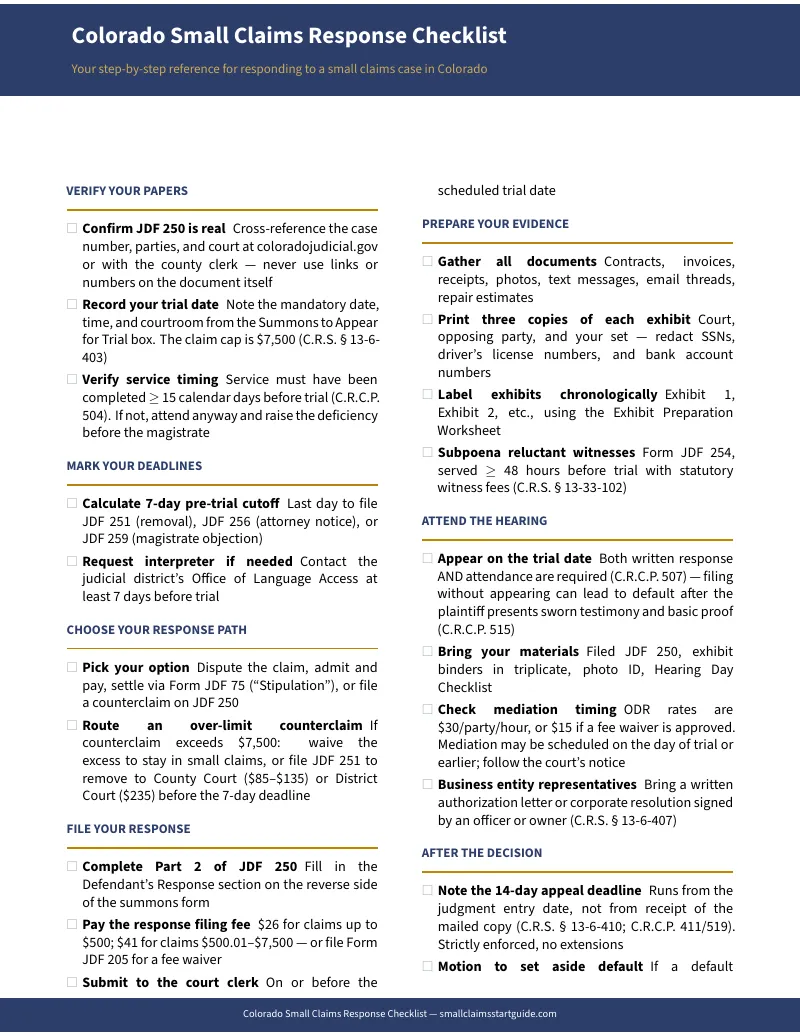
Fill-in tools that keep the process on track: the JDF 250 Response Decoder, Defendant Deadline Tracker, Triplicate Exhibit Organiser, Evidence Strategy Worksheet, Mediation Preparation Worksheet, Response Fee Calculator, Counterclaim Routing Checklist, Response Options Flowchart, and Hearing Day Checklist — alongside the 13-chapter guide and the 21-item response checklist. Print them, write on them, and know exactly where you stand.
Who This Is For
- Homeowners sued by a contractor. The contractor says you owe for work you believe was defective, incomplete, or never authorised. The guide covers how to organise contracts, change orders, photographs, and independent repair estimates into an evidence set the court can follow.
- Tenants or landlords in a security deposit dispute. Whether you are defending a claim for damages or responding to a suit over a withheld deposit, the guide covers the statutory timeline under C.R.S. § 38-12-103, the treble damages provision for bad-faith withholding under HB 25-1249, and how to present move-in and move-out documentation.
- Small business owners served with a customer complaint. The guide covers corporate representation rules (C.R.S. § 13-6-403 generally prohibits attorneys unless both sides consent in writing), how to present invoices and service records, and what to do when a business entity — not an individual — is the named defendant.
- Private vehicle sellers. A buyer claims you sold a defective car. The guide covers how to structure "as-is" defense documentation, repair records, and the bill of sale into evidence the court can evaluate.
- Anyone served with a non-debt small claims case in Colorado. If your claim involves a contractor, a landlord, a tenant, a customer, or a private sale — and you would rather spend an evening with a step-by-step guide than piece together scattered court instructions — this is for you.
This guide does not cover consumer debt collection lawsuits filed by lenders, debt buyers, or collection agencies. If you have been sued over a consumer debt, free legal aid is your best first step — the guide lists those resources.
Why Not Just Use the Free Court Resources?
You should use them — and the guide tells you exactly when and where. The Colorado Judicial Branch publishes Form JDF 250 and the JDF 248 instruction sheet for free. Self-Represented Litigant Coordinators (Sherlocks) at every county courthouse answer procedural questions. Colorado Legal Services offers free legal help to eligible low-income residents.
What those resources do not do is put the information in the order a defendant needs it. The instruction sheet (JDF 248) is written primarily from the plaintiff's perspective. The form (JDF 250) is seven pages of blank fields with no field-by-field guidance for the response side. The Sherlock can explain the rules but cannot fill in the form for you, review your evidence, or calculate your deadlines. The guide does the organisational work: every form, every fee, every deadline, in the order you encounter them as a defendant, with worksheets you can print and work through. It sits between the free information (which you still need) and paying a lawyer to walk you through what the court already provides.
What This Is Not
This guide explains the procedure. It does not give legal advice, predict outcomes, or tell you how to argue your case. It is not published by, affiliated with, or endorsed by the Colorado Judicial Branch, any county court, or any government agency. If you need legal advice, contact a lawyer. If you need free help, the guide lists the legal aid organisations and self-help resources available in Colorado.
Satisfaction Guarantee
Full refund, no time limit. If the guide is not what you expected, email [email protected] and we will refund you — no questions, no deadline.
Frequently Asked Questions
What if the rules change after I buy?
We update the guide when the rules change. Email us any time, even years later, and we'll send you the current edition free.