
You know the court exists. You do not know which form — or what happens after you file it.
Your contractor took your deposit and vanished. Your landlord kept your security deposit for "repairs" that never happened. A client owes you for three months of finished work. You have already searched "how to file small claims in Colorado" and found the state judiciary website, a confusing seven-page form packet, and a thread on r/Denver where someone suggests "just file, it only costs like $30" — which is wrong, it costs $55 for any claim above $500.
You do not need a 400-page national legal reference. You need to know whether your claim fits the $7,500 cap, how to send a demand letter that the judge actually wants to see, how to complete all four parts of Form JDF 250 without naming the wrong entity, how to serve the defendant at least fifteen days before the hearing, and how to walk into court with three organised exhibit sets instead of screenshots on your phone. One wrong name on the form, one late service attempt, and the magistrate continues your case before you open your mouth.
The Colorado Filing Workflow System
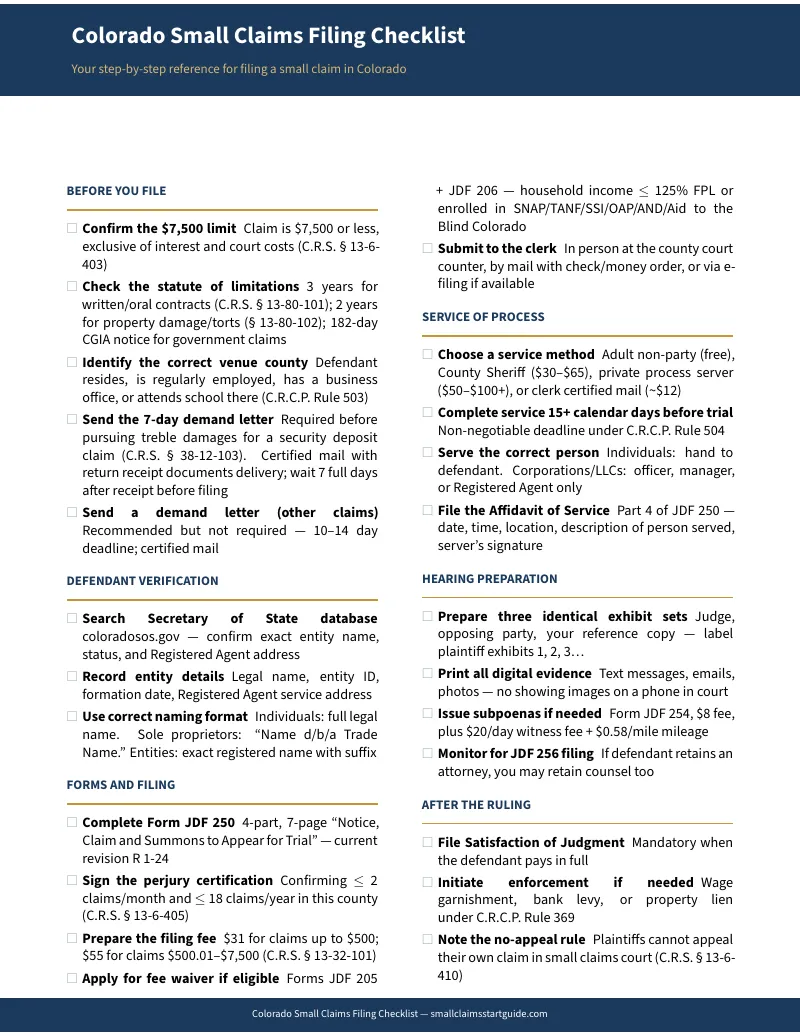
The Colorado Small Claims Filing Guide takes the entire process — from checking whether your claim qualifies through evidence preparation for the hearing — and puts it in one printable sequence with fill-in worksheets and a deadline calendar. Every step references the relevant statute (C.R.S.), the rule (C.R.C.P. 501–521), the exact form number, and the deadlines that apply in Colorado's 64 county courts.
This is not a 50-state overview and it is not a $99-to-$299 filing app that generates a PDF but cannot walk it into your local clerk's office, serve the defendant, or prepare you for mandatory mediation. It is a procedural workflow system: what to do, in what order, by when — built for Colorado's County Court small claims division, where the courts require paper filings and the clerks cannot tell you what to write on the form.
What's Inside
Checking the Limit and the Clock
Colorado caps small claims at $7,500, exclusive of interest and court costs. If your loss exceeds the cap, the guide explains when waiving the excess makes strategic sense under C.R.C.P. Rule 506 and when you are better off filing in the County Court civil division. It also walks through every statute of limitations that matters: six years for written contracts, three years for oral contracts, and two to three years for property damage. The guide shows you how to calculate your deadline — not just what the rule says, but what it means for the date you actually need to file by.
The Demand Letter — Because the Judge Will Ask
For security deposit claims, Colorado law mandates a 7-day demand letter by certified mail under C.R.S. § 38-12-103. For every other dispute, a demand letter is not legally required — but judges and magistrates routinely ask whether you tried to resolve the matter first, and showing up without one weakens your credibility before you present a single exhibit. The guide covers what the letter needs to say, how certified mail creates a delivery record the court accepts, and how long to wait before filing. The difference between "I want my deposit back" and a letter that cites the statute and sets a 7-day deadline is the difference between being ignored and prompting a settlement before you pay the filing fee.
Naming the Defendant — The Error That Kills Judgments
Filing against "Mountain View Renovations" when the registered entity is "Mountain View Renovations, LLC" can make your judgment uncollectible even if you win every argument at trial. Trade names, DBAs, dissolved LLCs, and contractors operating under personal names that do not match the Secretary of State registration — these naming errors are the single most common reason self-represented plaintiffs end up with an unenforceable piece of paper. The guide includes a Defendant Entity Verification Worksheet that walks you through the Colorado Secretary of State business database to confirm the exact registered name and agent for service before you complete Box A on Form JDF 250.
Filing the Complaint — Form JDF 250, Field by Field
Form JDF 250 is a four-part, seven-page packet. Part 1 goes to the court. Part 2 goes to the defendant and includes a Response and Counterclaim section. Part 3 is the Affidavit of Service you file after serving the papers. Part 4 is your record copy. The guide walks through every field: the county court heading and case number box, the party naming blocks, the claim narrative, the dollar amount and interest calculation at 8% per annum under C.R.S. § 5-12-102, and the perjury certification. Filing fees are $31 for claims up to $500 and $55 for claims from $500.01 to $7,500, uniform across all 64 counties. If you cannot afford the fee, the guide covers Form JDF 205 — the fee waiver affidavit under Chief Justice Directive 98-01.
Serving the Defendant — The 15-Day Rule
Service must be completed at least fifteen calendar days before the scheduled hearing date — miss the deadline and the court must reschedule. The guide covers all three Colorado service methods: certified mail (which you can send yourself), the county sheriff, and a private process server aged 18 or older. It includes a Process Service Tracker and 15-Day Calendar Audit that calculates your service deadline from the hearing date, tracks which method you used, and tells you when and how to file the Part 3 Return of Service affidavit with the clerk. When certified mail comes back "Unclaimed" or "Refused," the guide walks you through requesting re-service without losing your hearing slot.
Evidence Preparation — Three Sets, Printed, Indexed
Colorado small claims hearings run twenty to forty minutes. Judges do not wait while you scroll through phone screenshots. The guide includes a Triplicate Evidence Staging Matrix that organises your evidence into three identical physical sets — judge copy, defendant copy, your copy — with labeled exhibit tabs, chronological ordering, and a document log. For security deposit claims, it covers move-in and move-out photographs, deduction statements, and certified mail receipts. For contractor disputes, it covers contracts, change orders, independent repair estimates, and payment records. Every exhibit arrives in the order you need to present it.
The Hearing — Mediation, Then the Magistrate
Many Colorado county courts require mandatory pre-trial mediation on the day of the hearing. Denver County Court schedules it as the first step before any trial. The guide covers what mediation involves, how to prepare a negotiation position, and what happens if the other side agrees to settle during mediation (the agreement becomes an enforceable court order). If the case proceeds to trial, it covers courtroom layout, speaking order, how to present your evidence, and what happens if the defendant fails to appear.
Printable Worksheets and Deadline Calendar
Fill-in tools that keep the process on track: Defendant Entity Verification Worksheet, Demand Letter Template and Tracker, Process Service Tracker and 15-Day Calendar Audit, Triplicate Evidence Staging Matrix, Statutory Deadline Master Calendar, Filing Day Preparation Checklist, Mediation Worksheet, and Filing Cost Estimator — alongside the 13-chapter guide and the 24-item filing checklist. Ten printable PDFs in total. Print them, write on them, and know exactly where you are.
Who This Is For
- Tenants owed a security deposit. Your landlord had 30 days — or up to 60 if the lease said so — after you moved out to return your deposit or send an itemized statement of deductions under C.R.S. § 38-12-103. If the landlord failed to comply after you provided a forwarding address, you may be entitled to three times the amount wrongfully withheld. The guide covers the statutory timeline, the mandatory 7-day demand letter, and how to calculate your claim.
- Homeowners with a contractor dispute. The contractor took your advance deposit and disappeared, or the work is defective and they will not come back to fix it. The guide covers entity verification through the Secretary of State database, naming the correct defendant on Form JDF 250, and presenting repair estimates from independent licensed professionals.
- Small landlords owed rent or facing property damage. Your former tenant left owing rent or caused damage beyond normal wear and tear. The guide covers locating a former tenant for service of process, documenting damage with photographs and repair invoices, and filing within the statute of limitations.
- Sole traders and freelancers with unpaid invoices. A client owes you for completed work and has stopped responding. The guide covers naming a business entity correctly, establishing breach of contract evidence, and presenting an invoice trail — including the per-county filing frequency limits (two claims per month, eighteen per year under C.R.S. § 13-6-405) that matter when multiple clients owe you.
- Buyers refused a refund. You paid for something that never arrived, arrived defective, or did not match the description, and the seller will not refund you. The guide covers identifying a business's registered agent and how to apply venue rules under C.R.C.P. Rule 503.
- Anyone owed money in Colorado who wants to handle it without a lawyer. If your claim is $7,500 or less and you would rather spend an evening with a step-by-step guide than an afternoon at the courthouse Self-Help Center where the Sherlock can explain the rules but cannot fill in the form for you, this is for you.
Why Not Just Use the Free Court Resources?
You should use them — and the guide tells you exactly when and where. The Colorado Judicial Branch publishes Form JDF 250 and the JDF 248 instruction sheet in multiple languages for free. Self-Represented Litigant Coordinators (Sherlocks) at every county courthouse answer procedural questions under Chief Justice Directive 13-01. Colorado Legal Services offers free legal help to eligible low-income residents.
What those resources do not do is put the information in the order you need it. The instruction sheet (JDF 248) explains the rules in five dense pages. The form (JDF 250) is seven pages of blank fields with no field-by-field guidance. The Sherlock can point you to the right form but cannot draft your statement of claim, verify entity names, or organise your evidence. The guide does the organisational work: every form, every fee, every deadline, in the order you encounter them, with worksheets you can print and work through. It sits between the free information (which you still need) and a $99-to-$299 filing app that generates a PDF but cannot serve the defendant, walk you through mediation, or prepare you for the hearing.
What This Is Not
This guide explains the procedure. It does not give legal advice, predict outcomes, or tell you how to argue your case. It is not published by, affiliated with, or endorsed by the Colorado Judicial Branch, any county court, or any government agency. If you need legal advice, contact a lawyer. If you need free help, the guide lists the Legal Aid organizations and self-help resources in your area.
Satisfaction Guarantee
Full refund, no time limit. If the guide is not what you expected, email [email protected] and we will refund you — no questions, no deadline.
Frequently Asked Questions
What if the rules change after I buy?
We update the guide when the rules change. Email us any time, even years later, and we'll send you the current edition free.