You won the case. The court has not collected a penny for you.
The Sheriff Court issued your Decision Form. It says the debtor owes you money. But four weeks have passed, the debtor has not paid, and nobody from the court is chasing them — because the court does not do that. In Scotland, enforcing a Simple Procedure decision is entirely your job.
You are now expected to instruct a private Sheriff Officer, choose the right enforcement tool, pay upfront fees out of your own pocket, and navigate a system that uses terms like diligence, arrestment, and Charge for Payment — all without a solicitor, because solicitor fees for debts under £5,000 often exceed the debt itself.
The Enforcement Instruction System
This guide is the complete operational workflow for collecting a Simple Procedure judgment in Scotland. It does not give legal advice, and it does not promise recovery — no guide can guarantee that. What it does is put every enforcement step in sequence, with the correct forms, fees, deadlines, and decision points, so you can instruct a Sheriff Officer confidently instead of guessing which tool to use and hoping the debtor has assets in the right place.
Where free resources explain what diligence is, this guide tells you how to execute it — which tool to choose based on the debtor's asset profile, what each one costs up front, what you can recover from the debtor afterwards, and what to do when the debtor files a recall application or applies for time to pay.
What is inside
- The four-week waiting period audit — a deadline tracker that tells you exactly when enforcement becomes available, what events reset or freeze the clock (appeals, recall applications, Time to Pay orders), and how to verify that you are clear to proceed before paying officer fees.
- Charge for Payment walkthrough — how to instruct a Sheriff Officer to serve the formal demand, the 14-day payment window (28 days if the debtor is outside the UK or their address is unknown), and what you can do once it expires without payment. Typical officer fees for serving a Charge: £40–£85 plus VAT.
- Asset tracing framework — lawful ways to investigate the debtor's finances before spending money on enforcement, using public registers (Land Register of Scotland, Companies House, the Gazette, the Insolvency Register). This is the step most creditors skip — and the one that determines whether officer fees are an investment or a write-off.
- Bank Arrestment — freezing the debtor's bank account through a Sheriff Officer, including the £1,000 Protected Minimum Balance on personal accounts that cannot be touched, how the bank processes the frozen funds, and estimated officer fees of £70–£120 plus VAT.
- Earnings Arrestment — deducting money directly from the debtor's wages using statutory deduction tables, the employer's legal obligations once served, and what makes the arrestment invalid. Officer fees typically £70–£110 plus VAT.
- Attachment of goods — seizing the debtor's moveable property, what household items are exempt under the Debt Arrangement and Attachment (Scotland) Act 2002, and when this tool is worth the outlay versus when it is not.
- Procedural interruption navigator — exactly what to do if the debtor files a Form 13B recall application, a Time to Pay application, or enters formal insolvency (Minimal Asset Process bankruptcy). Each scenario has different consequences for your enforcement — the guide separates them so you know whether you are paused, stopped, or free to continue.
- Recovery expense ledger — track every penny of original debt, statutory interest at 8% per annum, court lodging fees (£23 for claims of £300 or less, £127 for claims over £300), and recoverable Sheriff Officer outlays. This ledger is what most creditors wish they had started on day one.
- Closing the case — recording full payment with the court, notifying the Sheriff Officer, and understanding the 20-year prescription period on enforcement in case the debtor pays in stages.
Who this is for
- An individual who won a tenancy deposit claim, a private sale dispute, or a personal loan case in Simple Procedure and the debtor is ignoring the court's decision
- A sole trader, plumber, joiner, freelancer, or small service provider chasing an unpaid court decision against a client who will not pay
- A small business director recovering a commercial invoice up to £5,000 who needs a clear workflow to hand to staff or follow themselves
- Anyone in Scotland holding a Simple Procedure Decision Form who has waited the mandatory four weeks and received nothing
If you have not filed your claim yet, see the Simple Procedure Claim Guide. If you have been served with a claim, see the Simple Procedure Response Guide.
Why not piece it together from free sources?
The Scottish Courts and Tribunals Service website publishes the rules and forms for free. Sheriff Officers have statutory fee schedules you can request. Citizens Advice Scotland writes about diligence. All of that is publicly available.
The problem is that free enforcement information in Scotland falls into three buckets, and none of them does what you need right now:
- SCTS official guidance explains the rules and provides blank forms — but offers no instruction templates for Sheriff Officers, no asset-tracing checklist, and no help deciding which enforcement tool to use first.
- Citizens Advice Scotland and debt charities cover diligence thoroughly — from the debtor's perspective. Their content explains how to defend against an arrestment, not how to execute one.
- "UK small claims" guides almost always describe the English system — County Court Judgments, High Court Enforcement Officers, Bailiffs — none of which exist in Scotland. An English enforcement guide applied to a Scottish decision produces wasted fees and wrong forms.
This guide covers Scottish enforcement only, using Scottish terminology, Scottish statutory thresholds, and the actual forms and officer instruction requirements that apply to Simple Procedure decisions.
What you get
Your purchase includes seven downloadable PDFs:
- guide.pdf — 14 chapters, 47 pages, covering every stage from the four-week waiting period through asset tracing, diligence tools, procedural interruptions, and case closure, with fee tables, decision frameworks, and worked examples.
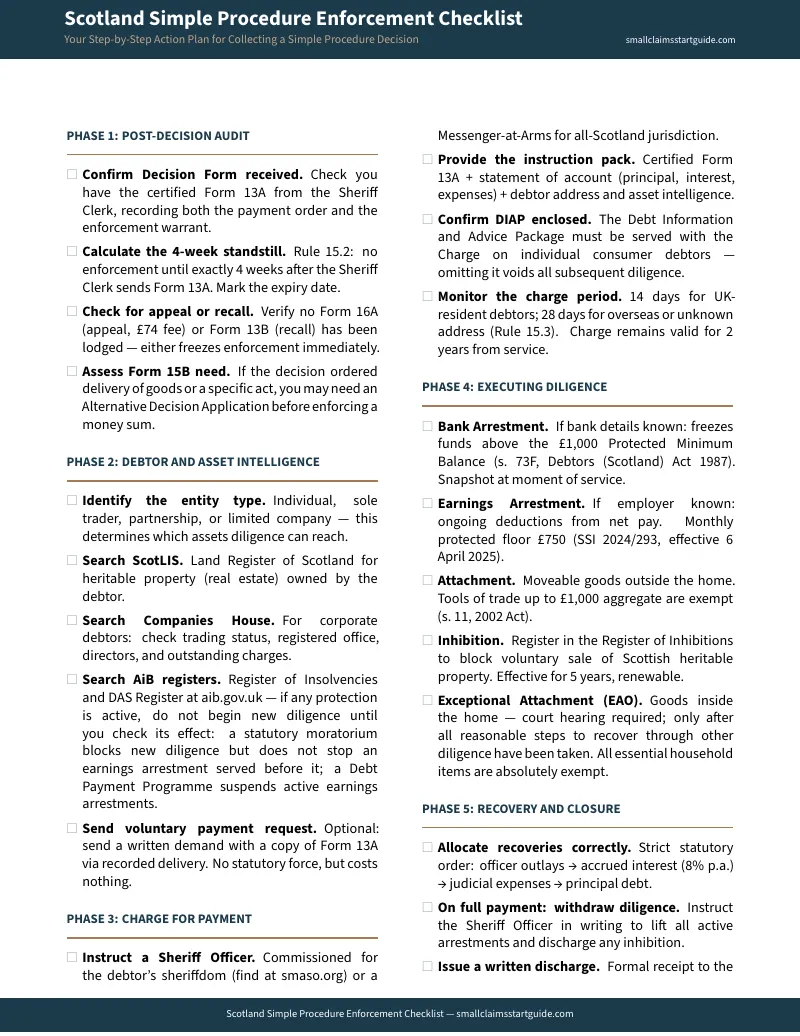
- checklist.pdf — a two-page enforcement reference sheet with every deadline, form, and decision point on a single printable document.
- charge-readiness-checklist.pdf — a 10-point audit confirming every prerequisite is met before you instruct a Sheriff Officer.
- sheriff-officer-instruction-pack.pdf — a fill-in template for preparing your instruction package: decision details, debtor information, asset intelligence, and requested actions.
- diligence-selection-matrix.pdf — a side-by-side comparison of Bank Arrestment, Earnings Arrestment, Attachment, and Inhibition, with costs, thresholds, and a write-in section for matching the right tool to your debtor.
- recovery-accounting-ledger.pdf — a printable ledger for tracking principal, interest, officer fees, and payments received, with the correct statutory allocation order built in.
- enforcement-timeline-tracker.pdf — a date log covering every milestone from the Decision Form through diligence execution, interruptions, and case closure.
All files are yours to keep permanently. No subscription, no login, no expiry.
The guarantee
Full refund, no time limit. If the guide does not help you navigate the enforcement process, email [email protected] and you will get every penny back. No forms, no waiting period, no questions.