You are owed money. The other side will not pay. Now what?
You have sent the messages, made the phone calls, maybe even put a demand letter through their door. The contractor who took your deposit and vanished, the client sitting on your invoice, the seller who will not refund a faulty appliance — they are betting you will not actually go to court.
Scotland's Sheriff Court exists so you can prove them wrong, without a solicitor and without spending hundreds on legal fees. But if you search "small claims UK," almost everything you find describes the English system — County Court, Money Claim Online, Form N1, Default Judgments — none of which exist in Scotland. File using English procedures in a Scottish court and your claim is rejected before it starts.
The Simple Procedure Filing System
This guide is a complete procedural walkthrough for Scotland's Simple Procedure — not a collection of tips, not legal advice, not an English guide with "Scotland" in the title. It is the step-by-step system that takes you from "I am owed money" to "I have a decree from the Sheriff Court," covering every form, fee, deadline, and decision point along the way.
Where free resources give you the pieces, this guide gives you the sequence. You read it once, front to back, and know exactly what to do at every stage — in the Scottish system, with Scottish forms, using the correct Scottish terminology.
What is inside
- Limit and prescription check — confirm your claim is within the £5,000 Simple Procedure ceiling (principal only — interest and expenses sit on top), verify your five-year prescriptive period under the Prescription and Limitation (Scotland) Act 1973, and check your claim uses the right court forum. The guide includes a worked example showing exactly how to calculate the prescription deadline for a specific invoice.
- Demand letter walkthrough — what your pre-action letter must contain, the 14-day minimum response window, and why Sheriffs want to see evidence that you tried to resolve the dispute before filing. Includes the correct format for recorded delivery and email demands.
- Respondent naming matrix — the exact legal name format for sole traders ("John Smith trading as JS Plumbing"), partnerships, and limited companies (with Companies House verification). Getting this wrong produces a decree you cannot enforce — and fixing it after filing costs time and money.
- Form 3A on Civil Online, section by section — parties, jurisdiction, remedy and interest calculation, the statement of claim narrative, ADR summary, and document uploads. The guide walks through each section of the form the way the portal presents it, so you can draft your responses offline before you log in.
- Court fees and fee exemptions — the full SCTS fee schedule (£23 for claims of £300 or less, £127 for claims up to £5,000, effective 1 April 2026), who qualifies for fee exemption, and how to submit the SCTS Fee Exemption Form alongside your Claim Form.
- Service, timetable, and proof — Form 3D's two critical dates (Last Date for Service and Last Date for Response), the three authorised service methods, and how to complete Form 6C (Confirmation of Formal Service) so the Sheriff Clerk accepts it. The printable Service and Timetable Tracker records every date as it arrives.
- When the respondent does not reply — applying for a decree using Form 7A, including the mandatory expenses pro-forma that the Sheriff Appeal Court's 2025 Cabot v Walls ruling now requires. Most free guides have not caught up with this change, and omitting the pro-forma gets your application rejected.
- Evidence, witnesses, and the hearing — Forms 10A and 11A deadlines (at least 14 days before the hearing), how to organise an evidence bundle, what the hearing looks like in practice, and what the Sheriff can award. Includes the Hearing Preparation Checklist.
- Expenses recovery under the new rules — the post-2025 Cabot v Walls regime: mandatory expense accounts for all Simple Procedure claims (defended and undefended), the percentage reductions under Rule 3.7 of the 2019 Taxation Rules (10% initial deduction, then 50% for claims under £1,000 or 25% for claims between £1,001 and £2,500), and a worked example showing exactly what you can expect to recover.
- Enforcement — instructing Sheriff Officers, the Charge for Payment (14 days in the UK, 28 days overseas), Earnings Arrestment, bank account Arrestment, and Attachment of moveable property. You must wait four weeks after Form 13A before starting diligence; a decree prescribes after 20 years.
Who this is for
- A homeowner whose builder or contractor took a deposit and abandoned the job
- A sole trader, freelancer, or small business owner chasing an unpaid invoice
- A tenant owed a deposit that the landlord will not return (where the deposit is not in a statutory protection scheme — those disputes go to the Housing and Property Chamber)
- A consumer refused a refund for a faulty product, a used car with undisclosed defects, or a cancelled service
- Anyone in Scotland owed money by another person, business, or organisation — up to £5,000
If you have been served with a Simple Procedure claim (you are the respondent), this guide is not for you — see the Simple Procedure Response Guide instead.
Why not piece it together from free sources?
You absolutely can. Every SCTS court form is free. Citizens Advice Scotland publishes step-by-step articles. Court staff answer administrative questions. None of that is paywalled.
The problem is not access — it is assembly. SCTS guidance explains what the rules require but does not walk you through structuring a claim narrative, organising evidence for the hearing, or filling in the expenses pro-forma that Cabot v Walls now demands. Citizens Advice Bureau advisers face heavy demand and appointment waiting times can miss your court deadlines. Court staff can help with portal issues but cannot advise on your claim wording, extend a deadline, or review your evidence.
And the biggest trap is not even Scottish. Most "small claims UK" content describes English procedures — County Court, Money Claim Online, Form N1. Use those in Scotland and your filing is rejected. This guide covers the Scottish system only, with the correct forms, terminology, and court rules.
What you get
Your purchase includes nine downloadable PDFs:
- guide.pdf — 13 chapters, 47 pages, covering every stage from checking the limit through enforcement, with worked examples, fee tables, and section-by-section Form 3A instructions.
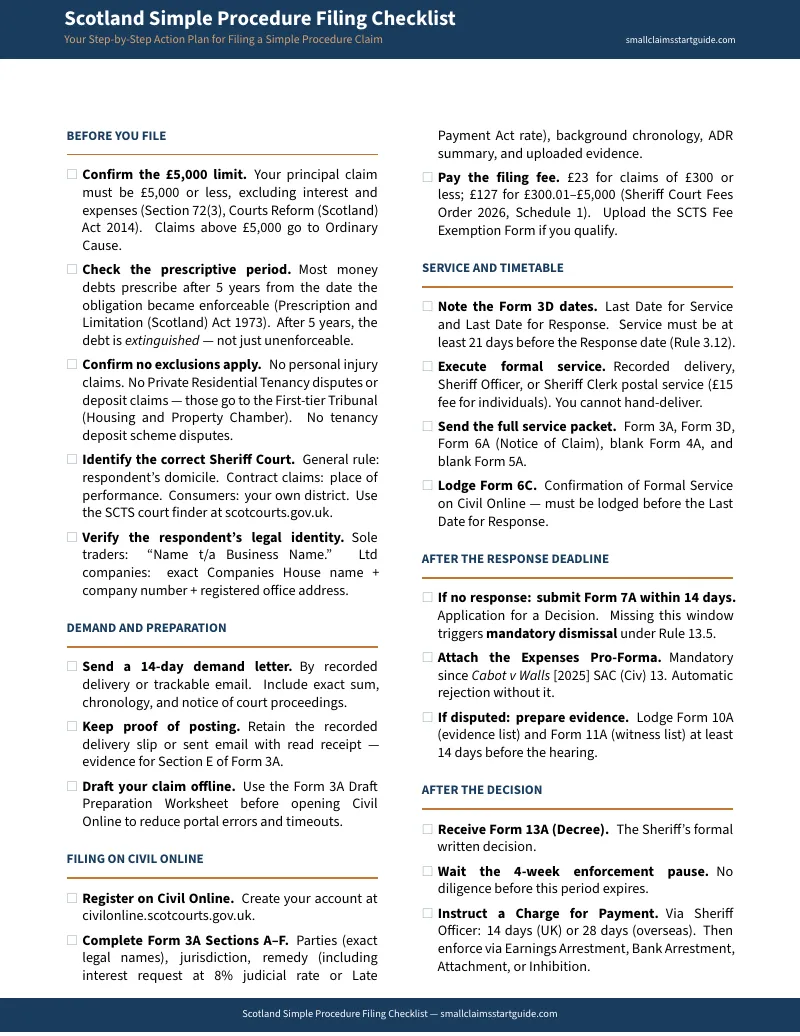
- checklist.pdf — a two-page reference sheet with the key steps, forms, fees, deadlines, and service methods.
- pre-filing-venue-and-eligibility-checklist.pdf — confirm the £5,000 limit, the five-year prescription clock, the right forum, and the right Sheriff Court before you open Civil Online.
- demand-letter-template.pdf — draft the 14-day pre-action letter and log recorded-delivery proof.
- form-3a-draft-preparation-worksheet.pdf — fill Civil Online Sections A–F on paper before you log in.
- service-and-timetable-tracker.pdf — convert Form 3D into service, response, Form 7A, evidence, and enforcement dates.
- evidence-and-witness-organiser.pdf — build Form 10A and Form 11A at least 14 days before the hearing.
- expenses-claim-calculator.pdf — work the SCTS Expenses Claim Form Pro-Forma and Rule 3.7 deductions before lodging Form 7A.
- hearing-preparation-checklist.pdf — the 14-day countdown and hearing-morning pack list.
All files are yours to keep permanently. No subscription, no login, no expiry.
The guarantee
Full refund, no time limit. If the guide does not help you navigate the process, email [email protected] and you will get every penny back. No forms, no waiting period, no questions.
Get the Simple Procedure Claim Guide →
Or download the free filing checklist first — it covers the key milestones, the current SCTS fee schedule, and links to every official form you will need.