
You know the money is yours. You just don't know how to make the court give it back.
The contractor took your deposit and disappeared. The invoice has gone unpaid for months. The buyer stopped responding the day you asked for your refund. You've done the reasonable thing — asked, reminded, waited — and now you're staring at the Courts of PEI website trying to make sense of blank Form 7A, a court rule booklet written for lawyers, and a fee schedule you had to dig out of a government regulation.
Prince Edward Island's Small Claims Section handles claims up to $16,000 — and the filing fee is $50. But between the form, the service rules, the deadlines, and the hearing itself, the process has enough procedural steps that a single mistake can stall your claim or waste a trip to the Charlottetown or Summerside registry.
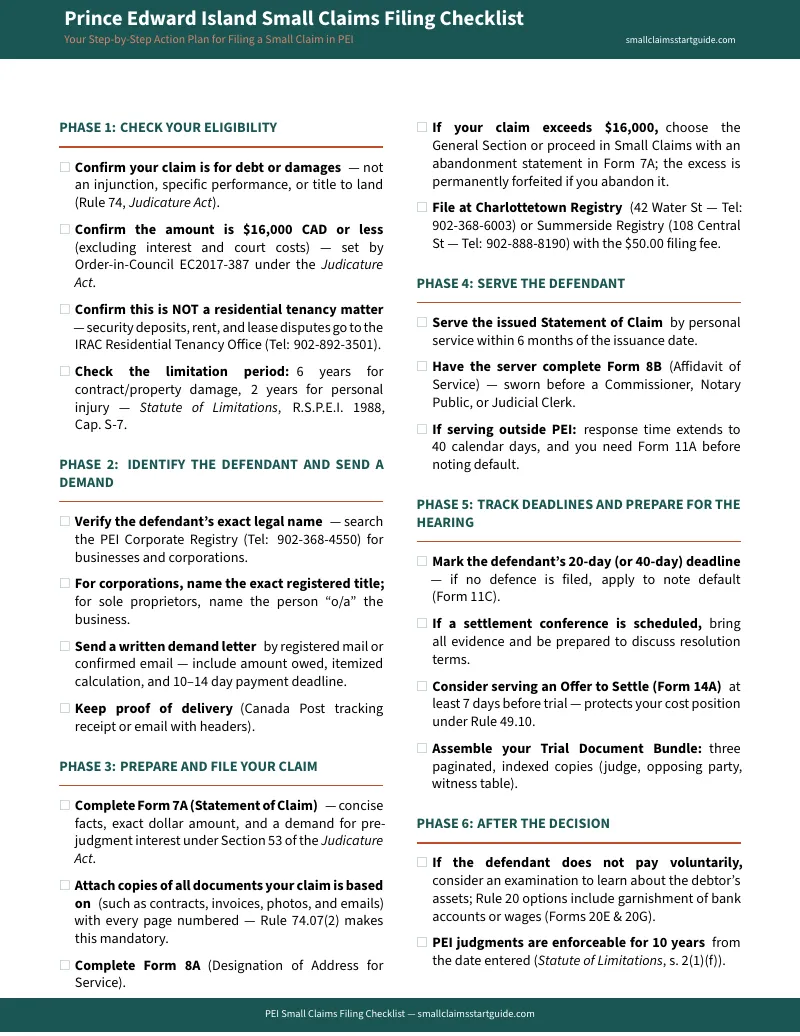
The PEI Filing Sequence — every step from demand letter to collecting your money
This is not a summary of Rule 74 or a high-level overview of how courts work. Making a Small Claim in Prince Edward Island is a complete procedural workbook that follows the Small Claims Section process from the moment you decide to act through to enforcing a judgment. Every step is in the order you'll actually do it, with the form numbers, the dollar amounts, the deadlines, and the practical details that the courts.pe.ca website and Community Legal Information cover separately and never in sequence.
What's Inside
- Forum eligibility screening — confirms your dispute belongs in the Small Claims Section before you pay anything, and catches the most common misfiling: residential tenancy deposits, which go to IRAC's Rental Office, not the court
- Limitation period check — PEI uses a 6-year limitation period for most contract and debt claims under the Statute of Limitations, but discovery rules and shorter periods for specific claim types can catch you out. The guide maps every limitation period to a claim type so you know whether your deadline has passed
- Demand letter framework — the structured pre-filing demand that signals you're serious about court action, with the elements that make the difference between a letter the other side ignores and one that produces a cheque. Many disputes settle at this stage
- Form 7A completion walkthrough — the blank Statement of Claim on courts.pe.ca does not explain how to name a sole proprietor versus an incorporated company, how to frame your cause of action, or how to calculate pre-judgment interest at the statutory rate. The guide walks through every field
- Service of process tracker — you must legally serve the defendant under Rule 74 and complete Form 8B (Affidavit of Service). Serve incorrectly and your claim goes nowhere. The tracker logs every attempt, tracks the 20-day defence deadline, and prepares you for the affidavit
- Settlement conference and hearing preparation — when the defendant files Form 9A (Statement of Defence), the court schedules a settlement conference or trial. The guide provides a structured framework for organizing your evidence, preparing witness testimony using Form 18A (Summons to Witness), and presenting your case to the judge
- Post-judgment enforcement roadmap — winning a judgment does not mean the money arrives. The guide covers what to do when the other side refuses to pay, including garnishment procedures and sheriff execution under PEI court rules
Who This Is For
- Homeowners in PEI who paid a contractor deposit — for renovations, a heat pump, roofing, landscaping — and got nothing in return
- Sole traders, freelancers, and small business owners chasing an unpaid invoice up to $16,000
- Buyers who paid for goods or services that were never delivered or arrived defective
- Property owners with a damage claim against a neighbour or a commercial operator
- Anyone in Prince Edward Island owed money and ready to stop waiting for it to show up on its own
Not for residential tenancy disputes. If your claim involves a security deposit, rent arrears, or a residential lease, the IRAC Residential Tenancy Office (902-892-3501) has exclusive jurisdiction — the Small Claims Section cannot hear it.
Why Not Just Use the Court Website?
The Courts of PEI website and Community Legal Information are the official sources — and the forms are free to download. But the information is scattered. courts.pe.ca gives you the blank forms and the text of Rule 74. CLI's guide explains the process at a high level. Neither one walks you through filing in sequence, field by field, with the practical details that matter when you're standing at the registry counter in Charlottetown or Summerside.
The court portal gives you Form 7A. It does not explain how to identify the correct legal name of a business defendant, how to calculate the interest you're entitled to claim, or what to do when the other side ignores your claim entirely. Registry staff can answer general procedural questions, but they cannot help you draft your claim, calculate your damages, or prepare your evidence. The CLI Lawyer Referral Service offers a 45-minute consultation for $25 — but the lawyer will not fill out your forms or review your evidence file.
This guide fills the gap between the blank forms and a prepared claimant.
What This Guide Does Not Do
This is a procedural guide, not legal advice. It will not tell you whether your claim will succeed, how the judge will weigh your evidence, or whether the amount you're claiming is reasonable. It explains how the Small Claims Section process works so you can navigate it yourself. Small Claims Start Guide is an independent publisher — not a court, not a legal aid provider, and not a law firm.
A Filing Error Costs More Than the Guide
Court filing fees at the Supreme Court of PEI are non-refundable. Name the wrong legal entity on Form 7A and your claim gets rejected at the registry — you pay again to refile. Miss the service window and your filed claim goes nowhere. File a residential tenancy deposit in Small Claims instead of with IRAC and you've wasted weeks and your filing fee.
For less than the cost of a single court filing fee, you get the complete procedural sequence — demand letter through enforcement — with every deadline, form number, and practical step in one place.
Get the Full PEI Filing Guide →
The full guide includes 9 printable worksheets and trackers: a demand letter worksheet, a filing preparation checklist, a statutory deadline calendar, a service of process tracker, an evidence binder index, a witness preparation sheet, a hearing preparation checklist, an offer to settle tracker, and a post-judgment enforcement tracker. Print them, fill them in as you go, and bring them to the hearing.
The free checklist confirms the basics — the $16,000 limit, the form numbers, the filing fees, and the key deadlines. If you want the complete step-by-step system for every stage of the process, the full guide picks up where the checklist stops.
Frequently Asked Questions
What if the rules change after I buy?
We update the guide when the rules change. Email us any time, even years later, and we'll send you the current edition free.