You know you're owed the money. You just don't know how to get it back.
The contractor took your deposit and disappeared. The client won't pay the invoice. The buyer backed out of the deal and stopped answering your messages. You've been patient, you've tried talking it out, and nothing has worked. Now you're on the Government of New Brunswick website trying to figure out how to actually take someone to the Small Claims Court — and what you're finding is a collection of blank PDF forms, a fee schedule with no context, and rules written for people who already know the system.
You shouldn't need a law degree to recover money someone owes you.
The New Brunswick Filing Sequence — every step mapped from demand letter to judgment
This isn't a collection of tips or a generic legal overview. Making a Small Claim in New Brunswick is a complete procedural roadmap that follows the Small Claims Court process from the moment you decide to act through to collecting your money after a decision. Every step is in the order you'll actually do it, with the form numbers, the deadlines, and the practical details that the court's own website scatters across government portals, court information pages, and separate regulation documents.
What's Inside
- Demand letter framework — a structured approach to the pre-filing demand, with the legal references that signal you're serious. Many disputes settle at this stage, before you ever visit a court registry
- Form 1 field-by-field walkthrough — because the blank Claim form doesn't explain how to name a sole proprietor versus an incorporated company, or how to describe your claim so the Adjudicator actually understands it
- Party-naming guidance — the specific rules for suing individuals, businesses operating under trade names, and corporations registered with Service New Brunswick, so your claim doesn't get rejected for a naming error
- Service and deadline tracker — you must serve the defendant within the time allowed, and they get 30 days to respond. Miss the window and your claim stalls. The tracker maps every deadline from the day you file
- Evidence preparation system — a structured approach to organizing contracts, receipts, photographs, and correspondence into the evidence package the Adjudicator expects, plus guidance on presenting your case clearly at the hearing
- Post-judgment enforcement roadmap — because winning a judgment doesn't mean the money appears. The guide covers registering your judgment with the Court of King's Bench, garnishment, and what to do when the other side refuses to pay
- Forum selection screening — a quick check that confirms your dispute belongs in Small Claims Court (not the Residential Tenancies Tribunal, not another division) before you pay filing fees
Who This Is For
- Sole traders and freelancers chasing unpaid invoices up to $20,000
- Homeowners who paid a contractor deposit and got nothing in return
- Small landlords owed money outside the Residential Tenancies Tribunal's jurisdiction
- Buyers who paid for goods or services that were never delivered or were defective
- Vehicle buyers dealing with undisclosed defects and a seller who won't make it right
- Anyone in New Brunswick owed money and ready to stop waiting for it to arrive on its own
Why Not Just Use the Court Website?
The Government of New Brunswick and the Courts NB website are the official sources — and the forms are free. But the information is scattered across gnb.ca, courtsnb-coursnb.ca, legalinfonb.ca, and separate regulation documents. Each one covers its piece in isolation. None of them walk you through the process from start to finish in the order you'll actually experience it.
The court portal gives you a blank Form 1 (Claim). It doesn't explain how to calculate pre-judgment interest under subsection 5(2) of the Small Claims Act, or the difference between suing "Jane Smith" and suing "Jane Smith c.o.b. Smith Contracting" — a mistake that can make your entire judgment unenforceable. The fee schedule tells you it costs $50 or $150 to file. It doesn't tell you what happens if the defendant ignores the claim entirely, or whether your dispute gets a straight default judgment or an assessment hearing.
This guide takes every official source, organizes the steps into one linear sequence, and fills in the practical gaps the court's documents assume you already know.
What This Guide Does Not Do
This is a procedural guide, not legal advice. It will not tell you whether your claim will succeed, how a Adjudicator will weigh your evidence, or whether the amount you're claiming is reasonable. It explains how the court process works so you can navigate it yourself — the same way a map shows you the roads without telling you where to drive.
If you need advice on the merits of your case, contact PLEIS-NB (Public Legal Education and Information Service of New Brunswick) or speak with a lawyer. New Brunswick is officially bilingual — the guide is published in English, but court proceedings and forms are available in both English and French.
A Filing Error Can Cost More Than the Guide
Court filing fees in New Brunswick are non-refundable. Name the wrong legal entity and your claim gets rejected at the registry — you pay again to refile. Miss the service deadline and your filed claim goes nowhere. File a residential tenancy dispute in Small Claims Court instead of the Residential Tenancies Tribunal and you've wasted weeks and every dollar you paid in fees.
The guide is built to catch these errors before they happen. For less than the cost of a single filing fee, you get the complete procedural sequence — demand letter through enforcement — with every deadline, form number, and practical step in one place.
Get the Full New Brunswick Filing Guide →
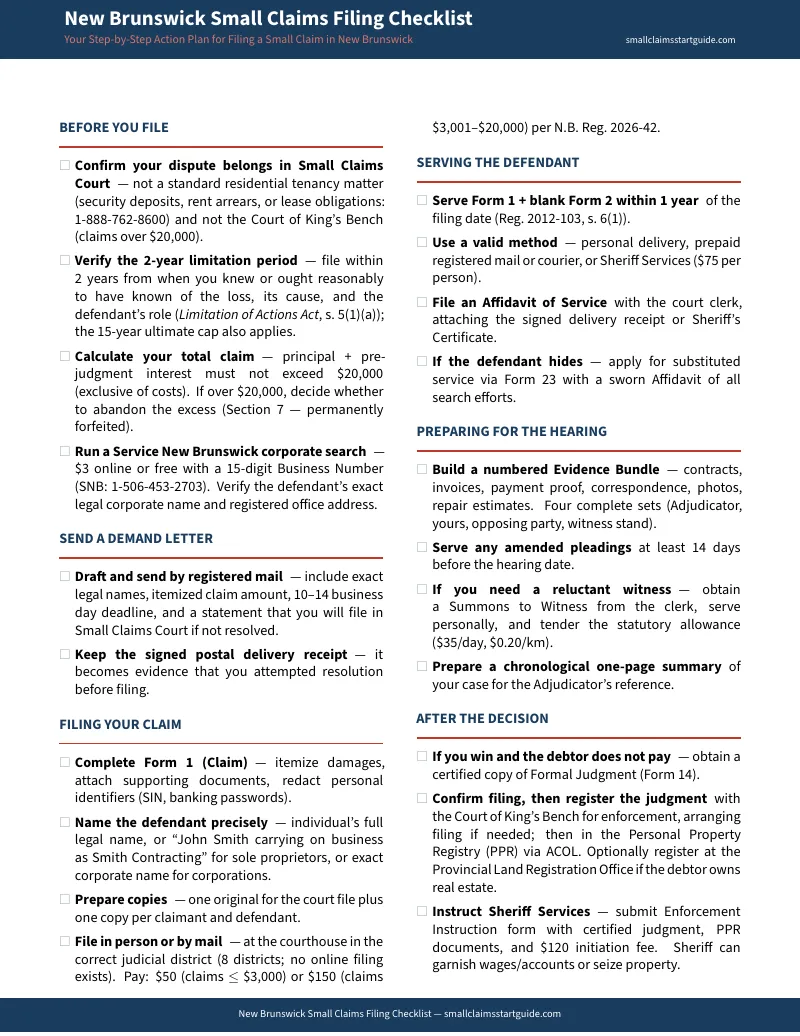
The full guide comes with nine printable worksheets and trackers: a demand letter worksheet, a filing fee calculator, a deadline calendar, a service of process tracker, an evidence bundle index, a hearing preparation checklist, a post-judgment enforcement tracker, a forum selection screening sheet, and a judicial district directory for all eight court registries. Print them, fill them in as you go, and bring them to the hearing.
The free checklist confirms the basics — the $20,000 limit, the form numbers, the key deadlines. If you want the complete step-by-step system for every stage of the process, the full guide picks up where the checklist stops.
Frequently Asked Questions
What if the rules change after I buy?
We update the guide when the rules change. Email us any time, even years later, and we'll send you the current edition free.