
You have been served. The 20-day clock is already running.
The envelope came by certified mail or through a county sheriff. Inside are court papers you have never seen before — a Civil Complaint, a Summons, and an information sheet full of legal references. You know you need to respond. You just do not know how, or where to start.
The court's website has a page with 66 forms listed 10 at a time. The clerk can accept your paperwork but cannot tell you what to write in it. The online guides you have found are either written for plaintiffs, apply to another state, or still cite the old $10,000 Magistrate Court limit that doubled to $20,000 in July 2025.
Meanwhile, every day that passes brings you one day closer to a default judgment — where the plaintiff wins everything they asked for, without the court ever hearing your side.
The Magistrate Court Response System
This is not a legal textbook. It is not a collection of generic templates pulled from a national database. The Magistrate Court Response System is a step-by-step procedural guide built specifically for West Virginia's 55-county Magistrate Court system — the only courts in the state that hear small claims. It walks you from the moment you open the envelope to what happens after the magistrate rules, covering every deadline, every form, every procedural step, and the mistakes that lead to default judgments.
The guide is written entirely for defendants — the person who has been served, not the person who filed the case. Every chapter, every worksheet, and every checklist is organized around the question you are asking right now: "I was just served — what do I do?"
What is inside
- guide.pdf — the 49-page step-by-step guide — 13 chapters covering every stage from understanding the papers in your envelope through to appeals, written in plain language with the West Virginia statutes and Magistrate Court Rules cited where they matter.
- service-packet-decoder.pdf — identify every document in your envelope (SCA-M207 or SCA-M208 complaint, Summons, Defendant Information Sheet SCA-MI-401NP) and find the date that starts your 20-day clock.
- response-deadline-calculator.pdf — walk through the exact computation: service date, add 20 calendar days under Magistrate Court Rule 4(b), adjust for weekends and court holidays, and mark your personal filing deadline. No guessing whether "20 days" means business days or calendar days.
- Form SCA-M225 walkthrough (Chapter 4) — a section-by-section guide to the official Answer form: completing the caption, selecting admit/deny/lack of knowledge for each allegation, asserting affirmative defenses, and filing a counterclaim if the plaintiff owes you money.
- answer-filing-checklist.pdf — the step most self-represented defendants miss. Filing your Answer with the clerk is only half the job. Rule 5 of the Rules of Civil Procedure for Magistrate Courts (RCPMC) requires you to separately serve the plaintiff with a copy and complete the Certificate of Service. The checklist ensures you do both.
- Counterclaim instructions (Chapter 5) — when to file a counterclaim, how to write it within Form SCA-M225, what happens when your counterclaim exceeds the $20,000 ceiling, and when removal to Circuit Court makes sense.
- settlement-terms-worksheet.pdf — how to settle the case before trial, why verbal agreements are dangerous, and the exact steps to get a written dismissal filed with the court so the case is properly dismissed.
- evidence-assembly-checklist.pdf — a printable organizer for contracts, invoices, photographs, text message printouts, and witness information. Magistrates require three physical copies of every exhibit (one for the court, one for the other side, one for you). The checklist tracks all three sets.
- hearing-preparation-worksheet.pdf — courtroom logistics, speaking order, exhibits to introduce, questions for the plaintiff, and the procedure for requesting a jury trial, a continuance, or ADA accommodations.
- agency-communication-log.pdf — a tracking sheet for every call and letter to the court clerk, the other party, Legal Aid, and Tuesday Legal Connect. One place for dates, names, and what was said.
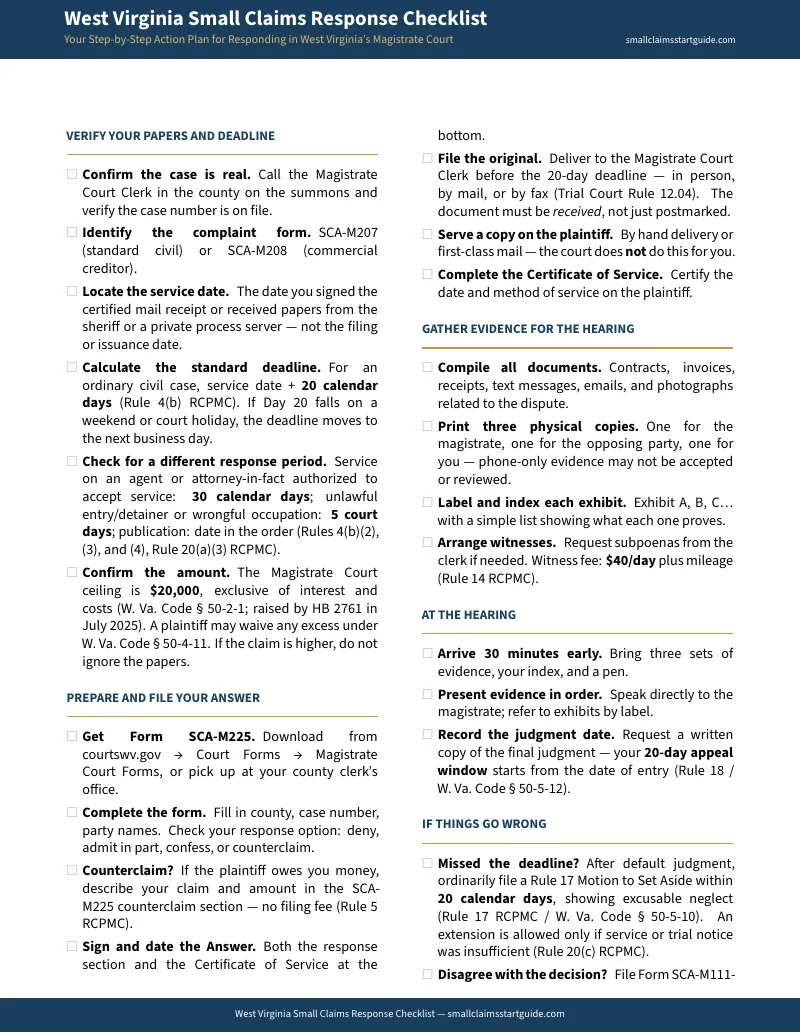
- checklist.pdf — the response checklist — a printable two-page, 25-item checklist covering deadlines, forms, filing, service, evidence, and the hearing. This is the free download; the full guide is the instruction manual behind every item on it.
Who this is for
- Homeowners served by a contractor claiming an unpaid balance — especially when the work was defective or incomplete
- Former tenants sued by a landlord over security deposits or alleged property damage
- Small landlords sued by former tenants over deposit withholding or maintenance disputes
- Small business owners, sole traders, and LLCs served by a customer or vendor
- Private vehicle sellers or buyers in a dispute over an undisclosed defect or an as-is sale
- Anyone served with a Magistrate Court Civil Complaint who needs to respond within 20 days
You do not need a lawyer. West Virginia Magistrate Court is designed for self-represented litigants. What you need is a system that tells you exactly what to file, how to file it, how to serve the other side, and what to bring to the hearing.
Why not just use the free court forms?
You absolutely should use the free court forms — they are available at courtswv.gov and they are the official documents you will file. The problem is that those forms arrive blank, with no instructions.
Form SCA-M225 gives you checkboxes for "admit" and "deny" — but it does not explain what those words mean in court, when "lack of knowledge" is the right choice, or what happens if you check the wrong box. The court's form catalog lists 66 forms on a searchable page with no guidance on which ones apply to you.
The free checklist tells you what to do. The full guide shows you how — with a deadline calculator, a field-by-field form walkthrough, a service checklist, and an evidence organizer. It is the difference between a to-do list and a manual.
What this guide does not do
This is a procedural guide, not legal advice. It does not tell you whether you will win, assess the strength of your defense, or represent you in court. It is not published by, affiliated with, or endorsed by the West Virginia Judiciary or any government agency. Courts publish their forms for free — this guide is an optional organizational tool that explains the process those forms are part of.
If you need legal representation, the guide includes contact information for the West Virginia State Bar Lawyer Referral Service, Legal Aid of West Virginia, and Tuesday Legal Connect.
Full refund, no time limit
If the guide is not what you expected, email [email protected] for a full refund. No time limit, no questions, no hassle.
You know someone filed a case against you. The guide shows you exactly what to do about it.
Get the Magistrate Court Response System →
Frequently Asked Questions
What if the rules change after I buy?
We update the guide when the rules change. Email us any time, even years later, and we'll send you the current edition free.