
You know you are owed money. You just do not know how to get it back.
The contractor took your deposit and disappeared. The landlord kept your security deposit and stopped returning calls. The customer who promised to pay next week said that six weeks ago. You have tried asking nicely. You have tried firmly. Now you are looking at West Virginia Magistrate Court — and the court's website gave you a stack of blank PDFs with zero instructions.
That is exactly where most people get stuck.
The Magistrate Court Filing System
This is not a legal textbook and it is not a collection of generic templates. The Magistrate Court Filing System is a step-by-step procedural guide built specifically for West Virginia's Magistrate Courts — the only courts in the state that hear small claims. It walks you from "I think I have a case" to "I am sitting in the hearing with my evidence organized," covering every form, fee, deadline, and procedural trap along the way.
West Virginia doubled its Magistrate Court limit to $20,000 in July 2025 (House Bill 2761). That means more claims qualify — but it also means more people are navigating the process for the first time, with outdated information everywhere. Half the legal directories on the internet still quote the old $10,000 cap.
What is inside
- The 47-page step-by-step guide — 14 chapters covering every stage from checking whether your claim fits the $20,000 limit through to collecting a judgment, written in plain language with West Virginia statutes cited where they matter.
- Line-by-line form instructions — which form to use (SCA-M207 for most claims, SCA-M208 for commercial creditor and contract actions), what to write in every field, and how to avoid the naming errors that lead to unenforceable judgments.
- Defendant Address and Registered Agent Verification Worksheet — write in the exact legal name, Organization/Control Number, registered agent, and physical service address from the WV Secretary of State Business Organization Search. Suing "Joe's Auto Repair" when the legal entity is "Mountain State Automotive LLC" means your judgment is worthless.
- Tiered Filing and Service Fee Calculator — filing fees run from $50 to $70 depending on your claim amount, plus $25–$30 per defendant for Sheriff service. Circle your tier, write in service costs, and complete the fee-waiver worksheet if you qualify under 150% of the federal poverty guidelines.
- Service Tracking and Deadline Calendar — certified mail, Sheriff personal service, or private process server: log every attempt, then write in the 20-day answer window, 6-month service deadline, default-motion date, and 20-day appeal window. West Virginia prohibits Sheriff service to PO Boxes — the worksheet requires a physical street address.
- Hearing Evidence Folder Organizer — Magistrate Courts require three hard-copy sets of every exhibit (one for the Magistrate, one for the defendant, one for you). Check off contracts, photos, text messages, receipts, and the SOS printout for each of the three sets, then number exhibits 1–10.
- Demand Letter Template — fill-in letter plus a certified-mail return-receipt log (tracking number, green card, payment deadline).
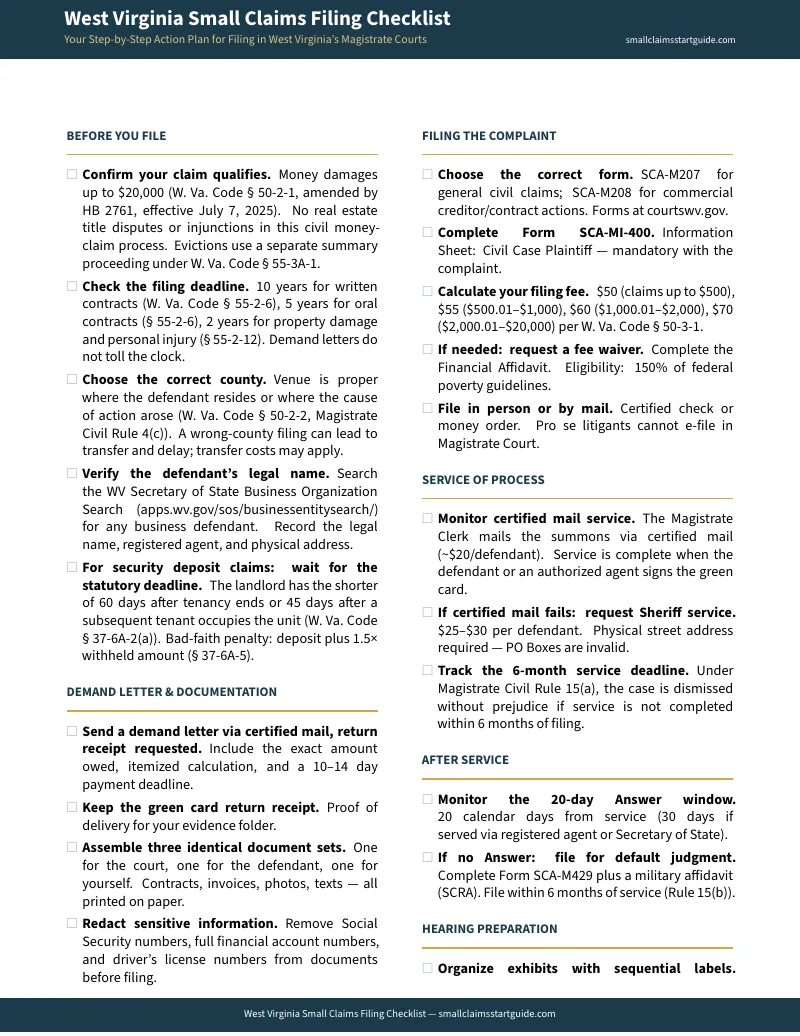
- The filing checklist — a printable two-page, 25-item checklist covering the limit, forms, fees, service steps, and deadlines. This is the free download; the full guide is the instruction manual behind every item on it.
Who this is for
- Homeowners whose contractor took a deposit and never finished the work
- Tenants owed a security deposit that the landlord will not return
- Small landlords with a tenant who left property damage behind
- Sole traders and freelancers with unpaid invoices
- Buyers who paid for something that was never delivered or was not what was promised
- Anyone owed money by a neighbour, business, or individual — up to $20,000
You do not need a lawyer. West Virginia Magistrate Court is designed for people to represent themselves. What you need is a system that tells you exactly what to file, where to file it, how to serve the other side, and what to bring to the hearing.
Why not just use the free court forms?
You absolutely should use the free court forms — they come from courtswv.gov and they are the official documents you will file. The problem is that those forms arrive blank, with no instructions on how to fill them in.
Form SCA-MI-400, the court's own information sheet, says it plainly: "Court personnel may assist you if requested, but they may only write down what you tell them." The clerk cannot tell you which form to choose, whether you have the right defendant name, or how to handle a failed service attempt.
The free checklist tells you what to do. The full guide shows you how — with line-by-line field instructions, a defendant lookup worksheet, a service tracker, and an evidence organizer. It is the difference between a to-do list and a manual.
What this guide does not do
This is a procedural guide, not legal advice. It does not tell you whether your claim will succeed, assess the strength of your evidence, or represent you in court. It is not published by, affiliated with, or endorsed by the West Virginia Judiciary or any state agency. Courts publish their forms for free — this guide is an optional organizational tool that explains the process those forms are part of.
If you need legal representation, the guide includes contact information for the West Virginia State Bar Lawyer Referral Service and Legal Aid of West Virginia.
Full refund, no time limit
If the guide is not what you expected, email [email protected] for a full refund. No time limit, no questions, no hassle.
You already know what happened. The guide shows you what to do about it.
Get the Magistrate Court Filing System →
Frequently Asked Questions
What if the rules change after I buy?
We update the guide when the rules change. Email us any time, even years later, and we'll send you the current edition free.