You were just served. The court date is already on the calendar — and most of what you'll find online is wrong about what to do next.
A sheriff's deputy left papers at your door, or someone handed them to you directly. The Warrant in Debt — Form DC-402 — says somebody is claiming you owe them money. A return date is printed on the form, and if you don't appear on that date after proper service, the court may enter a default judgment — the plaintiff still has to prove the claim under oath. If judgment is entered and no appeal is filed, the plaintiff can pursue bank garnishments and property levies after the 10-day appeal period expires.
The confusing part is that almost every legal blog, forum post, and out-of-state guidebook tells you to file a written answer within 21 days. That rule applies to Virginia's Circuit Courts and regular General District Court civil cases — not to the Small Claims Division. Under Va. Code § 16.1-122.3, no written answer is required by default. Your obligation is to show up on the return date. Defendants who wait for a written answer deadline that doesn't exist lose by default while thinking they still have time.
The Return-Date Defense Workflow
The Virginia Small Claims Response Guide is a structured, step-by-step workflow that takes you from the moment the papers arrive through the final options after the judge rules. It is built specifically for non-debt civil disputes in the Small Claims Division of Virginia's General District Courts — contractor claims, security deposit disputes, vehicle sale disagreements, and small business lawsuits — under Va. Code §§ 16.1-122.1 through 16.1-122.7.
This is not a form. It is the workflow that goes around the forms: understanding what the Warrant in Debt actually says, knowing that your return date is your hearing date, deciding whether to dispute, admit, settle, counterclaim, or remove the case, organising your evidence, preparing for the hearing, and knowing your options whatever the outcome.
Warrant in Debt Decoder (Form DC-402)
Form DC-402 is a dense, two-sided document that merges the plaintiff's claim application and the court's summons into a single sheet. The front shows the parties, the claim amount, and the return date. The reverse includes the serving officer's return, venue objection instructions, and the statutory Notice of Removal signature block. The guide decodes every field line by line — claim amount, return date, court location, the removal block — so you understand exactly what has been alleged and what the court expects from you.
Response Obligation — No Written Answer Needed
The biggest single mistake defendants make is assuming they need to file a written answer. In the Small Claims Division, under Va. Code § 16.1-122.3, the trial takes place on the return date. No paperwork needs to go to the clerk beforehand unless you are filing a counterclaim or a Notice of Removal. The guide explains precisely what your obligation is and what happens the moment you fail to meet it — a default judgment with immediate enforcement consequences.
Four Options Before the Judge Calls Your Case
You can dispute the claim outright, admit part or all of it, propose a settlement (which the judge must enter as an order to end the case), or file a counterclaim for up to $5,000 under Va. Code § 16.1-122.3. Each option has different procedural requirements and different consequences. The guide covers when and how to file a counterclaim before the return date, what happens if a counterclaim exceeds the $5,000 cap, and why a verbal settlement that isn't entered as a court order still leaves you exposed to a default judgment.
Right of Removal — and When It Makes Sense
Under Va. Code § 16.1-122.4, every defendant has an absolute statutory right to remove the case from the Small Claims Division to the regular General District Court docket before a decision is made. Removal lets you hire an attorney, conduct formal discovery, and follow regular civil procedure — but it also means longer timelines and higher costs. The guide explains the removal process, the signature block on Form DC-402 where you exercise the right, and the practical trade-offs so you can make an informed decision.
Evidence Organisation System
Disputes about contractor work, security deposits, and vehicle sales come down to documentation. The guide includes the Evidence Organization Binder, a printable four-part exhibit index that categorises your exhibits by type — contracts, photographs, communications, financial records — and tracks whether each one has been copied for the judge, the plaintiff, and yourself. Virginia's Small Claims Division relaxes formal rules of evidence under Va. Code § 16.1-122.5, giving judges broad discretion to admit anything helpful, but clear organisation still directly influences the outcome.
Hearing Preparation
What the courtroom looks like, how the judge runs proceedings in the Small Claims Division, how to present and respond to evidence, and how subpoenas work. The guide covers the informal hearing procedure, what to bring, how to address the judge, and the practical differences between a Small Claims Division hearing and a regular trial.
Post-Decision Roadmap
If the decision goes against you, you have 10 calendar days to file a notice of appeal to the Circuit Court under Va. Code § 16.1-122.7. An appeal gives you a completely new trial (de novo) in Circuit Court, but you must post a bond within 30 days. If a default judgment was entered because you missed the return date, the guide covers how to request that the court set it aside and what standard applies. The Post-Decision Action Log tracks the deadlines and requirements for each option.
Printable Standalone Tools
The guide comes with standalone worksheets designed to be printed and used alongside each stage of your case:
- Form DC-402 Paper Decoder — locate every critical detail on your Form DC-402 within the first hour of being served
- Defendant Timeline Worksheet — record the return date, subpoena cutoffs, the 10-day appeal window, and the 30-day bond deadline
- Evidence Organization Binder — organise contracts, photographs, communications, and financial records into labelled sets for the judge, the plaintiff, and yourself
- Hearing Day Preparation Checklist — print-and-carry list covering arrival, what to bring, courtroom procedure, and mediation
- Post-Decision Action Log — map the 10-day appeal window, 30-day rehearing motion, and 30-day bond requirement with dates for each path
Who This Guide Is For
- Homeowners sued by a contractor over a roofing job, renovation, or repair — and you believe the work was defective, the invoice was inflated, or the project was abandoned
- Former tenants sued for property damage exceeding the security deposit — and you dispute the landlord's deductions
- Former landlords sued for a security deposit — and you need to document legitimate deductions
- Small business owners, LLC members, or sole traders sued by a customer — and you need to know who can appear on behalf of the business under Va. Code § 16.1-122.4
- Vehicle sellers or buyers in a private-sale dispute — defective vehicle claims, stopped payments, or title transfer disagreements
- Anyone served with a non-debt small claim in Virginia who wants to understand the process and show up to court prepared
Why Not the Free Resources?
The Virginia Judicial System's self-help portal provides free statutory summaries, court pamphlets, and blank forms — and you should use them. The forms are the official documents. But the official guides are written primarily for plaintiffs filing lawsuits, not for defendants trying to understand what to do after being served. They explain each statutory provision in isolation without providing a step-by-step workflow, and the pamphlets do not decode Form DC-402 field by field from a defendant's perspective.
National guidebooks like Nolo's Everybody's Guide to Small Claims Court cover Virginia in a generic appendix table without mentioning the return-date appearance mechanism, the removal process, or the 10-day appeal timeline. Free forum posts routinely confuse the Small Claims Division's no-written-answer rule with Circuit Court procedure, sending defendants chasing a 21-day written answer deadline that does not exist in this forum.
The guide does not replace the free forms or the court's pamphlets. It provides the structured, Virginia-specific workflow that goes around them — built for defendants in the Small Claims Division, built around the return date, and focused on the procedural decisions you need to make before you walk into the courtroom.
Satisfaction Guarantee
Full refund, no time limit. If the guide does not help you, email [email protected] and you will get your money back.
What This Guide Is Not
This guide explains the procedure for responding to a small claims case in the Small Claims Division of a Virginia General District Court. It does not give legal advice, predict whether you will win, or tell you how to argue your case. It is not published by, affiliated with, or endorsed by the Supreme Court of Virginia, any General District Court, or any government agency.
If you have been sued by a lender, debt buyer, or collection agency over a consumer debt, this guide is not for you. Debt-collection suits involve federal statutes and state consumer protection laws that fall outside ordinary civil procedure navigation. Virginia Legal Aid (VALegalAid.org) and your local legal aid office provide free help with debt-collection cases.
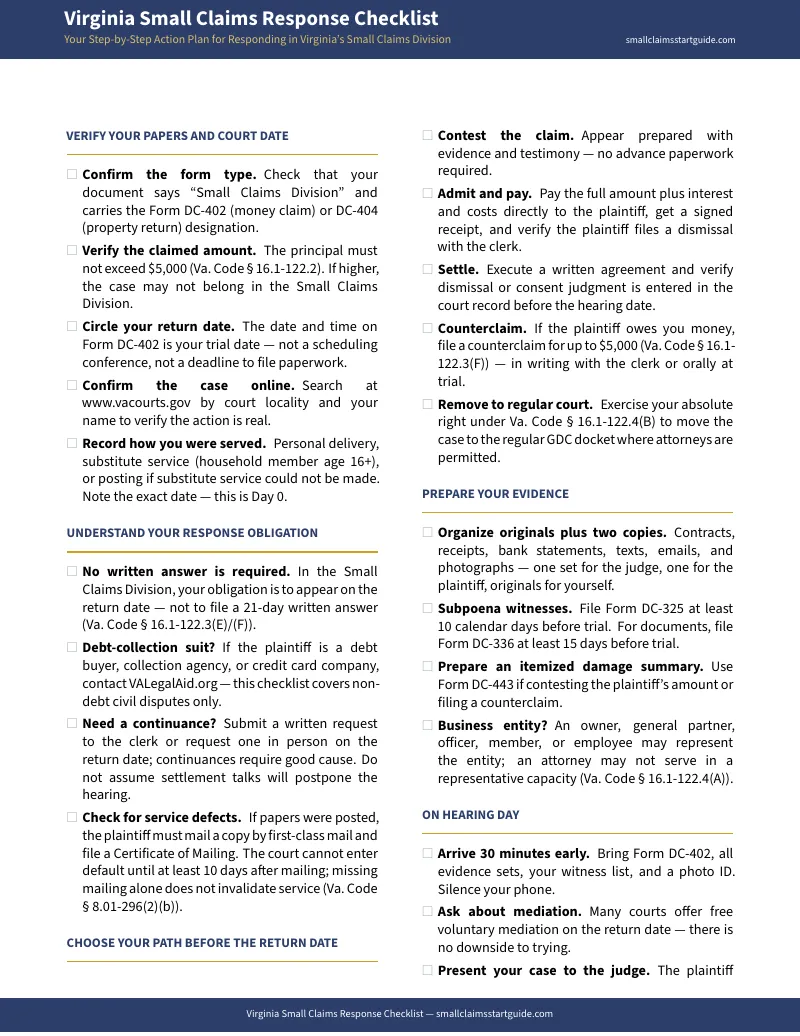
Get the free checklist to see the steps at a glance — or get the full guide with the complete return-date workflow, standalone tools, and every response, evidence, and post-decision procedure covered step by step.
Get the Virginia Response GuideInstant download. Printable PDF. Full refund, no time limit.
Frequently Asked Questions
What if the rules change after I buy?
We update the guide when the rules change. Email us any time, even years later, and we'll send you the current edition free.