
You know the court exists. You cannot figure out which track your case belongs on.
Your contractor took your deposit and vanished. Your landlord is sitting on your security deposit weeks past the 30-day deadline. A client owes you months of invoices and has gone silent. You searched "how to file small claims in Utah" and found out the information lives across utcourts.gov, county Justice Court pages, and a separate Online Dispute Resolution portal — and none of them explain the process in the order you actually need to follow it.
You do not need a legal textbook. You need to know which Justice Court to file in, whether that court uses the ODR platform or the traditional track, which forms to complete, how much it costs, how to get the papers to the other side, and what to bring to a hearing. One wrong name on the affidavit, one missed ODR registration window, and the court can dismiss your case before you say a word.
The Utah Filing Workflow
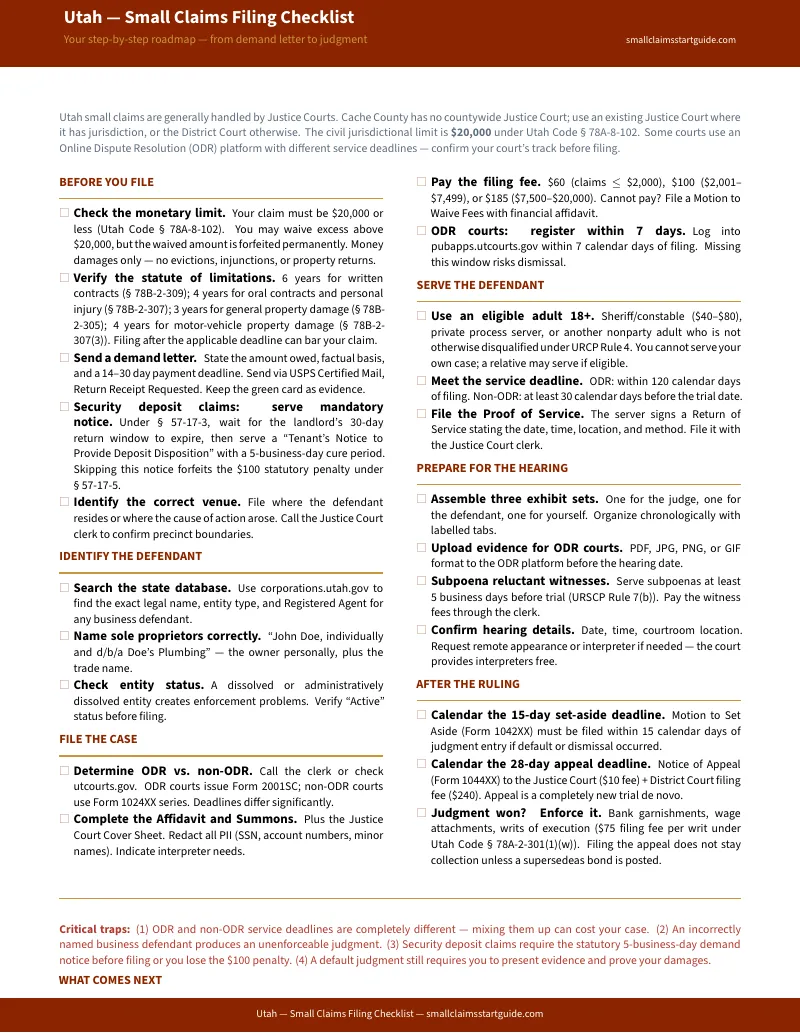
The Utah Small Claims Filing Guide takes the entire Justice Court process — from checking whether your claim fits the $20,000 limit through to enforcing the judgment after you win — and puts it in a single printable sequence. Every step names the statute, the form, the fee, and the deadline. No guesswork, no tab-juggling between five different court websites, no wondering what comes next.
This is not a 400-page legal reference and it is not a filing service that submits your paperwork but leaves you on your own at the hearing. It is a procedural workflow — the Dual-Track Filing System — that walks you through what to do, in what order, by when, whether your court uses ODR or the traditional process.
What's Inside
Understanding Utah's Justice Court System
Utah handles small claims through Justice Courts, each serving a specific geographic precinct. The guide starts by confirming your case belongs in small claims (money damages up to $20,000 under Utah Code § 78A-8-102), showing you how the dollar cap works with pre-judgment interest and attorney fees, and explaining what falls outside the system — equitable remedies, evictions, government defendants, and assigned debts.
Venue — Filing in the Right Court
You must file in the Justice Court that covers either the defendant's residence or the location where the dispute arose. The guide walks you through identifying your court using the utcourts.gov directory, verifying precinct boundaries, and handling the Cache County exception (no countywide Justice Court). Filing in the wrong court can mean a transfer or dismissal — and if the statute of limitations runs while you are refiling, the claim may be gone.
Statutes of Limitations — The Deadlines You Cannot Extend
Every claim type has a mandatory filing deadline: three years for personal injury, four years for oral contracts and property damage, six years for written contracts, and one year after the deposit disposition deadline for security deposits. The guide covers every deadline by claim type and shows you how to calculate yours. Sending a demand letter does not pause the clock.
The Demand Letter
For security-deposit claims under Utah Code § 57-17-3, the landlord's 30-day disposition clock starts running when the tenant provides a forwarding address — your demand letter proves it started. For contractor and invoice disputes, Utah judges routinely ask whether you tried to resolve the matter before filing. The guide covers what to include, how to send it by certified mail, and how long to wait before filing.
ODR or Traditional — Two Tracks, Two Sets of Rules
This is where Utah differs from most states. Some Justice Courts require Online Dispute Resolution through pubapps.utcourts.gov. Others use the traditional track. The ODR track has a 120-day service window after filing and requires platform registration within 14 days — miss that 14-day window, and you risk default. The traditional track requires service at least 30 days before the trial date. The guide identifies which track your court uses and walks through each one separately, so you follow the right set of deadlines from day one.
Filing the Affidavit and Summons
The Affidavit and Summons is the form that starts your case — different from the traditional civil complaint used in District Court. The guide covers every required field, including the cover sheet your court requires. The section that saves the most time is entity verification — using the Utah Division of Corporations to find the defendant's legal name before you file, because suing a trade name instead of the registered LLC makes your judgment unenforceable even if you win.
Court Fees and the Fee Waiver
Filing fees are tiered: $60 for claims up to $2,000, $100 for claims from $2,001 to $7,500, and $185 for claims from $7,501 to $20,000. The guide covers the schedule, how to pay, and the full process for requesting a fee waiver through the Motion to Waive Fees. What most self-help resources leave out: third-party costs such as process server fees ($40–$80) and certified mailing fees cannot be waived even when the court grants a fee waiver.
Serving the Defendant
You cannot hand the papers to the defendant yourself. Service must be completed by a sheriff, constable, private process server, or (with court approval) certified mail. The guide lays out every method with the cost, the timing, and what to do when the first attempt fails — including alternative service options when the defendant is avoiding you.
Evidence Preparation
Bring organised evidence or risk losing a solid claim. The guide shows you how to assemble your documents — contracts, invoices, text messages, photographs, repair estimates — in chronological order with copies for the judge, the defendant, and yourself. A structured exhibit index keeps everything reference-ready when the judge asks a question.
The Hearing
What the courtroom looks like, how the Justice Court judge runs the proceeding, how much time you typically get, how to present evidence clearly, and what happens if the defendant does not show up.
After the Decision
Winning does not mean the defendant pays on the spot. If the judgment remains unpaid, you may need to enforce it. The guide covers writs of garnishment, supplemental proceedings to discover assets, and judgment liens on real property — enough to understand your options and decide whether to handle enforcement yourself or use the sibling collection guide.
9 Printable Standalone Worksheets
Fillable PDFs you print and use throughout the case: a filing preparation worksheet, a demand letter template (with the mandatory statutory security deposit notice), an entity verification worksheet, a service planner, a service tracking log, an evidence binder organizer, a deadline calendar, a filing cost calculator, and a fee waiver checklist. Each one corresponds to a phase of the filing process — fill them in as you go.
Who This Is For
- Tenants owed a security deposit. Your landlord had 30 days under Utah Code § 57-17-3 to return your deposit or send an itemised statement. If they retained it without proper accounting, you may be entitled to the full deposit plus $100 in statutory damages. The guide covers the timeline and how to calculate your claim.
- Homeowners with a contractor dispute. The contractor took your deposit and disappeared, or the work is defective. The guide covers verifying their business registration with the Division of Corporations, naming the correct entity on your affidavit, and presenting repair estimates as evidence.
- Small landlords owed rent or damage costs. Your former tenant left owing rent or caused damage beyond normal wear. The guide covers documenting damage and serving a former tenant who has moved. Eviction proceedings are handled in District Court, not small claims.
- Sole traders and freelancers with unpaid invoices. A client owes you for completed work. The guide covers filing as a sole proprietor or DBA, suing a business entity, and presenting an invoice trail with pre-judgment interest calculations.
- Buyers refused a refund. You paid for something that never arrived or did not match the description. The guide covers identifying the seller's registered agent and establishing venue.
- Anyone owed money in Utah who wants to handle it themselves. If your claim is $20,000 or less and you would rather spend an evening with a step-by-step guide than an afternoon navigating court websites, this is for you.
Why Not Just Use the Free Court Resources?
You should use them — and the guide tells you exactly when and where. The Utah Courts website publishes forms and the Self-Help Center answers basic procedural questions by phone and email. Utah Legal Services offers free assistance to qualifying residents, and the University of Utah runs pro bono legal clinics.
What none of those resources do is put the information in the order you need it. The self-help pages are organised by topic — one page for fees, another for service rules, another for the ODR portal — not by step. The forms are blank PDFs without instructions on which fields trip people up. Court clerks can confirm fees and hearing dates but are legally prohibited from telling you how to complete your affidavit or what evidence to bring.
The guide does the organisational work: every form, every fee, every deadline, in the order you encounter them, with the ODR and traditional tracks laid out separately so you follow the right one. It sits between the free information (which you still need) and an attorney (who costs $200+ per hour to explain what the guide covers in an evening).
What This Is Not
This guide explains the procedure. It does not give legal advice, predict outcomes, or tell you how to argue your case. It is not published by, affiliated with, or endorsed by any Utah court, the Administrative Office of the Courts, or any government agency. If you need legal advice, contact a lawyer. If you need free help, the guide lists the resources available through the Utah Self-Help Center, Utah Legal Services, and the University of Utah Pro Bono Initiative.
Satisfaction Guarantee
Full refund, no time limit. If the guide is not what you expected, email [email protected] and we will refund you — no questions, no deadline.
Frequently Asked Questions
What if the rules change after I buy?
We update the guide when the rules change. Email us any time, even years later, and we'll send you the current edition free.