You have 14 days to respond. Most people don't realise that until half of them are gone.
You just got served with a small claims citation in a Texas Justice of the Peace Court. The paperwork is confusing, the language is unfamiliar, and somewhere in there is a deadline — 14 calendar days from the date of service to file a written answer. Miss it, and the court can enter a default judgment against you. The plaintiff wins without you ever getting heard.
The problem is that most of the advice you find online is wrong for your situation. Legal blogs and even TexasLawHelp mix up the Justice Court 14-day rule with the District Court "Monday next after 20 days" formula. Forum posts quote deadlines of 10, 20, or 30 days. The court clerk can confirm administrative facts but is legally barred from telling you what to write or which defenses to raise. And the blank answer forms the court provides are exactly that — blank forms with no instructions on how to fill them in.
The 14-Day Defense Workflow
The Texas Small Claims Response Guide is a structured, step-by-step workflow that takes you from the moment you receive the citation through the final options after the judge rules. It is built specifically for non-debt civil disputes in Texas Justice of the Peace Courts — contractor claims, security deposit disputes, vehicle sale disagreements, and small business lawsuits — under TRCP Rules 500–510.
This is not a form. It is the workflow that goes around the form: understanding what the citation and petition actually say, calculating your exact deadline, choosing the right type of answer, filing it correctly, building your evidence, preparing for the hearing, and knowing your options whatever the outcome.
Citation Decoder and Deadline Calculator
The citation is the most important document you will receive in this case, and it is written in legal language that assumes you already know how the court system works. The guide walks you through every section — cause number, plaintiff identity, court precinct, service date — and then uses that service date to calculate your exact TRCP 502.5(d) deadline, accounting for weekends, court holidays, and early closure rules. A printable deadline calculation log keeps the date visible and documented.
Answer Options Explained — Not Just a General Denial
A one-sentence general denial is enough to get into the courtroom and avoid a default judgment. But it is not your only option. The guide explains when a bare general denial is sufficient, when to raise specific affirmative defenses (the contract was fulfilled, the statute of limitations has expired, you already paid), how to file a counterclaim if the plaintiff actually owes you money, and the filing fee and procedural requirements for counterclaims under TRCP 502.6. It also covers admitting part of the claim and negotiating a settlement before trial.
Filing Navigation — eFileTexas, Counter, and Mail
Filing your answer sounds simple until you discover that the "Guide & File" interview tool on eFileTexas is often restricted to plaintiff petitions — defendants submitting an answer in many counties need to upload a standalone PDF through the standard eFileTexas portal instead. The guide covers the difference between the two systems, formatting requirements (text-searchable PDF, electronic signature as /s/ Name, sensitive data redaction under TRCP 21c), and the counter-filing and certified mail alternatives for counties that do not accept electronic answers.
Fee Waiver Process
If paying court costs would prevent you from affording basic necessities, the Statement of Inability to Afford Payment of Court Costs can waive your filing fee, counterclaim fee, and other court costs. The guide explains the eligibility standard, what the clerk can contest, and what happens if the plaintiff challenges your statement.
Evidence Organization System
Disputes about contractor work, security deposits, and vehicle sales are won or lost on documentation. The guide includes a printable evidence preparation checklist that categorises your exhibits by type — contracts, photographs, communications, financial records — and tracks whether each one has been copied three times: one set for the judge, one for the plaintiff, and one for your own reference. Three matching binders, chronological order, tabbed and ready.
Hearing Preparation
What the courtroom looks like, how the Justice of the Peace runs the proceeding, how to present and respond to evidence, how to handle witnesses, and the subpoena process under TRCP 500.8. The guide also covers requesting a jury trial — which must be done at least 14 days before the hearing date with the $22 jury fee.
Post-Decision Roadmap
If the decision goes against you, you are not finished. The guide maps every post-decision option: a Motion for New Trial within 14 calendar days under TRCP 505.3, an appeal by filing an Appeal Bond within 21 calendar days under TRCP 506.1 (which transfers the case to County Court for a completely new trial), and the Motion to Set Aside Default Judgment if you missed the original answer deadline. A printable post-decision roadmap tracks the deadlines and requirements for each option.
Five Printable Standalone Tools
The guide comes with five standalone worksheets designed to be printed and used alongside each stage of your case:
- Citation Papers Decoder Worksheet — locate every critical detail on your court papers within the first hour of being served
- 14-Day Deadline Calculation Log — compute your exact answer deadline under TRCP 502.5(d), accounting for weekends and holidays
- Answer & Service Proof Log — track what you filed, when, how, and when you served the plaintiff — your proof of compliance
- Trial Evidence & Exhibit Preparation Checklist — organise your evidence into three matching chronological binder sets
- Post-Decision Option Roadmap — map the 14-day motion window and 21-day appeal window with bond and fee waiver requirements
Who This Guide Is For
- Homeowners sued by a contractor over a roofing job, renovation, or repair — and you believe the work was defective, the invoice was inflated, or the project was abandoned
- Former tenants sued for property damage exceeding the security deposit — and you dispute the landlord's deductions
- Former landlords sued for a security deposit — and you need to document legitimate deductions
- Small business owners, sole traders, or LLC members sued by a customer — and you need to know who can file and appear on behalf of the business under TRCP 500.4
- Vehicle sellers or buyers in a private-sale dispute — defective vehicle claims, stopped payments, or title transfer disagreements
- Anyone served with a non-debt small claim in Texas who wants to handle the response themselves, correctly and on time
Why Not the Free Resources?
The court clerk and TexasLawHelp.org provide free blank answer forms — and you should use them. The forms are the official documents. But the forms arrive without context. They do not tell you which filing deadline applies to your court, how to calculate it, whether a general denial is enough for your situation, or how to organise the evidence that actually wins or loses the case.
County self-help packets cover local rules for one precinct but end at the county line. TexasLawHelp mixes District Court rules with Justice Court rules, and the answer deadline on its instruction pages sometimes quotes the wrong formula. National guidebooks like Nolo's cover Texas in a generic appendix table without mentioning the TRCP 502.5(d) 14-day rule, the eFileTexas defendant filing nuances, or the post-judgment motion timelines.
The guide does not replace the free forms. It provides the structured, statewide workflow that goes around them — specific to Texas Justice Courts, specific to defendants, and built for the 14-day window you are working inside.
Satisfaction Guarantee
Full refund, no time limit. If the guide does not help you, email [email protected] and you will get your money back.
What This Guide Is Not
This guide explains the procedure for responding to a small claims case in a Texas Justice of the Peace Court. It does not give legal advice, predict whether you will win, or tell you how to argue your case. It is not published by, affiliated with, or endorsed by any Texas court, the Office of Court Administration, or any government agency.
If you have been sued by a lender, debt buyer, or collection agency over a consumer debt, this guide is not for you. Debt-collection suits follow different rules under TRCP 500.3(b). The Texas Legal Services Center (TexasLawHelp.org) and your county's legal aid office provide free help with debt-collection cases.
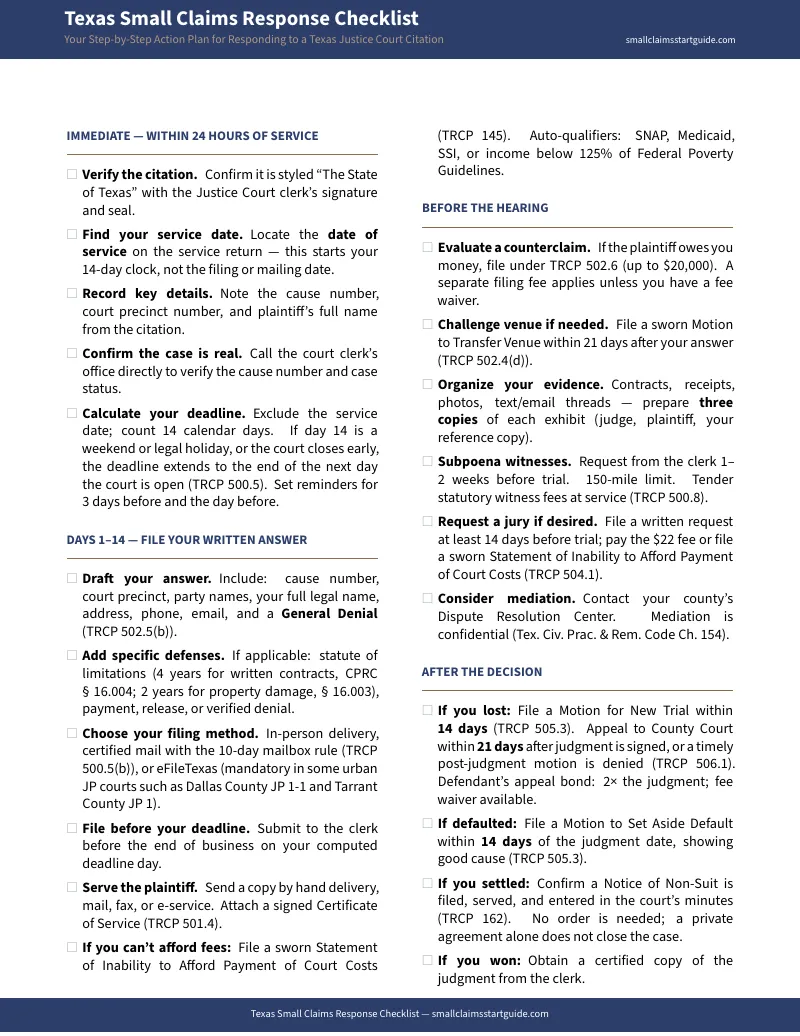
Get the free checklist to see the steps at a glance — or get the full guide with the complete 14-day workflow, five standalone tools, and every filing, evidence, and post-decision procedure covered step by step.
Get the Texas Response GuideInstant download. Printable PDF. Full refund, no time limit.