You Won the Case. The Court Won't Collect a Dollar for You.
The judge ruled in your favor. You proved your case, paid the filing fees, maybe even took time off work to be in court. And now — nothing. The debtor has not paid, the court clerk says enforcement is "your responsibility," and everything you find online is either generic advice that mixes up 50 states or forms with no instructions.
Texas Justice Courts have the authority to enter a judgment up to $20,000. They have zero obligation to help you collect it. Every enforcement tool — Abstracts of Judgment, Writs of Execution, bank garnishment, turnover orders — requires a separate filing, a separate fee, and a trip to a different office. Miss a deadline or file with the wrong office, and you have spent money you cannot get back on a step that accomplished nothing.
The Enforcement Roadmap System
This guide replaces the scattered search results, confusing county websites, and generic national books with a single document that maps the entire Texas post-judgment process from start to finish. It tells you which office handles each step, which form to file, what fee to expect, and — critically — which assets are actually reachable before you spend money on enforcement.
Most creditors learn about Texas exemptions the expensive way: after paying a Constable $180 to $400 to attempt a levy on property the debtor can legally protect. The Enforcement Roadmap System screens for that first, so you direct your effort and fees toward assets that can actually satisfy the judgment.
What's Inside
- The enforcement timeline, day by day — the 14-day post-judgment motion window, the 21-day appeal deadline, and when Writs of Execution can issue. No guessing when you can legally act.
- Post-judgment discovery under TRCP Rule 500.8(b) — how to send written interrogatories to the debtor without court approval, the mandatory 30-day response window, and what to do when the debtor ignores you.
- Abstracts of Judgment — requesting the abstract from the Justice Court, recording it with the County Clerk, and creating a lien that attaches to non-exempt real property for 10 years.
- Writs of Execution — the application, the Constable's role, the 30-day window for execution, levies on personal property, and the procedures for execution sales.
- Bank account garnishment — applying for a Writ of Garnishment, serving the financial institution, handling the garnishee's answer, and understanding how Texas wage-tracing rules protect recent payroll deposits.
- Turnover orders and receivership — reaching intangible assets like business receivables, cryptocurrency, and debts owed to the debtor that execution writs cannot touch.
- The Texas exemption framework — the constitutional wage garnishment ban, homestead protections, and the $50,000 / $100,000 personal property caps under Property Code Chapter 42. Includes a pre-levy screening framework so you know what is reachable before filing.
- Post-judgment interest calculations — the current OCCC rate, annual compounding under Finance Code § 304.003, and a tracking ledger so your balance is always accurate.
- Dormancy and renewal — the 10-year execution window under CPRC § 34.001, how to keep your judgment alive, and what happens if you miss the deadline.
- Case closure — filing a Release of Judgment, releasing Abstracts recorded in multiple counties, and obtaining satisfaction from the court record.
Who This Guide Is For
- You won a judgment in a Texas Justice of the Peace court and the debtor has not paid
- You're a small business owner recovering an unpaid invoice, service contract, or trade debt under $20,000
- You're helping a family member navigate the collection process — and the county website is not enough
Why Not Just Use the Free Court Website?
Texas court self-help pages provide blank forms. They do not explain the sequence. You can download an Application for Writ of Execution from Tarrant County's JP portal — but it will not tell you that you need to wait 30 days after judgment, that the Constable (not the clerk) carries out the levy, that the writ expires in 30 days if not executed, or that the debtor's tools and equipment may be exempt up to $50,000.
National legal books like Nolo's Everybody's Guide to Small Claims Court cover all 50 states in one volume. The Texas wage garnishment section alone creates dangerous confusion: in most states, you can garnish wages. In Texas, current wages are constitutionally protected from civil judgment collection. A generic book does not flag that distinction clearly enough to stop you from filing a garnishment that will be rejected.
County court websites vary dramatically. Denton County's Precinct 1 eliminated paper filings entirely as of December 2025 — every post-judgment filing must go through eFileTexas.gov. Tarrant County still accepts counter submissions for some filings. Constable service fees range from $90 in some precincts to $175 in others. The guide consolidates what you need to know so you are not calling three different offices to piece it together.
Satisfaction Guarantee
Full refund, no time limit. If the guide does not help, email [email protected] and you'll get your money back. No forms, no hoops.
Start Collecting What You're Owed
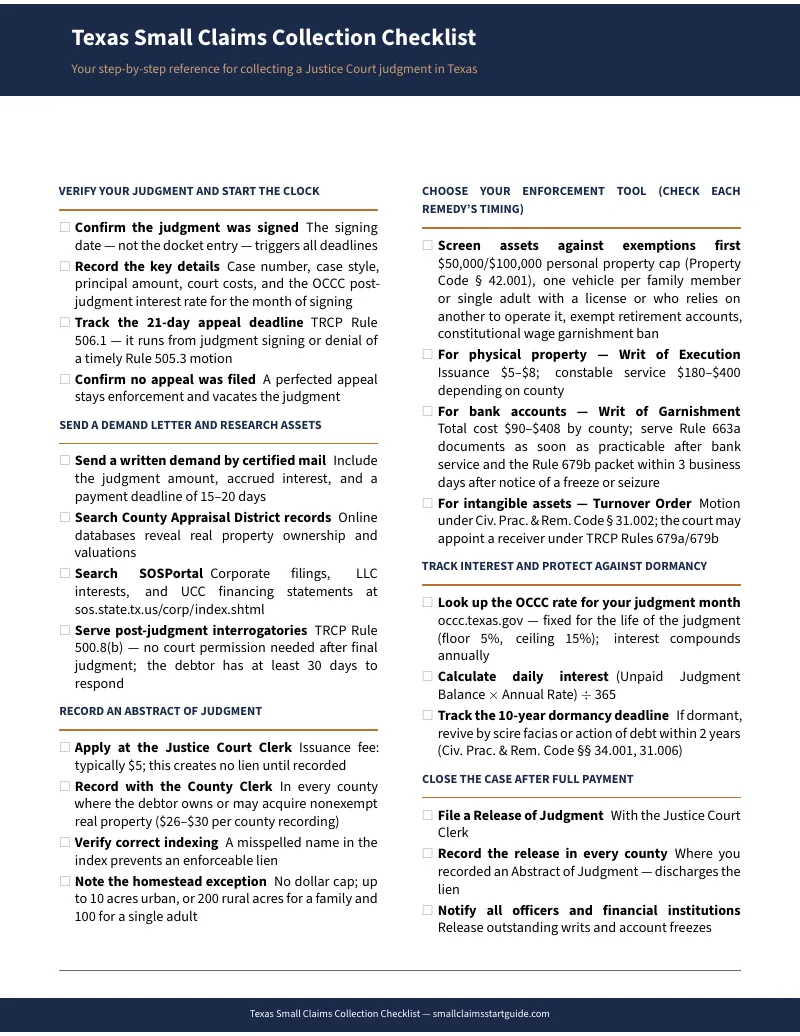
The free Texas Small Claims Collection Checklist gives you a one-page overview of the enforcement tools, waiting periods, and exemption caps. It is enough to understand the landscape.
The full guide — — gives you the step-by-step instructions, the filing sequences, the exemption screening framework, and the interest tracking tools to actually execute the process from start to finish.
Frequently Asked Questions
What if the rules change after I buy?
We update the guide when the rules change. Email us any time, even years later, and we'll send you the current edition free.