You know the court exists. You don't know which form to file first.
Your contractor took a deposit and vanished. Your landlord kept your security deposit past the 20-day statutory deadline. A client owes you for work you finished months ago and has stopped answering. You have already searched "how to file small claims in Rhode Island" and found the Judiciary website with blank PDF forms, a few Reddit threads where other tenants in Providence and Narragansett ask the same questions you have, a Nolo book that covers all fifty states but not Rhode Island's specific forms, and an automated filing service that lists the wrong jurisdictional limit.
You do not need fifty states. You need to know which form to file in Rhode Island District Court, what it actually costs when you add the Tyler Technologies e-filing surcharges, how to get the papers served by a Sheriff or a DBR-licensed constable, what happens when the court sends both sides to mediation at CMCRI, and what to bring to a hearing where — unlike the defendant — you have permanently waived your right to appeal. One wrong defendant name on Form DC-SC-1, one missing notarized Military Service Affidavit, and your filing gets rejected before the clerk even looks at your claim.
The Rhode Island District Court Filing Workflow
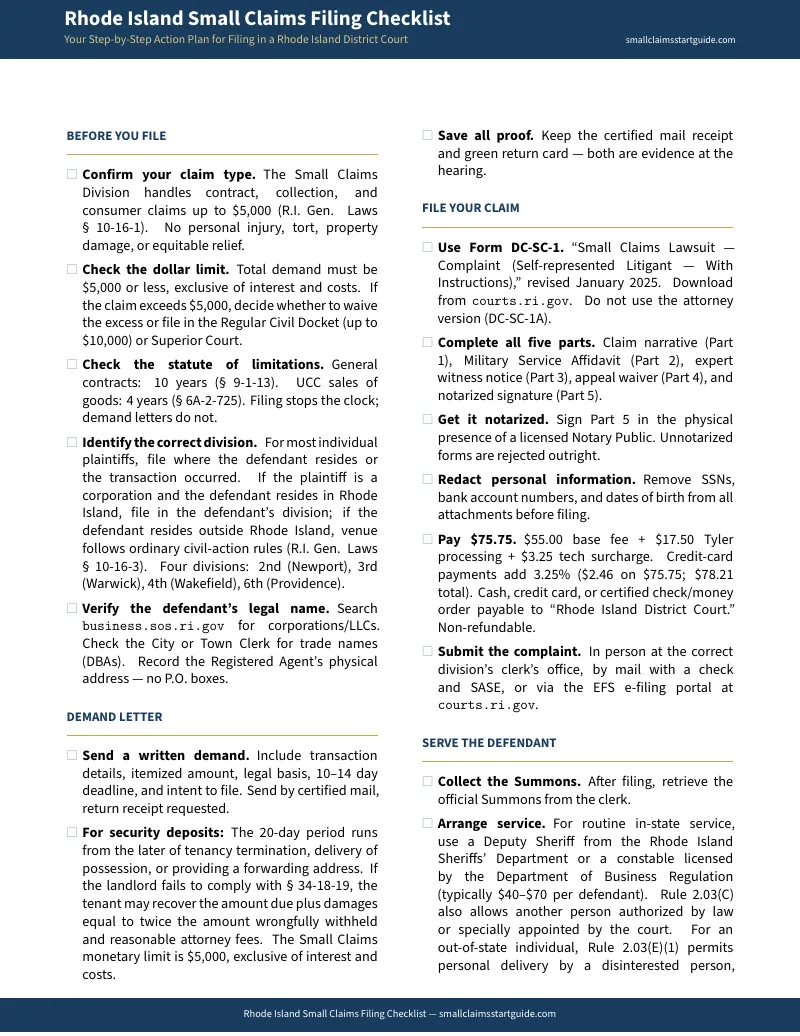
The Rhode Island Small Claims Filing Guide takes the entire process — from checking whether your claim fits the court's limits through to enforcing a judgment — and puts it in one printable sequence with checklists, worksheets, and a deadline calendar. Every step references the specific form, the statutory citation, and the timeline.
This is not a national overview that mentions Rhode Island in a footnote. It is not a $75–$100 automated filing service that may list an outdated $2,500 jurisdictional cap and omit the e-filing surcharges entirely. And it is not the court's instruction packet, which gives you field prompts on the form but no consolidated deadline calendar, no service tracking log, no evidence index worksheet, and no breakdown of the real filing cost.
What's Inside
Forum Fit — Checking the Limit and the Tort Exclusion
Rhode Island's Small Claims Division handles monetary claims up to $5,000, but only for claims arising from contracts, retail sales, or services rendered under G.L. § 10-16-1. Pure tort or negligence claims — property damage from a car collision, a neighbour's tree falling on your fence — are excluded under D.C.R.S.C.P. Rule 5.01 and must go to the District Court General Civil Docket instead. Filing a tort claim in Small Claims results in dismissal without prejudice and wasted court fees. The guide walks through the forum fit test so you know before you pay.
The Demand Letter — Because It Strengthens Your Case
Rhode Island does not require a formal demand letter before filing, but sending one is strongly advisable. It documents that you asked for payment and were refused, it gives the other side a chance to settle without the cost of court, and it strengthens your position at the hearing. The guide includes a demand-letter template with a mailing record and covers what to include, how to send it by certified mail, and how long to wait before filing.
Finding the Right Defendant — The Secretary of State Entity Search
Filing against a trade name or brand instead of the actual registered business entity is one of the most common reasons service fails or a judgment becomes uncollectible. If you are suing a business, you need its registered legal name. The guide walks you through searching the Rhode Island Secretary of State's online business database to identify the correct entity name, registered agent, and service address before you complete the court forms. A sole proprietor is sued by personal name; an LLC, corporation, or partnership is sued under its entity name on file with the state.
Form DC-SC-1 — Field by Field, Including the Notarization Trap
Form DC-SC-1 (Small Claims Lawsuit — Complaint for Self-Represented Litigants, revised January 2025) is the form that starts your case. The guide covers every field, with particular attention to the parts that cause the most rejections: naming the defendant correctly for each entity type, choosing the correct District Court division, writing a clear factual summary, and — the step most people do not know about until the clerk rejects their filing — executing the notarized signature and the Military Service Affidavit under 50 U.S.C. § 3931. The base filing fee is $55. If you file electronically through Tyler Technologies Odyssey File & Serve, add a $17.50 case processing fee, a $3.25 technology surcharge, and a 3.25% credit card fee — bringing the total out-of-pocket cost to roughly $75.75. The guide breaks down every fee so there are no surprises at the counter or the checkout screen.
Service of Process — Sheriffs, Constables, and Certified Mail
After the clerk files your complaint and issues a summons, you must get the papers to the defendant. Rhode Island provides several options: service through the Rhode Island Sheriffs' Department, service by a constable licensed through the Department of Business Regulation (DBR), or certified mail. The guide covers each method, explains how to find a licensed constable on the DBR website, walks through what to do when a defendant avoids service, and explains the return-of-service documentation you need to file with the court. The defendant has exactly 20 calendar days from verified personal service to file an Answer.
Court-Annexed Mediation Through CMCRI
When a defendant files an Answer, the court may refer both parties to the Center for Mediation & Collaboration Rhode Island (CMCRI) in Warwick for mediation before proceeding to trial. CMCRI mediators are neutral facilitators — they do not give legal advice, fill out forms, or decide the case. If mediation resolves the dispute, the agreement becomes binding. If it does not, the case proceeds to a hearing. The guide explains how to prepare for mediation, what documents to bring, and when it makes sense to settle.
Evidence Assembly — Three Sets, Chronological Order
Small claims hearings are brief. You will not have time to sort through a stack of papers in front of the judge. Bring three complete sets of every exhibit — one for the judge, one for the opposing party, and one for yourself — collated in chronological order: contracts, invoices, bank statements, photographs, text messages, repair estimates, and receipts. The guide shows you how to organise your evidence, how to print digital evidence like text messages and email screenshots, and how to build an evidence index that lets you find anything in seconds during the hearing.
The Hearing — And the Appeal Waiver You Need to Know About
What the courtroom looks like, how the judge runs the proceeding, how to present your evidence clearly, and what happens if the other side does not show up (default judgment). One rule every plaintiff must understand before filing: under G.L. § 10-16-1, plaintiffs permanently waive their right to appeal an adverse small claims decision the moment they file. Defendants retain a strict 2-day appeal window to the Superior Court. That asymmetric rule makes thorough preparation essential — the guide devotes a full chapter to getting ready for the hearing.
After the Decision — Judgments Do Not Pay Themselves
Winning in court does not mean the defendant pays on the spot. If the defendant does not pay voluntarily, the guide covers your enforcement options: recording the judgment as a lien, wage garnishment, bank account levies, and post-judgment interest.
Printable Worksheets and Planning Tools
Fillable worksheets: forum fit worksheet, demand letter planner, Secretary of State entity search worksheet, filing cost calculator, Form DC-SC-1 filing checklist, service of process tracker, evidence organisation matrix, hearing day preparation checklist, and deadline calendar. Plus a two-page, 25-item master checklist covering every step from demand letter to judgment enforcement. Print them, write on them, and check off each step as you go.
Who This Is For
- Tenants owed a security deposit. Rhode Island law requires landlords to return a security deposit within 20 days of the end of occupancy, or provide an itemised statement of deductions, under G.L. § 34-18-19. Bad-faith withholding exposes the landlord to statutory damages of up to twice the amount wrongfully withheld plus attorney fees. The guide covers the statutory timeline, how to calculate your total claim, and how to serve a landlord who may have moved out of state.
- Homeowners with a contractor dispute. The contractor took your deposit and disappeared, or the work is defective. The guide covers Secretary of State entity lookups, naming the correct defendant, and presenting repair estimates as evidence.
- Small landlords owed rent or damage costs. Your former tenant left owing rent or caused damage beyond normal wear. The guide covers documenting damage with photographs and invoices and locating a former tenant for service.
- Sole traders and small businesses with unpaid invoices. A client stopped paying. The guide covers how businesses file in the Small Claims Division and how to organise invoices, contracts, and correspondence into a presentable evidence package.
- Buyers refused a refund. You paid for something that never arrived or did not match the description. The guide covers finding a business's registered agent through the Secretary of State for service and choosing the correct District Court division.
- Anyone owed money in Rhode Island who wants to handle it without a lawyer. If your claim is $5,000 or less, arises from a contract, retail sale, or services rendered, and you would rather spend an evening with a step-by-step guide than piece together the process from scattered court pages and Reddit threads, this is for you.
Why Not Just Use the Free Court Resources?
You should use them — and the guide tells you exactly when and where. The Rhode Island Judiciary at courts.ri.gov publishes downloadable PDF forms including Form DC-SC-1 (revised January 2025) and a small claims instruction packet. Court clerks accept filings and collect fees at each District Court division.
What the official resources do not do is put the information in the order you need it. The instruction packet provides field prompts on the form but no consolidated deadline calendar, no service tracking log, no evidence index worksheet, and no breakdown of the Tyler Technologies e-filing surcharges that bring the real filing cost to roughly $75.75. Court clerks are prohibited from giving legal advice, selecting forms for you, or advising on case strategy under D.C.R.S.C.P. Rule 1.02. Rhode Island Legal Services serves income-eligible residents but prioritises housing defence and domestic violence — not general small claims plaintiffs. The Rhode Island Bar Association's Volunteer Lawyer Program offers a $25 initial consultation, not document preparation.
The guide does the organisational work: every form, every fee, every deadline, in the order you encounter them, with checklists and worksheets you can print and work through. It sits between the free information (which you still need) and a $75–$100 automated filing service that may list an outdated jurisdictional cap, omit the e-filing surcharges, and leave you on your own at the hearing.
What This Is Not
This guide explains the procedure. It does not give legal advice, predict outcomes, or tell you how to argue your case. It is not published by, affiliated with, or endorsed by the Rhode Island Judiciary, any District Court, or any government agency. If you need legal advice, contact a lawyer. If you need free help, the guide lists Rhode Island Legal Services (RILS), the Rhode Island Bar Association Volunteer Lawyer Program, and the Center for Mediation & Collaboration Rhode Island (CMCRI).
Satisfaction Guarantee
Full refund, no time limit. If the guide is not what you expected, email [email protected] and we will refund you — no questions, no deadline.
Get Started
Download the free Rhode Island Small Claims Filing Checklist — a two-page, 25-item summary of the limit, forms, fees, service steps, and deadlines. If you want the full guide with step-by-step instructions, fillable worksheets, and the deadline calendar, get the complete Rhode Island Small Claims Filing Guide for .
Frequently Asked Questions
What if the rules change after I buy?
We update the guide when the rules change. Email us any time, even years later, and we'll send you the current edition free.