
Oregon's Court Website Gives You the Forms. This Guide Gives You the Filing Sequence.
You know you're owed money. You know there's a small claims court. And when you go to the Oregon Judicial Department website, you find a stack of PDFs — Form SC-ClmNotice, Form F0577, a mediation notice in six languages — scattered across separate pages with no clear order.
You call the court clerk. They tell you they can't help you fill out the forms or tell you whether you're naming the right defendant. That's the line they're legally required to draw.
So you're left cross-referencing Oregon Revised Statutes against county court pages, guessing whether you need the Circuit Court eFiling portal or a paper form with a wet signature at the Justice Court, and hoping you don't miss the 63-day service deadline that triggers an automatic dismissal.
The Oregon Filing Sequence System
This guide takes the same public information — the OJD forms, the fee schedules, the service rules, the UTCR procedures — and organizes it into one filing sequence you follow from start to finish. Every step in order. Every deadline on one calendar. Every form identified by name and number.
It is not legal advice. It does not evaluate whether your claim will succeed. It does what the court clerk cannot: walk you through the administrative process of filing, serving and preparing for a hearing in Oregon small claims court.
What's Inside the Guide
- The Claim-Fit Check — whether your dispute falls within the $10,000 limit, which statute of limitations applies (Oregon has different windows for written contracts, oral agreements, property damage and personal injury), and the 60-day post-filing service rule that quietly kills cases before they start.
- Pre-Filing Demand Package — a demand letter framework with tracking log, because Oregon requires a good-faith collection effort before you file. Skip this step and the judge may ask why you didn't try to resolve it first.
- County Venue Selector — how to identify the right court across Oregon's 36 counties, including the split between Circuit Courts (eFiling through OJD iForms) and local Justice Courts (paper-only, wet signatures, money order payments). The wrong court means starting over.
- Business Entity Lookup Walkthrough — step-by-step instructions for searching the Oregon Secretary of State Corporation Division to find the registered legal entity name and the registered agent you serve. Naming a trade name or DBA instead of the legal entity risks dismissal.
- Filing Forms Checklist — every form you need identified by OJD number (SC-ClmNotice, F0577), with the fee structure ($57 / $102 for Circuit Court based on claim amount, $37 for Justice Court) and instructions for both electronic and paper filing.
- Service of Process Map — the four allowed service methods (county sheriff, private process server, certified mail with restricted delivery, and the alternative service option), including the certified-mail trap that catches self-represented filers when they use regular certified mail instead of restricted delivery.
- ORS 36.185 Mediation Notice — the mandatory attachment that must be served alongside your claim, with a checklist to make sure it reaches the defendant in the right form. Missing this notice can invalidate your service.
- 63-Day Service Clock & Tracking Log — a printable deadline calendar and service log, because if you don't file your Certificate of Service within 63 days of filing, the court dismisses your case automatically under UTCR 15.020.
- Hearing Preparation & Evidence Binder — how to organize contracts, receipts, photos and estimates into a structured trial set, what to expect in the courtroom, and the informal evidence rules that apply in Oregon small claims hearings.
- Post-Judgment Next Steps — what happens after the judge rules, the 30-day appeal window, and a clear hand-off to the collection process if the defendant doesn't pay voluntarily.
Who This Guide Is For
- A homeowner whose contractor took a deposit for repairs and stopped showing up
- A tenant whose landlord kept the security deposit past the 31-day statutory deadline
- A small landlord owed rent or repair costs after a tenant moved out
- A sole trader or freelancer with an unpaid invoice under $10,000
- A buyer refused a refund on a defective product or broken service agreement
- A neighbour with a property damage bill the other party won't acknowledge
If you've been served with a small claim (you're the defendant), this isn't the right guide — see the Oregon response guide instead.
Why Not Just Use the Free Court Forms?
You should use the free court forms — this guide tells you exactly which ones to download and how to fill them in. The OJD publishes every form you need at no cost.
What the court doesn't publish is a filing sequence. The forms arrive as individual PDFs on separate web pages. The instructions reference statutes by number without explaining what they mean in practice. The fee schedule is a dense PDF that doesn't tell you which tier applies to your claim amount. And nobody warns you about the 63-day service deadline, the certified-mail restriction, or the mediation notice you're required to serve alongside the claim.
This guide doesn't replace the court's forms. It puts them in order, fills in the gaps, and gives you tracking tools so you don't miss the deadlines that get cases dismissed before a judge ever sees them.
What You Get
The guide is a digital download — PDF files you can read on any device and print at home.
- The main guide — 49 pages covering every step from the demand letter to the hearing, with two worked dollar examples verified against the current fee schedule
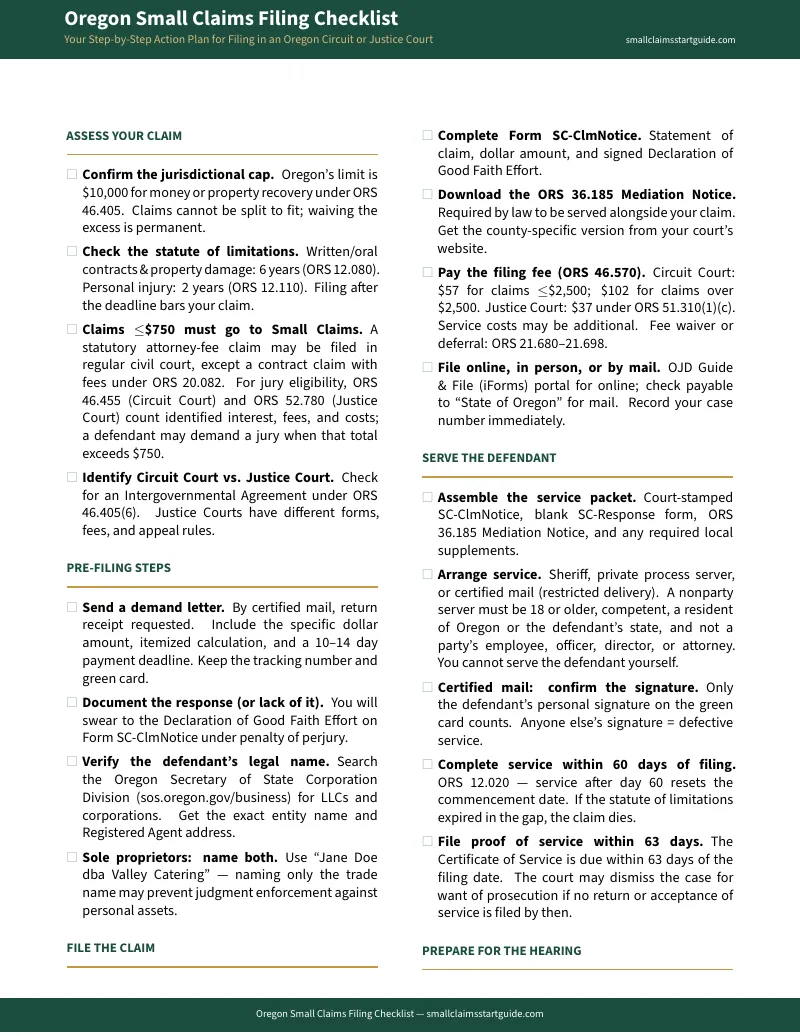
- The filing checklist — a printable 2-page checklist organized into 6 phases (demand, court selection, filing, service, hearing prep, post-judgment) with tick boxes and deadline fields
- Demand letter tracker — log your delivery method, tracking number, and response so you can complete the Declaration of Good Faith Effort
- Filing deadline calendar — one page with the 60-day service deadline, 63-day proof-of-service deadline, and post-service windows you fill in from your filing date
- Service of process log — track every service attempt, the certified-mail restricted-delivery details, and the service packet checklist
- Evidence inventory checklist — itemize every document, photo, and witness by evidence-binder tab with original/copy status
- Hearing preparation checklist — a pre-hearing checklist covering evidence copies, subpoenas, interpreter requests, remote hearing setup, and your key talking points
- Filing fee and cost tracker — record every out-of-pocket expense for reimbursement at judgment, with a post-judgment interest calculator
Full refund, no time limit. If the guide doesn't help, email [email protected] and you'll get your money back.
Get the full Oregon Small Claims Filing Guide — every form, every deadline, one sequence.
Frequently Asked Questions
What if the rules change after I buy?
We update the guide when the rules change. Email us any time, even years later, and we'll send you the current edition free.