You have 30 days. Most of the advice online says 14.
Oregon changed the small claims response deadline in January 2026. House Bill 2463 extended it from 14 calendar days to 30. But the blog posts, legal forums, and even some court websites still show the old number. If you are reading this after being served with a Notice of Claim, there is a good chance the first thing you Googled told you the wrong deadline.
That is not a small mistake. File too early in a panic and you skip options you did not know you had. File too late — or worse, assume calling the clerk counts as a response — and the plaintiff walks away with a default judgment.
The Response Navigator: four choices, one deadline, zero guesswork
This guide is built around a single idea: you should not have to decode legal procedure while a clock is running. The Response Navigator system walks you through the entire process from the moment you are served to the day the case closes — with decision trees, worksheets, and step-by-step instructions designed for people who have never set foot in a courtroom.
It is not legal advice. It does not tell you whether your case is strong or predict what the judge will do. It tells you exactly what to file, where to file it, how much it costs, and what to bring — so you can make your own decisions with the procedure handled.
What's inside
- Summons Decoder Worksheet — a field-by-field map of your Notice of Claim so you can identify your case number, filing court, service date, and true 30-day deadline in minutes instead of hours
- Response Options Decision Tree — a structured walkthrough of your four choices under Oregon law: admit and pay, deny and request a hearing, deny and file a counterclaim, or demand a jury trial for claims over $750
- Circuit Court vs. Justice Court Guide — the forms, fees, and filing addresses are different depending on which court your case is in, and filing the wrong form gets your response rejected (Justice Courts will not accept Circuit Court forms). The guide maps both systems side by side.
- Deadline and Fee Calculator — a worksheet that counts your 30 days from the service date and identifies your exact court fee: $37 for Circuit Court claims of $2,500 or less, or $50 for claims between $2,500.01 and $10,000
- Hearing and Evidence Prep Index — how to organize contracts, receipts, photos, and text messages into labeled exhibits using the Three-Copy Rule, plus a witness contact sheet and a chronology log
- Mediation Preparation — what to expect in Multnomah County's court-run pre-trial program and Yamhill County's Zoom mediation through Neighbor-to-Neighbor, including how to present digital evidence on screen
- Post-Decision Tracker — what happens after the ruling, how to appeal, how to set aside a default judgment within 60 days, how to enforce a counterclaim award, and how to file a Satisfaction of Judgment so the case is officially closed
Who this is for
- Homeowners and property owners sued by a contractor, tradesperson, or neighbor over work or property damage
- Former landlords served with a security deposit claim under ORS 90.300 — especially if you are facing potential double damages
- Small business owners and sole proprietors sued by a customer, client, or vendor
- Private vehicle buyers or sellers in a dispute over the sale
- Anyone in Oregon who just received small claims papers and needs to understand the procedure before the 30-day window closes
The guide is for non-debt civil disputes. If a lender, debt buyer, or collection agency sued you, free legal aid is the right first step — the guide includes those referrals too.
Why not just use the free court forms?
The Oregon Judicial Department publishes the official Defendant's Response form (Form F0508) for free. You should absolutely use it — your response goes on the court's own form no matter what.
The gap is everything around the form. The court's instructions do not walk you through how to decide between your four options. They do not include worksheets for organizing evidence into labeled exhibits. They do not explain the difference between Circuit Court and Justice Court filing. They do not prepare you for mediation or tell you what to do after the decision comes down. And the court clerk, by Oregon law, cannot help you choose — they can confirm office hours and mailing addresses, but they are prohibited from giving legal advice or filling in your response.
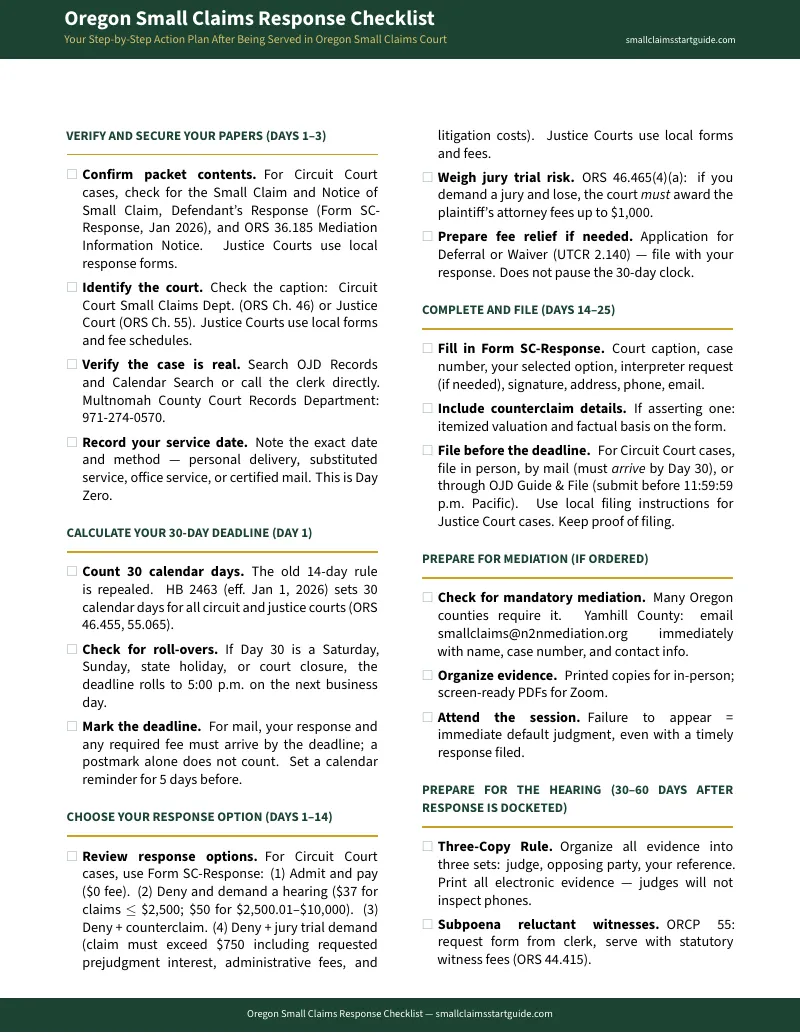
The free checklist covers what to do. The full guide covers how — with decision trees, worksheets, and step-by-step instructions that fit around the official forms.
The guarantee
Full refund, no time limit. If the guide does not help you navigate your response, email [email protected] and you will get your money back. No forms, no waiting period, no questions.
Download the free checklist to see the timeline and response steps at a glance. When you are ready for the full system — decision trees, evidence worksheets, mediation prep, and post-decision tracking — get the complete guide and walk through it at your own pace. The guide is a one-time purchase: buy it once, keep it forever, and come back to it at every stage of your case.
Frequently Asked Questions
What if the rules change after I buy?
We update the guide when the rules change. Email us any time, even years later, and we'll send you the current edition free.