You won. The judge ruled in your favour. And now nobody is going to hand you the money.
The Special Civil Part entered a judgment in your name — maybe for an unpaid loan, a security deposit, contractor damage, a broken agreement. You walked out of the courtroom thinking the hard part was over. Then you discovered the New Jersey Judiciary does not collect a single dollar for you. The clerk cannot tell you what to do next. The Ombudsman office can answer administrative questions but is legally prohibited from choosing your enforcement strategy or filling out your forms. And the other side has stopped returning your calls.
Welcome to the part of small claims court that nobody explains in advance: turning a piece of paper into actual money.
New Jersey gives judgment creditors serious enforcement tools — Information Subpoenas, bank levies, wage execution, personal property seizure, statewide real estate liens. But those tools are scattered across different court rules and form packets, require different filings, and go through different offices — the county Special Civil Part Office, court-appointed Special Civil Part Officers, and the Superior Court Clerk's Office in Trenton. A court officer will reject an incomplete execution request without explanation. A missing form, an incorrect fee, or a subpoena served on the wrong person can waste weeks and forfeit non-refundable court fees.
The Step-by-Step Execution System: every enforcement tool, every form, every office
This guide is not a legal article or a checklist of tips. It is a complete Step-by-Step Execution System — a sequential workflow that walks you through every post-judgment tool New Jersey's Special Civil Part gives you, from the day the appeal window closes to the day you file the Warrant to Satisfy Judgment and close the case. Each chapter covers one enforcement mechanism. Each mechanism has its own forms, fees, deadlines and exemptions laid out in order.
What's inside
- The appeal window and your first move — the 45-day appeal period under Rule 2:4-1, why filing an appeal does not automatically stop enforcement unless the court grants a stay, and how to use the waiting period productively by preparing your enforcement filings and sending a formal demand letter
- Asset discovery with Information Subpoenas — how to serve the Information Subpoena on the debtor (Appendix XI-L, Form CN 11840) and on non-parties such as banks and employers (Appendix XI-R, Form CN 10191), the mandatory 14-day response window, and what to do when the debtor ignores it
- Motion to Enforce Litigant's Rights — the step-by-step procedure for compelling a debtor who ignores your subpoena, using the court's Packet CN 10546, including the fee ($25, waived in the Small Claims Section) and how to request sanctions
- Bank levies and turnover motions — requesting a Writ of Execution ($35 court fee), delivering it to the Special Civil Part Officer, how the officer restrains the debtor's bank account using Form CN 11711, and filing a Motion to Turn Over Funds using Form CN 10547 to convert frozen money into actual payment
- Wage execution — the Notice of Application for Wage Execution (Appendix XI-I, Form CN 11236), the Application for Wage Execution (Packet CN 10548), the income threshold ($217.50 per week), and handling a debtor who changes employers
- Personal property seizure — directing the Special Civil Part Officer to seize nonexempt personal property, the $1,000 statutory exemption under N.J.S.A. 2A:17-19, the officer's fees ($7 delivery plus mileage plus 10% commission on collected funds), and how public sales work
- Statewide real estate lien — requesting a Statement for Docketing from the local Special Civil Part, submitting it to the Superior Court Clerk's Office in Trenton with the $35 fee, and how docketing creates a lien that attaches to any real property the debtor owns or later acquires anywhere in New Jersey
- Exemptions and protected income — the debtor's $1,000 personal property exemption, protected income streams (Social Security, SSI, disability, unemployment), and how to evaluate whether the debtor has attachable assets before incurring additional court fees
- Post-judgment interest calculations — the state-mandated rate under Rule 4:42-11(a)(ii) (4.50% per annum for 2026, 4.00% for 2027), how to compute interest on the judgment balance, and adding enforcement costs to the total owed
- Closing the case — filing the Warrant to Satisfy Judgment when the debtor has paid in full, the filing fee ($35 for un-docketed judgments, $50 for docketed judgments), and why failing to file can result in court sanctions
Who this is for
- A landlord who won a damage or security deposit judgment and the tenant has not paid
- A contractor or freelancer with a judgment for unpaid work and no idea where the debtor banks
- A sole proprietor with an unpaid invoice judgment and a debtor who has gone silent
- A tenant who won back a security deposit and the landlord refuses to pay
- A small business that won a judgment under $5,000 and needs to enforce it without hiring a lawyer
- Anyone holding a New Jersey Special Civil Part money judgment who needs to know what enforcement tools exist and how to use them
If you already have a money judgment from the Special Civil Part and the debtor has not paid, this guide was built for you. It does not cover filing the original case or responding to one — those are separate guides.
Why not just piece it together from free sources?
You can try. The New Jersey Judiciary's self-help website links to brochures and blank forms — CN 10282 outlines your enforcement options, CN 10546 provides the Motion to Enforce packet, CN 10548 covers wage execution. But each document explains one tool in isolation. None of them gives you the prerequisite sequence: which subpoena to serve first, how long to wait, what to file when the debtor ignores it, which execution request to submit next, and which officer handles which type of levy. Court clerks will hand you blank forms but are legally prohibited from telling you which ones to file or in what order. The Ombudsman can explain court procedures but cannot advise on enforcement strategy.
No single free source gives you the complete enforcement workflow from judgment entry to case closure. You would spend hours bouncing between Judiciary PDFs, court self-help pages, and form instructions, still unsure which form to file first, what each step costs, and whether the debtor can claim an exemption that blocks the whole attempt. The Step-by-Step Execution System puts every tool in one document, in the order that makes financial sense, with the fee breakdowns and form references so the court officer accepts your filing the first time.
What you get
- The full guide — 14 chapters covering every enforcement tool from the appeal window through the Warrant to Satisfy Judgment
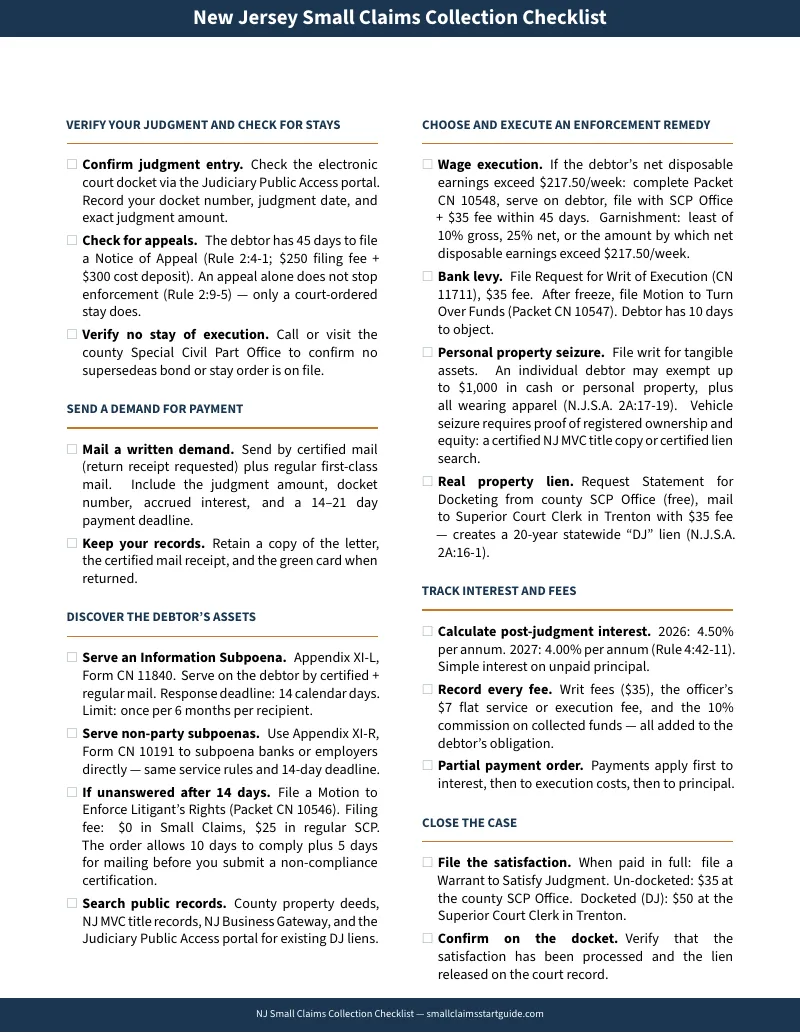
- The collection checklist — a two-page printable of 18 enforcement actions, key forms, deadlines, fees and exemption highlights
- Post-Judgment Balance Calculator — track the original award, Rule 4:42-11 interest, execution fees, partial payments and the running total owed
- Enforcement Remedy Decision Checklist — match each known asset to the correct tool, forms and estimated fees before you spend on a writ
- Information Subpoena Response Tracker — log each XI-L and XI-R mailing, the 14-day deadline, and whether answers arrived
- Execution Fee Ledger — record every writ, officer, commission and docketing cost so the running total is added to the debtor
- Service and Mailing Log — document every certified and regular mailing with tracking numbers and return-receipt results
Full refund, no time limit. If the guide is not useful, email [email protected] and we will refund the full amount.
Get the New Jersey Judgment Collection Guide →
The free checklist tells you what enforcement tools exist. The full guide shows you how to use each one — step by step, form by form, with the fee breakdowns and prerequisite sequences so you do not waste money filing the wrong thing first. For less than the cost of a single Writ of Execution filing, you get the entire enforcement workflow in one place.
Frequently Asked Questions
What if the rules change after I buy?
We update the guide when the rules change. Email us any time, even years later, and we'll send you the current edition free.