Nevada has Justice Court townships across 17 counties, each with its own filing rules. One wrong choice and your case is dismissed before it starts.
You are owed money. You know small claims court exists. But when you search for how to file in Nevada, you find the Las Vegas Justice Court website saying you must e-file through eFileNV, Henderson's court saying you need a certified-mail demand letter with a waiting period, Sparks requiring exhibits at mandatory mediation, and rural townships that only take paper filings at the counter. The Civil Law Self-Help Center has guides, but they cover Clark County only. Nolo's national book mentions Nevada in a reference table. Automated filing platforms charge fifty to two hundred dollars and still use outdated fee schedules.
The court forms are free. You should download them. But blank forms do not tell you which of Nevada's township courts has jurisdiction over your claim, whether you need to wait after sending a demand letter, how to format your PDF so eFileNV does not reject it, or how to assemble the three-set evidence binder the judge expects on hearing day.
The Nevada Township Filing System inside this guide is what makes the difference. It maps every step — from choosing the right township court through to the day you walk into the hearing — against the specific rules of each Justice Court jurisdiction. Not a national overview. Not a generic checklist. A single-state, township-by-township procedural roadmap built from NRS Chapter 73, current court fee schedules, and the local rules that trip up filers who treat Nevada as one court.
What's Inside the Guide
Township Venue Worksheet
Under NRS 73.010, you file where the defendant lives, works, or where the contract was made or the injury happened. That sounds simple until you realise Las Vegas, Henderson, North Las Vegas, Boulder, and Searchlight are all separate townships in Clark County alone, each with its own Justice Court. Reno and Sparks are separate townships in Washoe County with different local rules. The guide walks you through identifying the correct township from the defendant's address and the location of the dispute, covering all seventeen counties. File in the wrong one and the court dismisses your case. Reno Justice Court lists a $125 fee for a transfer from Small Claims into Justice Court.
Demand Letter Protocol — Township by Township
Henderson Justice Court requires a formal demand letter sent by certified mail with return receipt, and you must wait before filing. Las Vegas Justice Court lets you file immediately after sending the demand — no waiting period — as long as you attach proof to the complaint. Most rural townships expect a demand but enforce it differently. The guide covers the demand requirements for every township, with a template letter, certified mail tracking instructions, and a timeline showing when you can file after sending.
eFileNV Walkthrough
In Las Vegas Justice Court, all civil filings go through the Odyssey eFileNV portal. Filings get rejected for incorrect PDF formatting, missing Civil Court Cover Sheets, unredacted personal identifiers, or wrong lead document classifications. The guide walks through the e-filing process: account setup, case type selection, document uploads, electronic signature requirements, and the specific formatting rules that cause rejections. For courts that do not use eFileNV, it covers the paper filing process, accepted payment methods, and mailing addresses.
Filing Fees — Current Schedule with Fee Waiver Guide
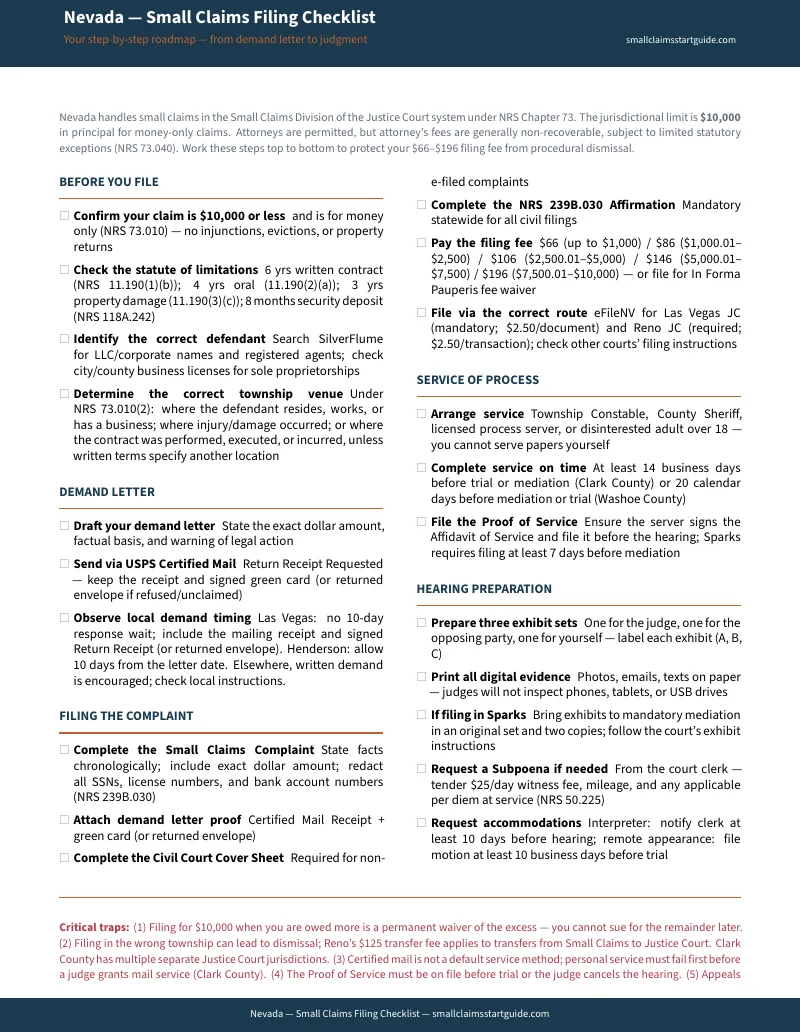
Nevada's small claims filing fees are tiered by claim amount: $66 for claims up to $1,000, $86 for $1,001–$2,500, $106 for $2,501–$5,000, $146 for $5,001–$7,500, and $196 for $7,501–$10,000. Constable, sheriff, or process-server charges are extra — confirm the current amount with the clerk. The guide includes the fee schedule, a fillable filing-fee calculator, and the In Forma Pauperis fee waiver application — if granted, the court waives both filing fees and Constable service fees.
Business Entity Lookup on SilverFlume
Suing "Bob's Plumbing" when the registered legal entity is "R. Smith Plumbing Services LLC" means your judgment may be unenforceable. The guide walks you through the Nevada Secretary of State's SilverFlume portal to find the exact legal name, status, and registered agent for any business entity you need to sue. It covers the difference between serving a registered agent and serving a managing agent, and what to put on the complaint form when the defendant operates under a trade name.
Service of Process Tracker
The defendant must be served at least fourteen business days before trial or mediation in Clark County, and at least twenty calendar days before mediation or trial in Washoe County. File the Proof of Service promptly; in Sparks it must be on file at least seven days before mediation. Miss these deadlines and the hearing can be cancelled. The Service of Process Log records the method used, the server, the date of completed service, and the proof-of-service filing date.
Three-Set Evidence Binder System
You need three identical copies of every piece of evidence: one for the judge, one for the defendant, one for yourself. Each set needs numbered or lettered exhibit cover sheets. In Sparks, bring the original and two copies to mandatory mediation. In Incline Village, the court accepts exhibit submissions by email but bars file-sharing links. The kit includes printable exhibit cover sheets and a binder assembly checklist.
Hearing Preparation and Mediation
Some Nevada courts use mandatory mediation before the case goes to a judge. Sparks and Reno both route cases through mediation first. The guide covers what mediation looks like, what the mediator can and cannot do, how to prepare for both the mediation session and the hearing itself, how to present your evidence clearly, how to question the other side's witnesses, and what happens if the defendant does not show up.
Post-Decision Roadmap and Appeal Deadlines
After the judge rules, the appeal window is short and court-specific: seven calendar days from decision filing in Clark County (plus three calendar days if the judgment is mailed), and five judicial days after the decision date in Washoe County. If no appeal is filed, the judgment becomes final. A judgment does not mean the defendant hands you a cheque. The guide explains the appeal timeline and your options if the defendant does not pay voluntarily — and points to the companion judgment collection guide for the full enforcement process.
Who This Guide Is For
- Tenants owed a security deposit — Your landlord withheld your deposit past the thirty-day deadline under NRS 118A.242, or deducted for ordinary wear and tear the statute does not allow. You need to know how to calculate your claim, document the property condition, and file in the right township.
- Homeowners suing a contractor — The contractor took your deposit and disappeared, or the work was defective or unpermitted. You need to identify the correct legal entity through SilverFlume, name them properly on the complaint, and present repair estimates as evidence.
- Sole traders and freelancers with unpaid invoices — A client owes you for completed work. You need to verify the client's business registration, determine venue when the client is in a different county, and bring the right evidence.
- Small landlords owed rent or facing property damage — Your former tenant left owing rent or caused damage beyond the security deposit. You need to document the loss, calculate your claim under the $10,000 cap, and file a money action rather than an eviction proceeding.
- Buyers and tourists fighting bogus charges — A Las Vegas hotel or resort added charges you never authorised. You need to navigate Clark County's e-filing system and identify the correct corporate entity to sue.
- Anyone owed $10,000 or less in Nevada — Nevada law prohibits recovering attorney's fees in small claims, so hiring a lawyer guarantees a net loss on most claims. This guide gives you the procedural roadmap to handle it yourself.
Why Not Just Use the Free Court Website?
You should use the court website. The official forms are free, the filing portals are public, and the Civil Law Self-Help Center in Las Vegas offers free classes and consultations. Use all of it.
The problem is not access. The problem is fragmentation. Nevada's small claims information lives across the Las Vegas Justice Court site, the Henderson court pages, the North Las Vegas court site, the Washoe County Reno and Sparks portals, the Incline Village court page, a dozen rural township offices, the Civil Law Self-Help Center, and the statewide Nevada Judiciary portal. Each court publishes its own local rules — demand letter requirements, e-filing procedures, exhibit submission deadlines, mediation rules — and none of them cross-reference the others.
The guide puts everything in one sequence. Township-by-township. Step by step. With printable worksheets for the parts that require tracking. If you have the time to piece together six court websites and a dozen local rule sets, you do not need it. If you would rather spend an evening reading one document and printing the worksheets that apply to your case, this is built for that.
What You Get
The full guide is an instant download. Printable PDF. You get the 48-page filing guide (14 chapters) plus ten fillable worksheets: Township Venue Worksheet, Defendant Entity Verification Worksheet, Demand Letter Template, Demand Letter Tracker, Service of Process Log, Evidence Tracker and Exhibit Organizer, Three-Set Evidence Binder Checklist, Master Deadline Calendar, Filing Fee Calculator, and Clerk Question Log.
Full refund, no time limit. If the guide does not help, email [email protected] and you get your money back.
There is also a free checklist — a two-page summary of the limit, forms, fees, service steps, and deadlines (21 items). It covers what to do. The full guide covers how to do it, township by township, with the worksheets and tracking tools that keep you on schedule.
Get the Nevada Filing Guide —
Frequently Asked Questions
What if the rules change after I buy?
We update the guide when the rules change. Email us any time, even years later, and we'll send you the current edition free.