You Were Served. The Hearing Date Is Set. Now What?
In Massachusetts, the moment a small claims case lands in your mailbox, the clock is not ticking the way you think. Most people go straight to Google and find advice about filing a written answer within 20 days. That advice is for regular civil cases under Mass. R. Civ. P. 12(a) — it does not apply to small claims. Under Uniform Small Claims Rule 3(b), you are not required to file any written response at all, and missing that imaginary deadline does not cause a default.
But knowing what you do not have to do is only the beginning. You still need to know what you should do — and how to do it in a system designed to move fast.
That is why people who have been served with a small claim in Massachusetts — homeowners sued by contractors, tenants and landlords in deposit disputes, small business owners facing customer claims, vehicle sellers hit with defect allegations — use the Response Roadmap System to prepare for a hearing that happens once.
What Free Resources Get Wrong
Mass.gov publishes the statutes and blank forms. Court Service Centers confirm hearing dates and hand you paperwork. MassLegalHelp explains your rights in broad terms. But none of them walk you from "I just got served" to "I am standing in front of the Clerk-Magistrate with organised evidence and a clear plan." Here is where defendants get stuck:
- The answer deadline panic — Online advice overwhelmingly tells defendants to file a formal written answer within 20 days. That is the rule for regular civil cases, not small claims. The real obligation is to appear at the hearing. Getting this wrong wastes time drafting a document that is not required and missing preparation that actually matters.
- Response option confusion — You can dispute the claim, file a voluntary written answer, pay before the hearing, request an instalment plan, mediate, or counterclaim. The court website lists these options on different pages with no decision framework. Which one fits your situation? What are the forms? What are the deadlines for each?
- The hearing itself — Clerk-Magistrate hearings in Massachusetts move fast. r/massachusetts threads describe sessions where the Magistrate asks rapid-fire questions and interrupts unstructured narratives. Defendants who walk in with a pile of loose papers and no plan lose cases they could have won on the facts.
What's Inside the Response Roadmap System
- Notice Parsing Walkthrough — How to read the Statement of Small Claim line by line, verify the case is real on MassCourts, and identify the hearing date, court division, and claim amount so nothing catches you off guard
- Rule 3(b) Answer Decision Guide — The actual rule on written answers, when filing one voluntarily helps your case, when it does not, and how to serve it on the plaintiff if you choose to file
- Five-Path Response Router — A decision tree that maps your situation to the right procedural option: dispute, voluntary answer, pre-hearing payment, instalment request, or mediation, with the forms and timing for each
- Counterclaim Procedure — How to file your own claim against the plaintiff at no additional fee, the mandatory 10-day pre-trial notice rule under Rule 3(c), and what happens when your counterclaim exceeds the $7,000 limit
- Evidence Binder Blueprint — How to organise contracts, receipts, photos, text messages, and payment records into a chronological trial binder that the Clerk-Magistrate can follow without asking you to repeat yourself
- Hearing Presentation Framework — A structured approach to presenting your defence in a compressed session, including how to handle interruptions, direct Magistrate questions, and witness testimony
- Default Judgment Relief Roadmap — If you missed the hearing, the step-by-step Rule 8 motion to vacate, the excusable-neglect standard, and a worked example showing what courts actually accept
- 10-Day Appeal Navigator — The strict appeal deadline, the $100 bond or indigency waiver, what a de novo trial before a judge or jury of six looks like, and how to calculate whether appealing makes financial sense
- Exempt Income Reference — Which income sources are protected from enforcement under G.L. c. 224 § 16 (Social Security, disability, unemployment) and how the payment review hearing works
- Printable Worksheets — Six separate PDFs you can print and fill in: a response-option decision flowchart, hearing preparation worksheet, evidence inventory log, counterclaim planning worksheet, post-decision action checklist, and agency communication log
Plus the Free Checklist
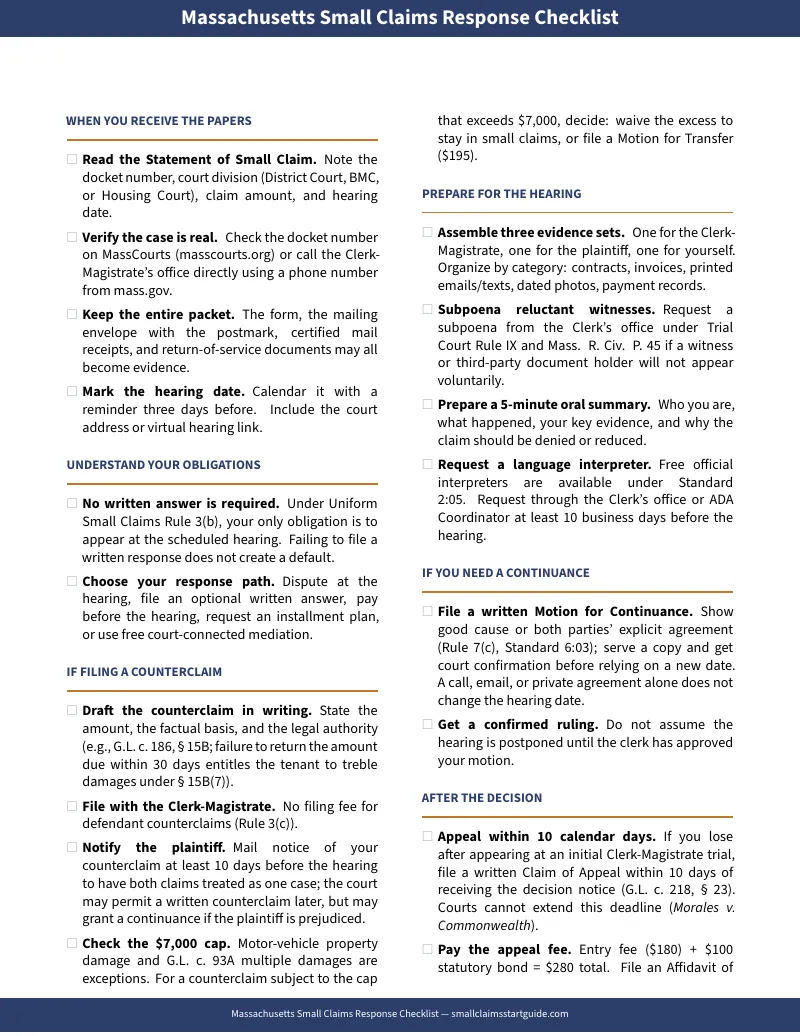
Not ready to commit? Download the Massachusetts Small Claims Response Checklist for free — a one-page rundown of the response deadline, your options, the documents to gather, and the hearing preparation steps. It tells you what to do. When you need to know how, the full guide is here.
Who This Is For
- A homeowner sued by a contractor over a disputed invoice or unfinished project
- A former tenant fighting a landlord's claim for rent or property damage, or a landlord sued by a tenant over a security deposit
- A small business owner served by a customer claiming a refund or service failure
- A private vehicle buyer or seller dealing with a post-sale claim over undisclosed defects
- Anyone in Massachusetts who received a Statement of Small Claim and wants to understand their options before the hearing
Who This Is Not For
- If you are being sued by a lender, debt buyer, or collection agency — that is a consumer debt matter with its own protections, and the guide directs you to free legal aid resources including MassLegalHelp
- If you want to file your own claim, see the Massachusetts Small Claims Filing Guide
- If you won a judgment and the other side will not pay, see the Massachusetts Judgment Collection Guide
- If you need legal advice about whether you will win — this guide explains the procedure, not legal strategy
The Real Cost of Getting It Wrong
A default judgment means the plaintiff gets everything they asked for — potentially including statutory damages that double or triple the original claim under G.L. c. 93A or c. 186 § 15B. Once that judgment is entered, your wages, bank accounts, and non-exempt property are exposed to enforcement. Filing a motion to vacate is possible, but courts grant it only for excusable neglect — "I forgot" or "I was busy" does not meet that standard.
The guide costs less than a single hour of attorney consultation and exists to make sure you walk into that hearing with a plan instead of a stack of loose papers.
Satisfaction Guarantee
Full refund, no time limit. If the guide does not help, email [email protected] and you will get your money back.
What This Guide Does Not Do
This is not a law firm, not a legal aid organisation, and not affiliated with any Massachusetts court. It does not predict outcomes, give legal advice, or tell you whether your defence will succeed. Courts publish their forms for free. What this guide adds is the organised, step-by-step procedure that connects those forms into a coherent defence — from reading the papers to preparing evidence to understanding what happens after the Clerk-Magistrate's decision.
Frequently Asked Questions
What if the rules change after I buy?
We update the guide when the rules change. Email us any time, even years later, and we'll send you the current edition free.