You Won. They Haven't Paid. Now What?
You spent months preparing your case. You showed up, made your argument, and the court ruled in your favor. You expected the money to follow.
But it didn't.
Weeks have passed — maybe months — and the debtor has not paid a dime. The courthouse has not called. No one froze any bank accounts on your behalf. You are starting to realize that Massachusetts courts do not collect judgments. They leave that entirely to you.
And now you are stuck with questions no one at the courthouse will answer: When can I actually start enforcing? Which tool do I use first? Do I need a constable or a sheriff? What if they claim they have no money?
The Enforcement Execution System
The Collecting a Small Claims Judgment in Massachusetts guide gives you what the court's website does not — a step-by-step execution workflow that tells you exactly what to file, who to hand it to, what it costs, and what happens next.
This is not a summary of court rules. It is a chronological action plan built specifically for Massachusetts District Court, Boston Municipal Court, and Housing Court small claims sessions. Every waiting period, every form, every officer handoff — organized in the order you need them.
What's Inside
- Post-judgment timing guide — the 10-day appeal window, the 30-day default stay, and how to verify the docket before spending a cent on officer fees. One premature filing wastes $40–$80 in constable fees you cannot recover.
- Payment review hearing playbook — how Rule 7B hearings work, how to read the debtor's Financial Statement (Form TC0098), and the questions that surface undisclosed bank accounts, vehicles, and income streams.
- Officer selection matrix — municipal constable vs. county deputy sheriff, broken down by process type, geography, fee structure, and what each officer is authorized to do. Choosing the wrong one means starting over.
- Enforcement tool-by-tool walkthrough — Notices to Show Cause, capias civil arrest warrants, Writs of Execution, bank attachments, wage garnishment, and real estate liens. Each one with the form name, filing location, typical fee, and expected timeline.
- Exemption reference — Massachusetts wage shields under G.L. c. 246, § 28 and property protections under G.L. c. 235, § 34, in plain language. Know what is off-limits before you spend money trying to attach it.
- 20-year enforcement strategy — how to keep your judgment alive, re-examine the debtor when their circumstances change, and add accrued interest and enforcement costs to the balance.
- Case closure protocol — filing the Acknowledgment of Satisfaction of Judgment, clearing the court docket, and protecting yourself from retributive claims after you have been paid.
Who This Is For
- You won a money judgment in a Massachusetts small claims session and the other side has not paid
- You are collecting a security deposit judgment from a former landlord who is ignoring you
- A contractor, customer, or business owes you money under a court order and you need to know your enforcement options
- You tried calling the court and were told they cannot advise you on what to do next
Why Not Just Use the Free Resources?
Mass.gov publishes Uniform Small Claims Rules 7B and 9, a handful of overview pages, and links to blank PDF forms. The information is accurate — and scattered across dozens of pages with no sequence, no context, and no practical guidance on what to do with it.
Court clerks hand you forms but are legally prohibited from telling you which form to file first, which officer to give it to, or whether the debtor's assets are even reachable. Legal aid organizations serve defendants, not judgment creditors trying to collect. Harvard's Small Claims Advisory Service can answer a question — but it is staffed by student volunteers who cannot walk you through the operational details of serving a capias warrant or levying a bank account.
The guide fills that gap. It takes everything the court publishes and organizes it into a single workflow — in the right order, with the practical details that the official sources leave out.
The Real Cost of Guessing
A constable service fee runs $40–$80. A capias warrant execution can cost $100–$250. Attempting to garnish wages that are exempt under Massachusetts law wastes the service fee entirely — plus the time you spent at the clerk's office.
A private collection attorney charges $200–$450 per hour or takes 33–50% of whatever is recovered. Most attorneys will not touch a small claims judgment because the numbers do not justify their fees.
The guide costs less than a single constable service fee — and shows you how to use each enforcement tool correctly the first time.
What You Get
- The full guide (PDF) — 50 pages covering every enforcement stage from post-judgment timing through case closure
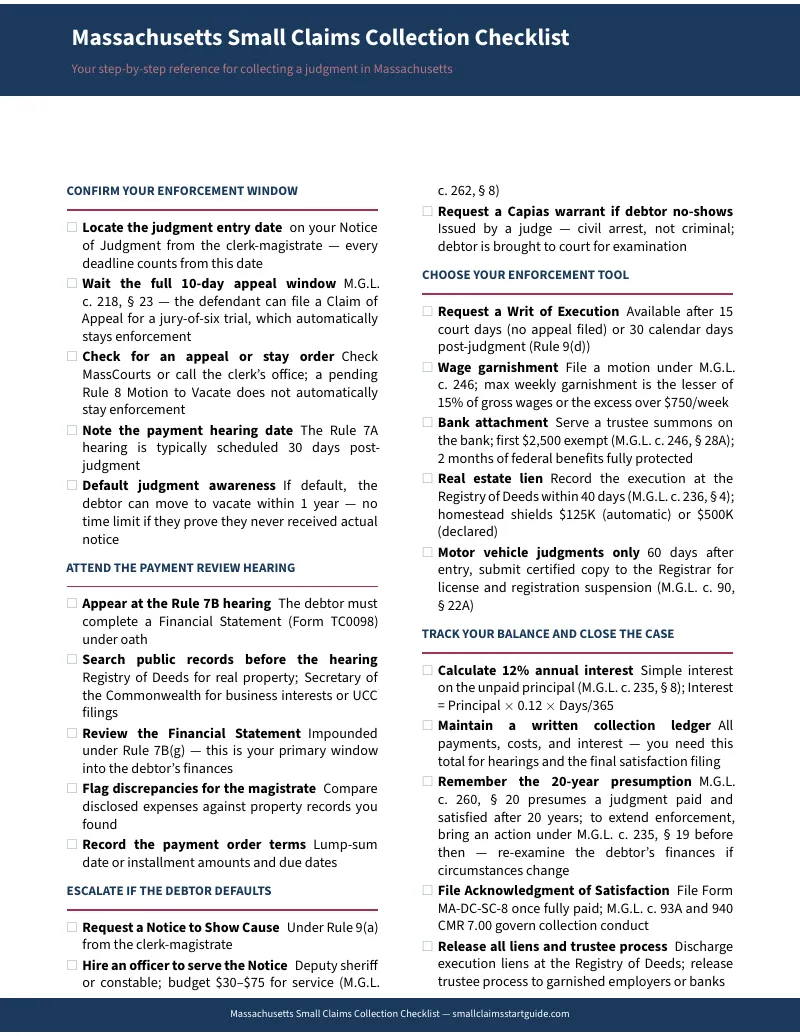
- The collection checklist (PDF) — a condensed reference with every deadline, form name, and officer handoff
- 6 printable worksheets (PDF) — enforcement decision flowchart, collection balance tracker, officer fee comparison, wage garnishment calculator, enforcement action log, and real estate levy feasibility worksheet
Every purchase comes with a full refund, no time limit. If the guide does not help, email [email protected] and you will get your money back.
You already did the hard part — you won in court. The guide shows you how to finish the job.
Download your copy now and start collecting →
Frequently Asked Questions
What if the rules change after I buy?
We update the guide when the rules change. Email us any time, even years later, and we'll send you the current edition free.