You Just Got Served — Now What?
You are holding court papers. The hearing date is weeks away. And every search result you find either talks about a different state or tells you to "consult an attorney" without explaining what you actually need to do between now and your court date.
Indiana's small claims process is different from most states — no written answer is required, the hearing rules are informal, and if you have been sued in Marion County, you are dealing with a completely separate township court system with its own jurisdictional cap. Generic national guides get these details wrong, and the court's own website gives you blank forms without the workflow that connects them.
The Indiana Court Response System
This guide is built around one problem: you have been served with a Notice of Claim in Indiana, and you need a clear sequence of steps — not scattered legal jargon.
The Indiana Court Response System walks you through the entire process in order: verifying your papers are real, understanding the no-answer rule that confuses defendants who read national guides, choosing among five response strategies, building your evidence in the three-copy format Indiana courts require, and knowing exactly what happens at the hearing and after the judge rules.
It covers both Marion County's nine township small claims courts and the Circuit or Superior Court small claims dockets across the other 91 counties — because the dollar caps, filing fees, and appeal routes differ.
What's Inside
- Paper and Date Decoder — how to read your Notice of Claim line by line, decode the cause number, verify the case on mycase.in.gov, and confirm your hearing date is real
- Indiana's No-Answer Rule Explained — why you do not need to file a written answer (unlike California or New York), what the court actually expects, and the one hidden 10-day deadline most defendants miss entirely (the jury trial demand under Small Claims Rule 4(C))
- Five Response Strategies — pay before the hearing, admit and request installments, settle and file it with the court, dispute the claim at trial, or file a counterclaim under Small Claims Rule 5
- Three-Copy Evidence Organizer — the step-by-step system for printing and organizing your photos, contracts, text messages, and receipts into the format Indiana courts expect (one copy for the judge, one for the opposing party, one for you)
- Business Defendant Compliance (Rule 8(C)) — the January 2025 update that lets corporations, LLCs, and partnerships send a full-time employee to court without hiring an attorney, with the Corporate Resolution and Employee Affidavit requirements explained
- Default Judgment Recovery — what to do if you already missed your hearing, how to file a Motion to Vacate under Trial Rule 60(B), and the grounds and time limits that apply
- Counterclaim Mechanics — when to file your own claim against the plaintiff, the 7-day notice rule, and what happens when your counterclaim exceeds the court's dollar cap
- Hearing Day Walkthrough — courtroom layout, how the judge runs the hearing, what to say and what not to say, and how to present evidence without a lawyer
- After the Decision — appeals to the Indiana Court of Appeals, installment payment orders, Proceedings Supplemental, and statutory interest
The guide includes six printable worksheets and planners — a case verification worksheet, deadline calculator, three-copy evidence organizer, hearing preparation checklist, business representative compliance pack, and post-decision action planner — plus a complete resource directory for every Indiana county.
Who It's For
- A homeowner served by a contractor over a remodeling or repair dispute
- A former tenant or landlord in a security deposit disagreement
- A small business owner, LLC, or corporation facing a customer claim
- A private vehicle seller or buyer involved in a sale dispute
This guide covers non-consumer-debt small claims. If you have been sued by a credit card company, debt buyer, or collection agency, the guide points you to Indiana Legal Services and other free legal aid resources — those cases involve specialized federal protections that require different guidance.
Why Free Resources Are Not Enough
Indiana's official self-help portal at indianalegalhelp.org provides blank forms — Appearance forms, Continuance motions, Fee Waiver requests. What it does not provide is a workflow that connects those forms into a step-by-step sequence. The site confirms that "Answers are not usually filed in Small Claims court" but does not explain what you should do instead, how to organize evidence, or how to prepare for the hearing.
The court clerk can confirm your hearing date and courtroom number. By law, they cannot tell you how to prepare your case, whether to file a counterclaim, or what evidence to bring.
Nolo's national small claims guide covers general concepts but misses the Marion County township distinction, the updated Rule 8(C) corporate representation rules, and the specific appeal procedures that changed when Marion County courts became courts of record in 2018. Generic Etsy and Gumroad templates often tell you to file a written answer within 20 days — a requirement that does not exist in Indiana.
This guide fills the gap between blank forms and hiring an attorney: the organized procedural workflow that Indiana's free resources do not assemble for you.
Your Purchase
You get immediate access to 8 PDFs:
- The Full Guide (PDF, 49 pages) — 14 chapters covering every step from receiving the papers through the hearing and post-decision options, with a complete Indiana resource directory
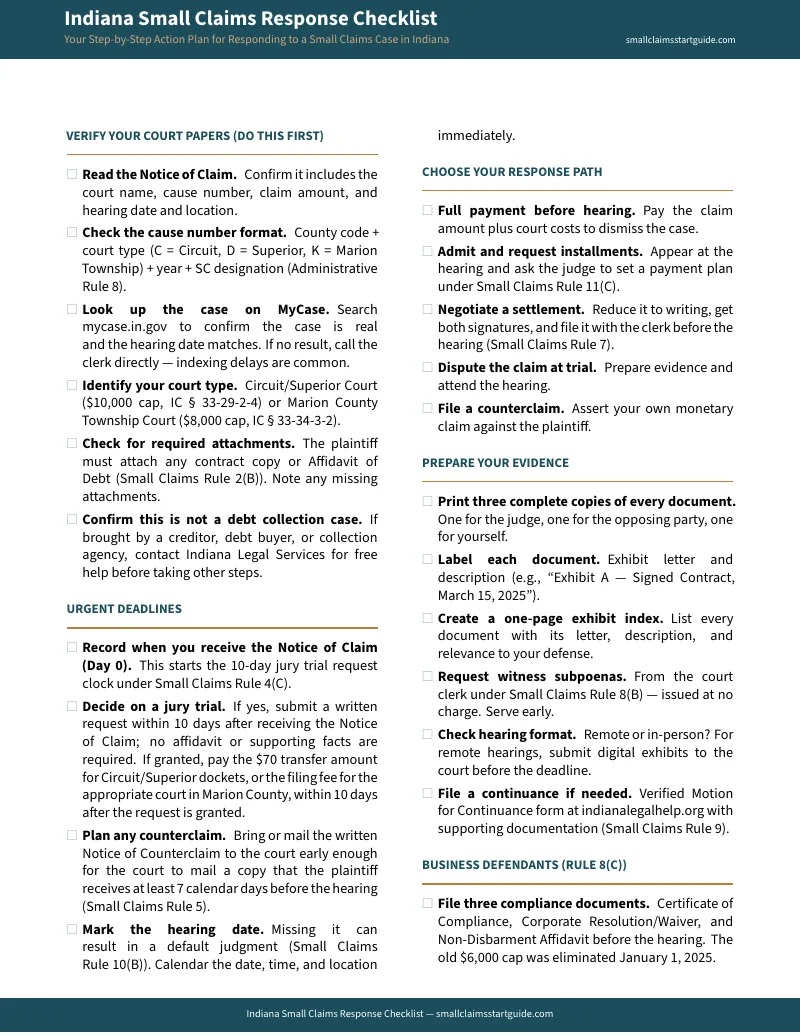
- The Response Checklist (PDF, 2 pages) — a printable checklist that puts every deadline, document, and preparation step in order
- Case Verification Worksheet — record the details from your Notice of Claim, decode the cause number, and verify the case on mycase.in.gov
- Deadline Calculator — track the 10-day jury demand window, counterclaim deadline, hearing date, and post-decision appeal deadlines
- Three-Copy Evidence Organizer — log every exhibit, track which copies are printed, and organize evidence by category
- Hearing Preparation Checklist — day-before and day-of tasks for in-person and remote hearings
- Business Compliance Pack — Rule 8(C) requirements for sending a non-attorney employee to represent a corporation, LLC, or partnership
- Post-Decision Action Planner — record the judgment details and plan your next steps, whether that means appealing, paying, or collecting
Every purchase comes with a full refund, no time limit. If the guide does not help, email [email protected] and you will get your money back.
Get the Indiana Small Claims Response Guide →
Or download the free checklist to start with the essentials — deadlines, response options, and evidence preparation steps on one printable page.
Frequently Asked Questions
What if the rules change after I buy?
We update the guide when the rules change. Email us any time, even years later, and we'll send you the current edition free.