You're owed money. The court has a process. This guide puts every step in order.
Filing a small claims case in the District of Columbia should be straightforward — the court designed it for people without lawyers. But between the entity verification, the form assembly, the filing fees, the service rules, and the mediation referral on your first court date, most self-represented filers discover that "simplified procedures" still means dozens of steps spread across multiple court offices and an online portal that assumes you already know the filing codes.
One wrong move — suing a trade name instead of the registered entity, formatting your filing double-sided, missing the service proof deadline — and the case stalls or gets dismissed before a judge ever looks at it.
The DC Small Claims Filing Roadmap
This guide is a complete procedural roadmap for filing a small claims case in the Small Claims and Conciliation Branch of DC Superior Court. It puts every step in the order you actually do them — from the demand letter to the hearing — with the forms, fees, deadlines, and filing options mapped out so you are not piecing it together from five different court web pages.
The court's own resources give you the raw forms. The Clerk's Office answers administrative questions but cannot help you draft anything or tell you what order to do things in. The guide fills the gap between downloading a blank Statement of Claim and walking into your hearing with an organized case.
What's Inside
- Entity Verification Workflow — how to search the DLCP CorpOnline / BOSS registry to find the defendant's legal corporate name and registered agent, so your judgment is actually enforceable against their assets
- Demand Letter Framework — what a pre-suit demand needs to include, how to send it by certified mail, and why judges look for it at the hearing
- Line-by-Line Form Walkthrough — the Statement of Claim and Information Sheet, field by field, with the cause-of-action language the clerk expects
- Filing Fee Map — the full fee schedule ($5–$45 based on claim size), certified mail charges, motion fees, and how to apply for a fee waiver if you qualify
- Two Filing Paths — step-by-step instructions for filing in person at Court Building B (Room 120) and for filing online through eFileDC, including the portal's formatting requirements and consent to electronic service
- Service of Process Tracking — certified mail, restricted delivery, and what to do when the defendant refuses or dodges delivery: the motion for special appointment, hiring a process server, and filing proof of service
- Statute of Limitations Reference — the time limits for contracts, property damage, security deposits, sale-of-goods claims, and intentional torts, with the accrual rules that determine when the clock starts
- Hearing Preparation System — how to organize your evidence binder, build an exhibit index, and prepare for mandatory Multi-Door mediation on your first court date
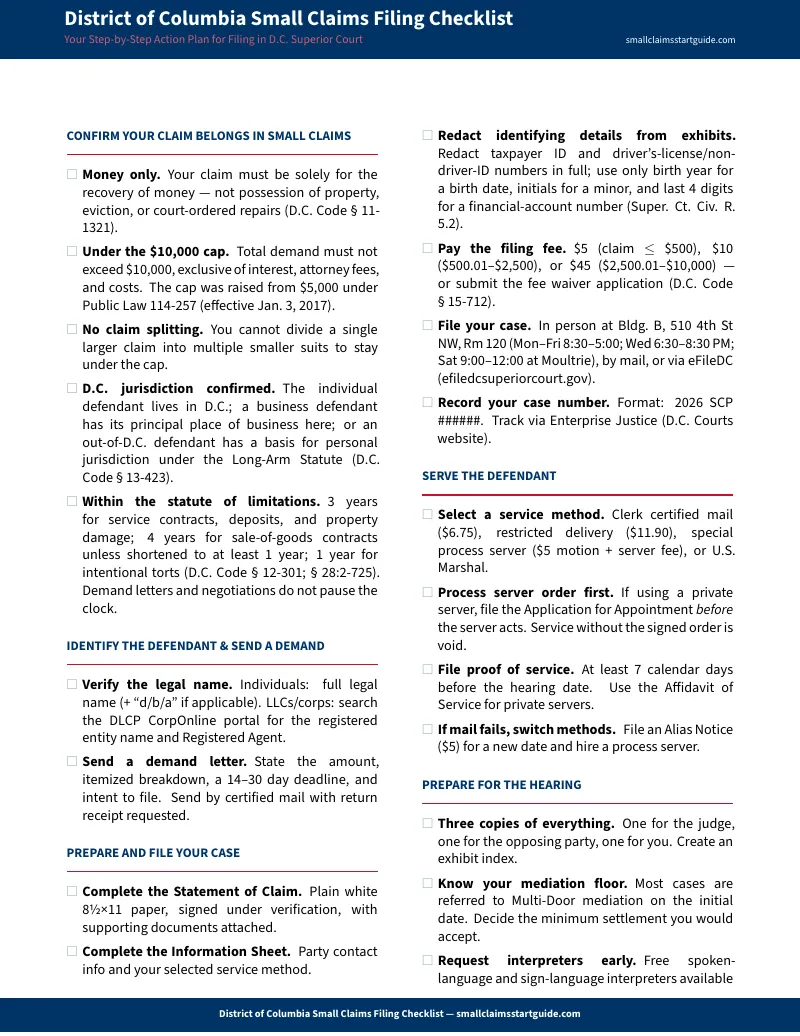
- One-Page Filing Checklist — every step, form, fee, and deadline on a single printable page so nothing falls through the cracks
- 6 Fillable Worksheets — entity verification form, filing fee calculator, service tracking log, hearing preparation checklist, statutory deadline calendar, and judgment enforcement tracker — print them and fill them in as your case progresses
Who This Is For
This guide is for anyone in the District of Columbia who is owed money and wants to recover it through Small Claims Court without hiring a lawyer:
- Tenants whose landlord kept a security deposit past the 45-day deadline without an itemized accounting
- Homeowners who paid a contractor deposit for work that was never finished or was done defectively
- Small landlords owed back rent or damage costs after a tenant moved out
- Sole traders and freelancers with unpaid invoices
- Buyers who received defective goods and were refused a refund
- Anyone with a property damage claim — auto collision, mover damage, neighbour damage — under $10,000
Why Not Just Use the Free Court Forms?
The DC Courts website publishes every form you need — and the guide links directly to them. What the court does not publish is a single document that puts the forms, the filing sequence, the fee schedule, the service rules, and the hearing preparation into one workflow you can follow from start to finish.
The Clerk's Office at Court Building B will answer questions about office hours and filing locations. They are legally prohibited from helping you draft your claim, advising on cause-of-action language, or organizing your evidence. The free legal aid options — the NLSP hotline (Thursdays only, 9:15 to noon) and the DC Bar clinic (alternating Mondays, capped at 15 people) — are valuable but hard to access on your schedule.
The guide does what none of these resources do: it puts every step in sequence, with the detail you need to complete each one, in a format you can print out and work through at your own pace.
Satisfaction Guarantee
Full refund, no time limit. If the guide does not help you, email [email protected] and we will refund your purchase — no questions, no deadline.
Get Started
Download the free checklist to see the steps at a glance, or get the full guide for the complete walkthrough — forms, fees, service tracking, evidence preparation, and hearing-day procedures, all in one document.
The guide is — less than the filing fee for most claims, and a fraction of what even a single hour of attorney time costs in D.C.
Frequently Asked Questions
What if the rules change after I buy?
We update the guide when the rules change. Email us any time, even years later, and we'll send you the current edition free.