You Just Got Served. The Clock Is Already Running.
A constable knocked on your door, or a certified mail envelope arrived with a green card to sign. Inside: a Civil Complaint and a blank Answer form from the Justice of the Peace Court. The papers say someone wants money from you — up to $25,000 — and you have exactly 15 calendar days from the date you received them to file a response. Not 20 days. Not 30. Fifteen.
Miss that deadline and the court enters a default judgment against you. That means the plaintiff gets what they asked for — garnished wages, levied bank accounts, a lien on your property — without you ever getting to tell your side. No second warning. No grace period.
The Delaware Defendant's Procedural Roadmap
This guide is a step-by-step procedural roadmap for responding to a civil claim in Delaware's Justice of the Peace Court. It does not give legal advice, predict outcomes, or tell you how to argue your case. It tells you exactly what to file, in what order, by which deadline — so you do not lose by default when you might have won at the hearing.
What makes it different from the court's free booklet: the JP Court publishes a narrative explaining what the rules say. This guide converts those rules into a filing sequence — which form to complete first, how to count your deadline from the service date (with worked examples), and the administrative step that gets every second business defendant's Answer rejected before a magistrate ever looks at it.
What's Inside
- 15-day deadline calculator — step-by-step instructions for counting from your service date, with three worked examples showing what happens when Day 15 falls on a weekend, a court holiday, or Thanksgiving. Record your dates on the included filing tracker so nothing slips.
- Form 51 field-by-field — the Answer to Complaint form explained line by line, including the three response postures (demand a trial, admit the claim, request a Bill of Particulars) and when each one makes sense
- Rule 57 entity checklist — if you're an LLC, corporation, or partnership, the court will reject your Answer unless you've filed a notarized Form 50 and paid a $20 annual fee first. The guide walks you through the Georgetown submission, the eFlex route, and the timing so your response isn't dead on arrival.
- Counterclaim filing map — when the plaintiff actually owes you money, Form 01CC lets you claim it in the same case. The guide covers the filing fees, the notarized affidavit requirement, the proof of service form (MISC 27C), and the hard rule: filed at least 5 days before trial.
- Default judgment recovery — if you already missed the deadline, the Motion to Vacate chapter explains the $15 motion fee, the excusable neglect standard, and a worked timeline showing exactly how the process plays out
- Hearing preparation by dispute type — how to organize your evidence into three indexed copy sets for the magistrate, the opposing party, and yourself. Includes scenario-specific strategies for contractor disputes, security deposit claims, vehicle sales, and commercial customer complaints.
- Settlement and mediation — the JP Court offers free voluntary mediation through its Civil Mediation Unit. The guide covers how to request it, what to expect, and the Stipulation of Dismissal that makes a settlement binding.
- Court of Common Pleas appeal — if you lose, you have 15 calendar days from the judgment date to file an appeal for a completely new trial (trial de novo). The guide breaks down the $135 CCP filing fee, the Sheriff service costs, and the timeline so you do not miss this second window.
Who It's For
- A homeowner served by a contractor claiming money for disputed work
- A tenant or former landlord in a security deposit or property damage claim
- A small business owner — LLC, sole trader, or corporation — sued by a customer
- A private vehicle buyer or seller facing a dispute over a sale
- Anyone in Delaware who received JP Court papers and needs to respond before the 15-day deadline runs out
Why Not Just Use the Free Court Forms?
The court's forms are completely free — and you should download them from courts.delaware.gov. This guide does not replace them. It explains the order you need them in, what to write on each line, and the procedural traps that catch self-represented defendants.
Here is what the free booklet does not cover: how to calculate your deadline when service was by certified mail versus constable delivery. What happens when you file an Answer without Form 50 on record (the clerk rejects it, and your 15-day clock keeps ticking). How to frame a counterclaim so it is not dismissed on a technicality. When to settle versus when to push for a hearing.
The court publishes the rules. This guide puts them in the order you need to follow them — and flags the ones that trip people up.
Satisfaction Guarantee
Full refund, no time limit. If the guide isn't what you expected, email [email protected] and you'll get your money back.
Get Started
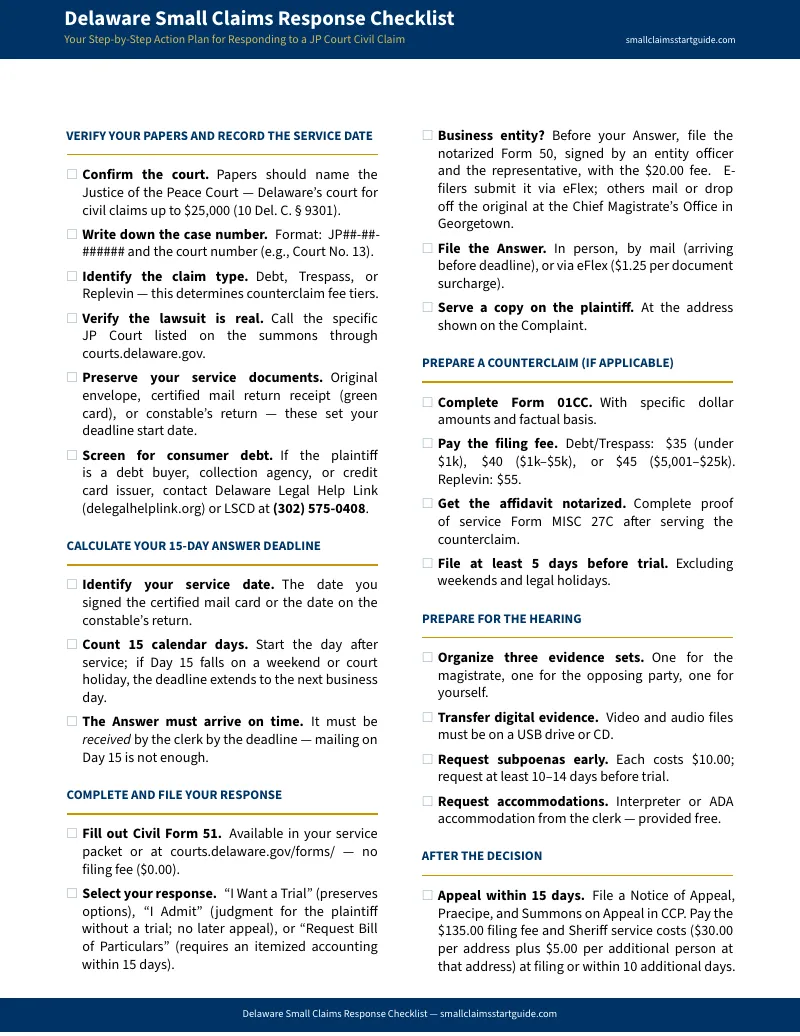
Download the free checklist to see the response steps at a glance. When you're ready for the full sequence — every form, every deadline, every worked example, plus the hearing preparation worksheet — get the complete guide for and respond with confidence.
Get the Delaware Small Claims Response Guide →
Frequently Asked Questions
What if the rules change after I buy?
We update the guide when the rules change. Email us any time, even years later, and we'll send you the current edition free.