You Won. They Haven't Paid. Now What?
You went to court. You made your case. The Justice of the Peace ruled in your favor. But the judgment is just a piece of paper — and the person who owes you money is acting like it doesn't exist.
Here's what most people don't realize until it's too late: Delaware courts don't collect for you. The JP Court enters the judgment and steps back. Every enforcement action — the forms, the fees, the deadlines, the follow-up when something fails — lands on you.
And the system isn't designed to make that easy. The forms are scattered across different court pages. The rules about which tool to use, and when, aren't explained anywhere in plain language. File the wrong form first, and you've wasted $20 in non-refundable fees on a garnishment that was never going to work.
The Delaware Judgment Collection System
The Collecting a Small Claims Judgment in Delaware guide is a structured enforcement system that takes you from an unpaid judgment to a closed case. It organizes every JP Court enforcement tool into a logical sequence — so you know exactly what to file, when to file it, and what to do when something doesn't go as planned.
This isn't a list of tips. It's an operational roadmap built around the specific forms, fees, statutes and deadlines that apply to Delaware JP Court judgments. Every step cites the actual court rule or Delaware Code section behind it.
What's Inside the Guide
- Enforcement Readiness Gate — before you spend a dollar on execution fees, the guide walks you through the 15-day appeal window, stays and motion-to-vacate checks so you know your judgment is actually enforceable
- Asset Discovery Workflow — a structured approach to identifying the debtor's wages, bank accounts and real property before you choose an enforcement tool, so you don't file blind
- Wage Garnishment Filing Sequence — the complete Civil Form 17 process: the $20 fee, the 4-copy submission rule, serving the employer, the 20-day answer timeline, and what Delaware's single-garnishment rule means for your case
- Property Levy via Civil Form 16 — when a constable levy makes sense, what happens if the debtor refuses entry, how to request a show-cause hearing, and the separate steps to request a sale
- Superior Court Real Estate Lien — the $10 Prothonotary transcript process that converts your JP Court judgment into a 10-year lien on the debtor's real property in New Castle, Kent or Sussex County
- Exemption Breakdown — every category Delaware protects from seizure under 10 Del. C. §§ 4902–4914, including the head-of-family exemption and trade tools limit, so you avoid wasting fees on untouchable assets
- Post-Judgment Interest Ledger — a ready-to-use declining-balance calculation method for tracking partial payments and statutory interest under 6 Del. C. § 2301(a)
- Judgment Revival Protocol — what to do if five years pass without full collection, using Civil Form 15A and the Scire Facias process
- Satisfaction Compliance Checklist — the mandatory post-collection filing that most creditors forget, and the statutory penalty of up to half your judgment amount if you skip it under 10 Del. C. § 9567
Who This Is For
- Individuals who won a JP Court judgment over an unreturned security deposit, a personal loan, property damage or a defective auto repair — and the debtor is ignoring the ruling
- Sole traders and contractors with an unpaid commercial judgment who need to start garnishing wages or attaching accounts without legal fees that would eat into the recovery
- Landlords who secured a money judgment alongside an eviction and need to collect after the tenant relocated
This guide is strictly for people who already have a final judgment. If you're still deciding whether to file or preparing for a hearing, the Delaware Small Claims Filing Guide covers that.
Why Not Just Use the Free Court Forms?
The court forms are free — and you should use them. This guide doesn't replace them. It tells you which form to file, in what order, with how many copies, and what to do when the first attempt doesn't work.
The JP Court website gives you Civil Form 16 as a blank PDF. It doesn't tell you that filing it against a debtor with no seizable personal property wastes your $20 fee. It doesn't explain that you need to check for prior garnishments before filing Form 17. It doesn't warn you that a judgment entered in JP Court doesn't automatically lien real estate — and it definitely doesn't walk you through the Prothonotary transcript process to fix that.
Court clerks can answer basic procedural questions, but they're prohibited from helping you draft documents, choose strategies or explain what to do when a garnishment comes back "Wages Not Attached."
The guide fills the gap between free forms you can download and a lawyer you'd rather not hire for a case this size.
What You Get
Your download includes 7 PDFs:
- The full guide — 55 pages covering every enforcement tool, form, fee and deadline in the Delaware JP Court collection process
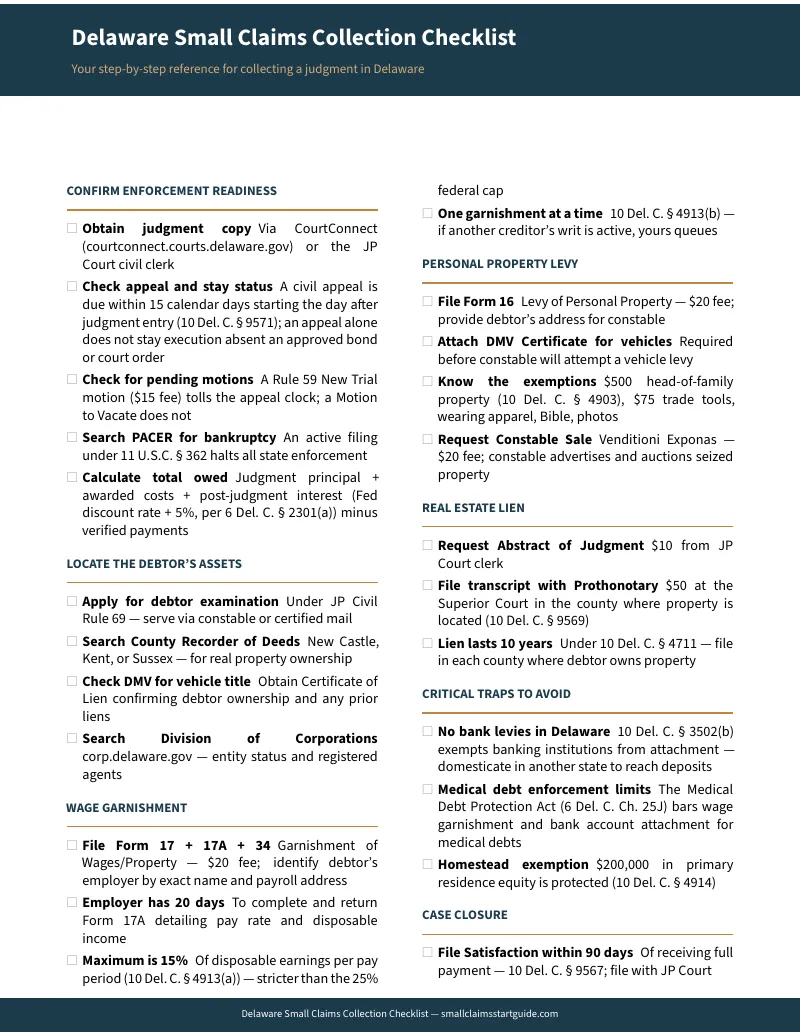
- Collection checklist — a printable quick reference with the enforcement steps, key forms and statutory deadlines
- Judgment balance and interest tracker — a fill-in ledger for recording partial payments using Delaware's allocation order (costs → interest → principal) and calculating post-judgment interest
- Enforcement action log — a running record of every filing, writ, constable return and follow-up across your case
- Debtor examination question script — 18 prepared questions for a JP Civil Rule 69 examination, organized by the enforcement tool each answer unlocks
- Enforcement decision flowchart — a one-page reference that walks you from "Is the judgment enforceable?" to the right enforcement tool based on the debtor's assets
- Satisfaction filing checklist — the step-by-step close-out process for both the JP Court and Superior Court filings, with the 90-day penalty deadline
Satisfaction Guarantee
Full refund, no time limit. If the guide doesn't help, email [email protected] and you'll get your money back.
Get the Delaware Judgment Collection Guide →
Or start with the free Delaware Collection Checklist — a printable overview of the enforcement options, forms and deadlines — and decide from there.
The full kit includes the 55-page guide plus 6 printable standalone tools: a balance and interest tracker, an enforcement action log, a debtor examination question script, a decision flowchart, and a satisfaction filing checklist — everything you need to run the collection process from a single folder.
Frequently Asked Questions
What if the rules change after I buy?
We update the guide when the rules change. Email us any time, even years later, and we'll send you the current edition free.