You won. The court agreed. Now nobody's collecting the money for you.
Connecticut courts decide disputes. They do not enforce the decisions. Once the magistrate enters your money judgment, the court's active role ends. Every step after that — finding the debtor's bank account, garnishing their wages, seizing their property, placing a lien on their house — falls entirely on you.
That's where most judgment holders get stuck. They call the court clerk and are told, correctly, that the clerk's office cannot help them collect. They download Form JD-CV-3 and submit it without knowing they need a prior installment order or discovery step first — and the application comes back rejected. They try to figure out bank executions and discover there are two different forms depending on whether the debtor is a person or a business. They don't know that a 20-day stay kicks in automatically when a wage execution is served, or that the marshal needs specific written instructions before they'll act.
The information is out there — scattered across the Judicial Branch website, the State Marshal Commission Manual, statutory text, and court form repositories. But nobody has put it in order. That's what the Connecticut Judgment Enforcement System does.
What's inside
- The enforcement decision tree, mapped step by step — From the voluntary payment window through post-judgment discovery, wage executions, bank levies, property seizures, real estate liens and satisfaction filings. Every stage names the exact Judicial Branch form, the statutory authority, and what happens if the debtor doesn't comply.
- Post-judgment discovery workflow — How to use Interrogatories (Form JD-CV-23) to compel written disclosure of assets under oath, and when to escalate to an Examination of Judgment Debtor (Form JD-CV-54) that forces the debtor into court. The guide covers the 30-day response window, sanctions for non-compliance, and the prerequisite sequence so your filings aren't rejected.
- Wage execution package — Form JD-CV-3 with the mandatory exemption attachment JD-CV-3a, the prerequisite installment order or failed discovery step, the automatic 20-day stay after employer service, and the garnishment formula: the lesser of 25% of disposable earnings or the amount above 40 times the applicable minimum wage. Every prerequisite is mapped so the clerk accepts your application on the first submission.
- Bank execution guide — Form JD-CV-24 for individual debtors, JD-CV-24N for business entities, and the exemption form JD-CV-24A. The guide explains the marshal's 45-day execution window, the service limitation for individual accounts, and what happens when the debtor claims exempt funds.
- State Marshal coordination system — How to select a marshal in the correct county, what documentation must accompany every execution order, how the 15% statutory fee under C.G.S. § 52-261(a)(6) is calculated and added to the judgment debt, and how to draft clear cover letter instructions so the marshal can act without calling you back for clarification.
- Judgment lien recording workflow — Step-by-step instructions for drafting a Judgment Lien Certificate under C.G.S. § 52-380a, identifying the correct municipal Town Clerk's office, recording the lien against the debtor's real property, and using the 4-month relation-back rule when a pre-judgment attachment exists.
- Post-judgment accounting ledger — A structured system for tracking your base judgment, the $95 court entry fee, post-judgment interest under C.G.S. § 37-3a, marshal collection fees, execution filing costs, partial payments received, and the remaining balance at any point. When the debt is satisfied, the guide walks through the formal satisfaction filing.
- Timeline and expiration reference — The 10-year execution limit under C.G.S. § 52-598(b), the 15-year independent action window, judgment revival mechanics, and a printable deadline tracker so the enforcement window doesn't close while you're still collecting.
Who this is for
You have a Connecticut small claims money judgment and you haven't been paid. Maybe you sued a former landlord for your security deposit and the court agreed — but the landlord hasn't sent a check. Maybe a contractor owes you for work they never finished, or a client stiffed you on an invoice, or someone damaged your property and the court awarded you damages. The judgment is entered, the voluntary payment window has passed, and you need to know what to do next.
This guide is for judgment creditors — people who won and need to collect. If you haven't filed your claim yet, the Connecticut Small Claims Filing Guide covers forms, fees and the hearing. If you've been served with a claim, the Connecticut Small Claims Response Guide covers answer deadlines, counterclaims and settlement.
Why not just use the court's free resources?
You should — and the guide tells you exactly where to find every official form and resource. The Connecticut Judicial Branch publishes all execution forms (JD-CV-3, JD-CV-5, JD-CV-23, JD-CV-24, JD-CV-54) for free. The State Marshal Commission Manual lists fee schedules and county marshal directories. Court Service Centers answer administrative questions in person.
What the free resources don't give you is a single, ordered workflow that connects the dots. The forms are blank, with no instructions explaining prerequisite steps. The Marshal Commission Manual is written for marshals, not for the people who hire them. The statutory text cites section numbers that reference other section numbers. Court staff are legally prohibited from selecting enforcement tools for you or advising which one to use first.
This guide takes everything a Connecticut judgment creditor needs — discovery tools, execution applications, marshal instructions, Town Clerk lien filings, interest calculations and satisfaction procedures — and puts it in one document, in order, with the prerequisites mapped and the statutory references verified. The time it saves is the months you'd otherwise spend submitting paperwork that gets rejected because you missed a step nobody told you about.
Satisfaction guarantee
Full refund, no time limit. If the guide doesn't help, email [email protected] and we'll refund you — no deadline, no form to fill in, no questions.
Important notices
This is an independent, privately published guide. It is not affiliated with the Connecticut Judicial Branch, any court, government department or legal aid organisation. It does not constitute legal advice, does not predict collection outcomes and does not provide legal representation. Court forms referenced in this guide are available free from jud.ct.gov. If your case involves complex legal issues or amounts exceeding the small claims limit, consult a licensed attorney.
Ready to start collecting?
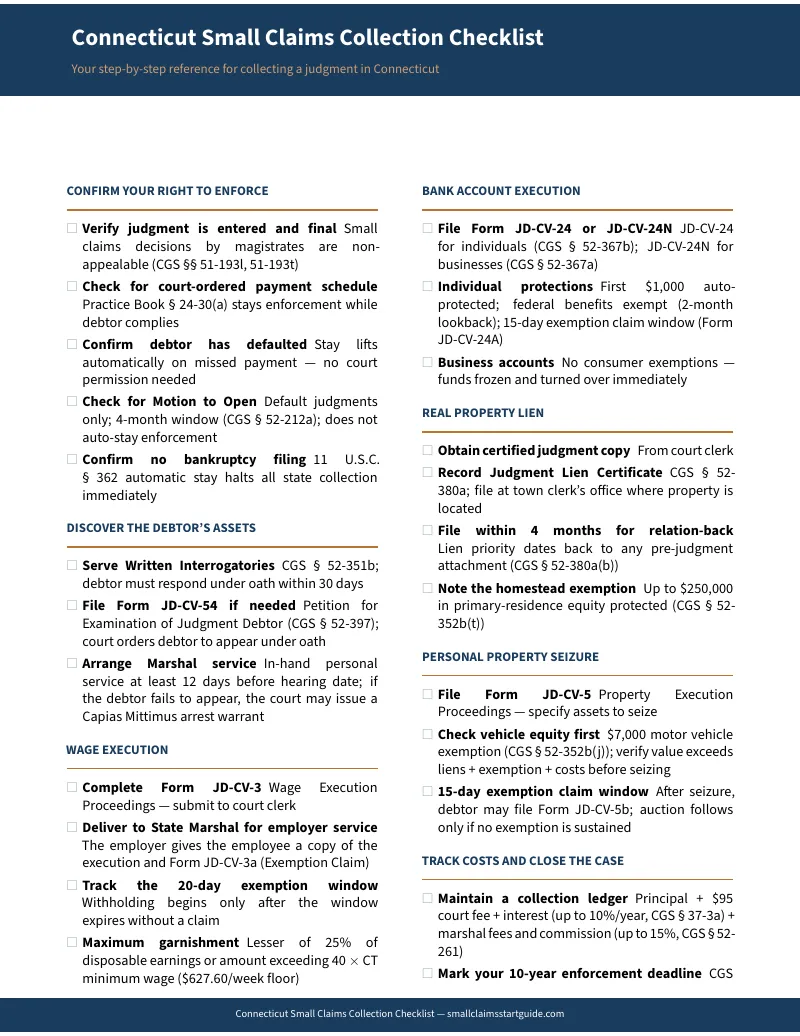
Download the free checklist to see the enforcement steps at a glance. When you're ready for the full system — every form walkthrough, the discovery sequence, marshal coordination, lien recording and the accounting ledger — gets you everything.
Frequently Asked Questions
What if the rules change after I buy?
We update the guide when the rules change. Email us any time, even years later, and we'll send you the current edition free.