
Connecticut does small claims differently — and that trips people up
In most states, you file your paperwork first and the court serves the other side. Connecticut flips that. You serve the defendant before you file. Get the order wrong and the clerk hands everything back.
That's just one of the steps where first-time filers get stuck. Which form is the writ? Which one is the service proof? What goes in the envelope to the defendant, and what goes to the court? How do you name a business that's really an LLC operating under a trade name? What happens when your certified mail comes back undelivered?
The court's website has the forms. Legal aid sites explain your rights. But nobody puts the steps in order for you — from the demand letter all the way through the hearing — with a timeline, a tracking system and a binder layout for your evidence.
That's what the Connecticut Filing Protocol System does.
What's inside
- The serve-first workflow, mapped step by step — Form JD-CV-40 (the writ), JD-CV-121 (defendant instructions), JD-CV-122 (service instructions) and JD-CV-123 (your proof of service), in the exact order the court expects them. Each form gets a plain-language walkthrough explaining which fields matter and what the clerk checks.
- Entity verification protocol — A concrete process for searching the Secretary of the State's CONCORD database and town clerk trade name filings to identify the legal entity behind a business name. Getting the defendant's name wrong is one of the most common reasons cases get dismissed before they start.
- Certified mail tracking checklist — A fill-in tracker for your certified mail receipt number, delivery date, return receipt ("green card") and Statement of Service deadline, so you have everything the clerk needs when you file.
- Printable deadline calendar — Covers every window that matters: the demand letter response period, certified mail delivery tracking, the gap between service and filing, hearing preparation milestones and the 30-day statute window for security deposit demands.
- Dollar-limit decision tree — The standard $5,000 cap, the $15,000 home improvement contractor exception under C.G.S. § 52-549w, and the security deposit double-damages provision under C.G.S. § 47a-21. One page tells you which limit applies to your claim.
- Hearing evidence binder index — An organized system for contracts, invoices, photos, text messages and receipts. Short docket slots mean you need to find any document in seconds. The binder layout is designed for that.
- Fee waiver instructions — If the $95 filing fee is a hardship, the guide walks through form JD-CV-120 and what to expect.
- Housing Session routing guide — Security deposit and landlord-tenant claims get routed to specialized Housing Sessions in specific courthouses (Hartford, New Haven, Bridgeport, Waterbury, Stamford, New Britain). The guide maps which towns go where.
Who this is for
You're owed money by someone in Connecticut and you want to get it back through small claims court without hiring a lawyer. Maybe it's a contractor who took your deposit and vanished, a former landlord sitting on your security deposit, a client who won't pay an invoice, or a neighbour whose tree crushed your fence. The amount is under the limit, you've asked and been ignored, and now you want to know exactly how to file.
This guide is for plaintiffs — people filing a claim. If you've been served with a small claims writ and need to respond, the Connecticut Small Claims Response Guide covers answer deadlines, counterclaims and settlement steps.
Why not just use the court's free resources?
You should use them — and this guide tells you where to find every one. The Connecticut Judicial Branch publishes the forms (JD-CV-40, JD-CV-120, JD-CV-121, JD-CV-122, JD-CV-123) for free, and Court Service Centers offer in-person help with administrative questions.
What the free resources don't give you is a single, ordered workflow that puts all the steps in sequence. The forms are scattered across different pages. The instructions assume you already know which order they go in. The service rules are in one document, the filing rules in another and the hearing preparation advice in a third. Court staff are prohibited from helping you fill in forms or advising on entity naming, timing or evidence organisation.
This guide takes everything a Connecticut small claims plaintiff needs — the demand letter, entity verification, service tracking, form completion, filing and hearing prep — and puts it in one document, in order, with a deadline calendar and a tracking checklist. The time it saves is the hours you'd otherwise spend working out the sequence yourself.
Satisfaction guarantee
Full refund, no time limit. If the guide doesn't help, email [email protected] and we'll refund you — no deadline, no form to fill in, no questions.
Important notices
This is an independent, privately published guide. It is not affiliated with the Connecticut Judicial Branch, any court, government department or legal aid organisation. It does not constitute legal advice, does not predict case outcomes and does not provide legal representation. Court forms referenced in this guide are available free from jud.ct.gov. If your case involves complex legal issues or amounts exceeding the small claims limit, consult a licensed attorney.
Ready to get your Connecticut filing organised?
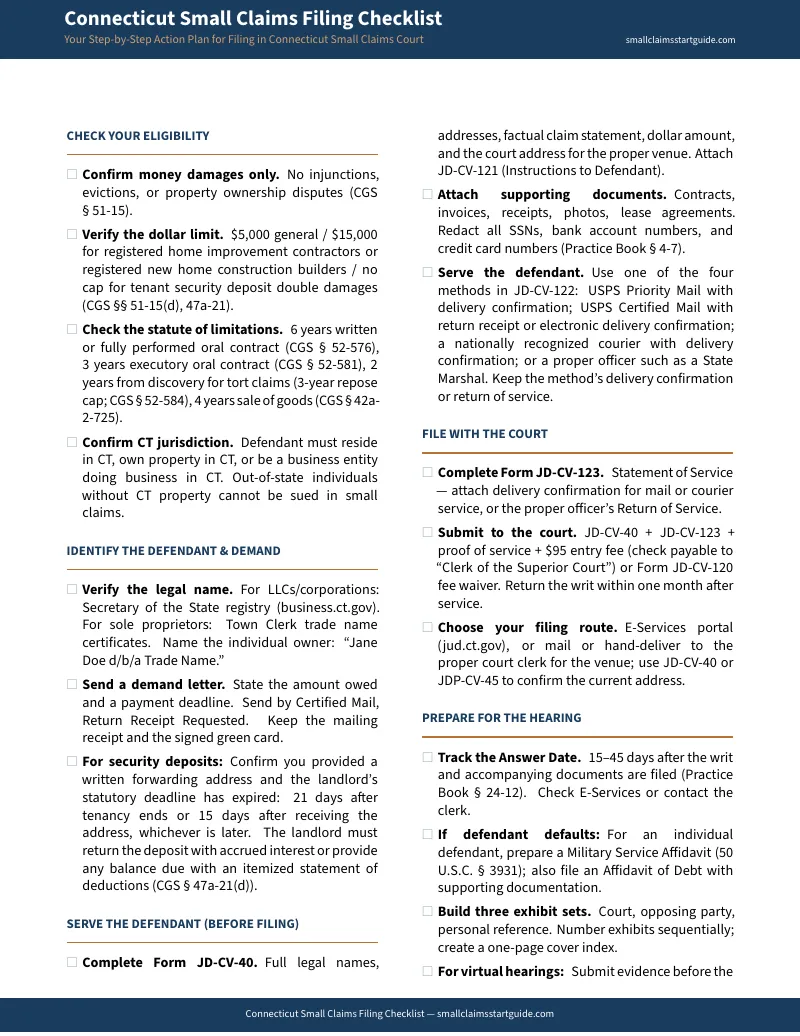
Download the free checklist to see the basic filing steps at a glance. When you're ready for the full workflow — every form walkthrough, the service tracker, the deadline calendar and the hearing binder — gets you everything.
Frequently Asked Questions
What if the rules change after I buy?
We update the guide when the rules change. Email us any time, even years later, and we'll send you the current edition free.