You won. The judge ruled in your favour. And now nobody is going to hand you the money.
The Superior Court entered a judgment in your name — maybe for an unpaid loan, a security deposit, property damage, a broken contract. You walked out of the courtroom thinking the hard part was over. Then you discovered the court does not collect a single dollar for you. The clerk cannot tell you what to do next. Your county's Small Claims Advisor can answer general questions but is legally prohibited from choosing your enforcement strategy or filling out your forms. And the other side has stopped returning your calls.
Welcome to the part of small claims court that nobody explains in advance: turning a piece of paper into actual money.
California gives judgment creditors serious enforcement tools — bank levies, wage garnishment, real property liens, personal property liens, vehicle seizure, debtor examinations under oath. But those tools are scattered across different statutes, require different forms, go through different county offices — the Court Clerk, the Sheriff, the County Recorder, the Secretary of State — and each office has its own fees, local instruction forms, and packet requirements. The Sheriff will reject an incomplete packet without explanation. One missing form — SER-001, an address verification declaration, a blank copy of SC-133 — can waste weeks and forfeit non-refundable levying fees.
The Multi-Agency Collection System: every enforcement tool, every office, every form packet
This guide is not a legal article or a checklist of tips. It is a complete Multi-Agency Collection System — a sequential workflow that walks you through every post-judgment tool California's Small Claims Division gives you, from the day the mandatory 30-day enforcement stay expires to the day you file the Acknowledgment of Satisfaction of Judgment and close the case. Each chapter covers one enforcement mechanism. Each mechanism has its own forms, sheriff instruction requirements, fees, deadlines and exemptions laid out step by step.
What's inside
- The 30-day enforcement stay and appeal window — when you can start enforcing under CCP § 116.810, what happens if the debtor appeals or moves to vacate, and how to use the waiting period productively by preparing your enforcement packets and researching assets
- Asset discovery tools — how to use the Judgment Debtor's Statement of Assets (Form SC-133), court-ordered debtor examinations (Forms SC-134 and EJ-125), document subpoenas (Form SC-107), and the new consumer debt examination framework (Form EJ-141, effective January 2025) to find bank accounts, employment and property
- Bank levy walkthrough — the Writ of Execution (Form EJ-130) paired with Sheriff levying instructions (Forms SER-001 and SER-001A), mandatory address verification declarations (Form WG-015/EJ-135), how to target the bank's central process office instead of a retail branch, the $2,325 automatic exemption for personal debt judgments, and what happens when the debtor claims additional exempt funds
- Wage garnishment — the Earnings Withholding Order process, the dual-cap calculation (lesser of 20% of disposable earnings or the amount exceeding 48 times the state or local minimum wage), employer response requirements, and handling a debtor who changes jobs
- Real property liens — recording the Abstract of Judgment (Form EJ-001) with the County Recorder, the 10-year lien duration, multi-county recording when the debtor owns property in more than one county, and the homestead exemption amounts ($300,000–$600,000 tied to county median sale price)
- Secretary of State personal property liens — filing Form JL-1 to encumber a debtor's commercial equipment, inventory and accounts receivable statewide, plus vehicle seizure through the Sheriff and DMV lien recording
- Exemptions decoded — the automatic $2,325 bank exemption, wage garnishment shields, homestead protections, personal property categories, and the 15-day deadline for opposing a debtor's Claim of Exemption (Forms EJ-160, EJ-170, EJ-175) before the Sheriff releases frozen funds
- Post-judgment interest and cost recovery — how to calculate 5%, 7% or 10% statutory interest under CCP § 685.010, filing the Memorandum of Costs After Judgment (Form MC-012) to add enforcement expenses to the balance, and the two-year deadline for cost claims
- Judgment renewal and long-term enforcement — the 10-year judgment lifespan, renewal via Form EJ-190 filed between 5 and 10 years after entry, and how renewal resets the interest rate rules for personal debt judgments
- Satisfaction of Judgment — filing Form SC-290 within 14 days of written demand after full payment, the $50 statutory penalty for late filing under CCP § 116.850, and releasing recorded property liens
Who this is for
- A landlord who won a damage or security deposit judgment and the tenant has not paid
- A homeowner whose contractor owes money after a small claims ruling and is not responding
- A sole trader with a judgment for an unpaid invoice and no idea where the debtor banks
- A tenant who won back a security deposit but the landlord refuses to pay
- A small business that won against a customer or vendor and needs to enforce across multiple counties
- Anyone holding a California Superior Court Small Claims Division judgment who needs to know what enforcement tools exist and how to use them
If you already have a money judgment from a California Small Claims Division and the debtor has not paid, this guide was built for you. It does not cover filing the original case or responding to one — those are separate guides.
Why not just piece it together from free sources?
You can try. The California Courts self-help website outlines your enforcement options and links to the Judicial Council forms. But it does not show you how to assemble the multi-form Sheriff instruction packet — pairing Form EJ-130 with Forms SER-001 and SER-001A and the required address verification declaration — that the Sheriff actually needs to execute a levy. The San Francisco Sheriff's page explains bank levies for its county. The Alameda County Sheriff's page has different local requirements. Los Angeles County's Department of Consumer and Business Affairs publishes an MC-012 instruction sheet but does not cover how to get there from the writ stage. The Judicial Council's MC-013-INFO pamphlet walks you through interest calculation formulas but does not explain when to use 5% versus 10%.
No single free source gives you the complete enforcement workflow across all 58 counties. You would spend hours bouncing between government websites, court self-help pages and county sheriff instruction sheets, still unsure which form to file first, what each step costs, and whether the debtor can claim an exemption that blocks the whole attempt. The Multi-Agency Collection System puts every tool in one document, in the order that makes financial sense, with the packet assembly instructions so the Sheriff accepts your filing the first time.
What you get
- The full guide — 14 chapters covering every enforcement tool from the 30-day waiting period through satisfaction of judgment
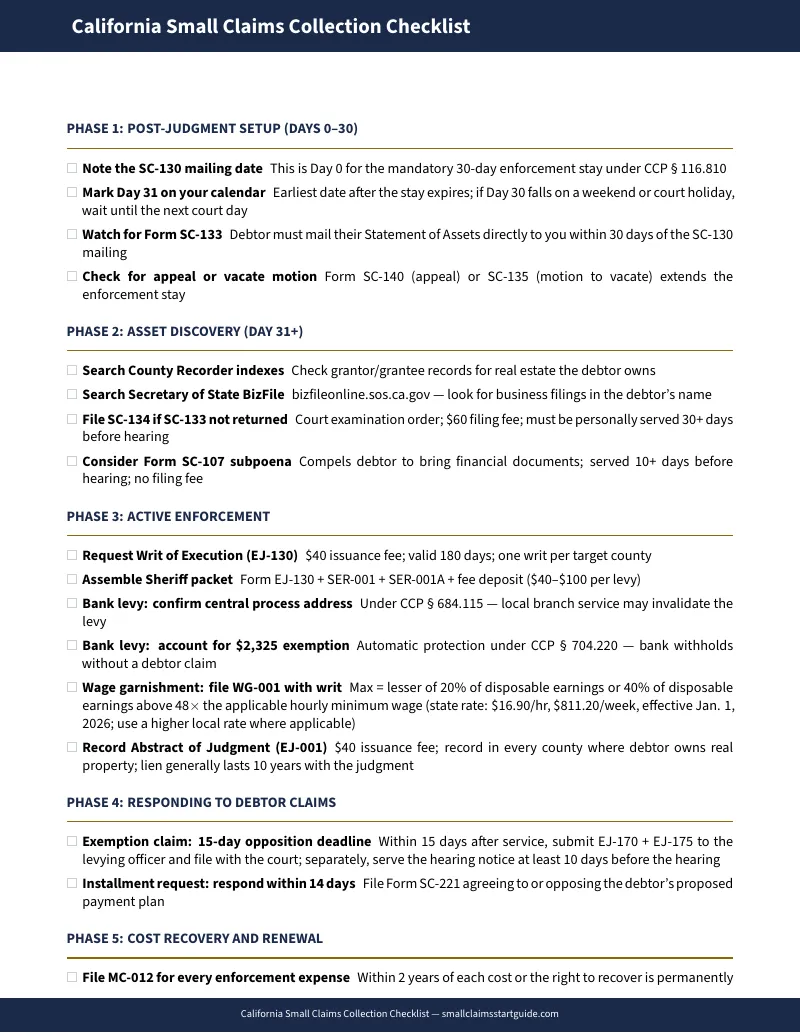
- The collection checklist — a printable summary of enforcement options, key forms, deadlines, fees and exemption highlights
- Judgment balance ledger — track the original award, statutory interest accrual (5%, 7% or 10%), enforcement costs added, partial payments received and the running total owed
- Asset discovery worksheet — record what you know and what you have found through SC-133 statements, debtor examinations, property records and public searches
- Enforcement filing tracker — log each writ filed, the court and sheriff fees paid, the service date, response deadlines and outcome
- Enforcement decision tree — choose between bank levy, wage garnishment, property liens and seizure based on what you know about the debtor's assets and income
- Enforcement timeline planner — track every critical deadline from the SC-130 mailing date through judgment renewal, including the 30-day enforcement stay, appeal windows and writ expiration dates
- Sheriff packet assembly checklist — check off every form, fee deposit and instruction sheet required for bank levies, wage garnishments and vehicle seizures before submitting to the Sheriff
- Exemption dispute response timeline — track the deadlines after a debtor files a Claim of Exemption, including the 15-day opposition deadline that releases frozen funds if missed
Full refund, no time limit. If the guide is not useful, email [email protected] and we will refund the full amount.
Get the California Judgment Collection Guide →
The free checklist tells you what enforcement tools exist. The full guide shows you how to use each one — step by step, form by form, with the Sheriff instruction packets assembled and the exemption rules decoded. For less than the cost of a single writ filing and sheriff levy deposit, you get the entire enforcement workflow in one place.
Frequently Asked Questions
What if the rules change after I buy?
We update the guide when the rules change. Email us any time, even years later, and we'll send you the current edition free.