You Won Your Case. The Court Moved On. The Debtor Hasn't Paid.
Winning a judgment in Alaska District Court feels like the finish line — until you realize the court does not collect a cent for you. No clerk calls the debtor's bank. No sheriff shows up at their door. The judge signs the judgment, and the case is over as far as the court is concerned.
Now you're staring at a stack of CIV execution forms scattered across the Alaska Court System's website, trying to figure out which ones apply, which offices to contact, and what order to do things in. The Judgment Creditor Booklet (CIV-550) is 16 dense pages of general procedures. The self-help portal sends you to a dozen different form links. And none of it tells you what to try first when you have no idea what the debtor owns.
The Alaska Judgment Collection Roadmap
This guide turns that pile of disconnected forms and booklets into a single, ordered enforcement plan. We call it the Alaska Judgment Collection Roadmap because that is what it does — it maps every step from the mandatory 48-hour post-judgment waiting period through each enforcement tool, all the way to filing the Satisfaction of Judgment when the debt is finally cleared.
Instead of guessing which CIV form to file or hoping the process server knows what to do with it, you follow the roadmap: identify what the debtor has, pick the right enforcement tool, assemble the correct paperwork, hand it off to the process server with written instructions, and track every dollar recovered.
What's Inside
- The 48-hour stay and demand letter — confirm enforcement can begin, then send a final payment demand that resolves roughly a third of cases without a single writ
- Debtor examinations — how to request a Civil Rule 69 examination to make the debtor disclose their bank accounts, employer, real property and Permanent Fund Dividend eligibility under oath
- Bank account levies — the CIV-501 writ, the creditor's affidavit (CIV-505), process server instructions (CIV-560), and exactly what happens at the bank when the writ arrives
- Wage garnishment — CIV-507 paperwork, the employer's response form (CIV-526), continuing-lien garnishment mechanics, and the federal and state exemption limits that cap each paycheck deduction
- PFD levies — Alaska's unique Permanent Fund Dividend attachment (CIV-502/503), including timing, the application deadline, and how to intercept next year's payout
- Personal property seizure — notice of levy (CIV-510), the process server's role, auction procedures, and when seizure is worth the cost
- Real property liens — recording an abstract of judgment at the Department of Natural Resources Recording District so the debt attaches to the debtor's land or home
- Exemptions guide — Alaska's homestead exemption ($72,900), vehicle exemption ($4,050), and every other protected category, with a step-by-step response when the debtor files a Claim of Exemptions (CIV-515)
- Interest and cost tracking — calculating the 6.75% statutory interest rate, crediting partial payments, and a ledger that tracks every dollar of principal, interest, fees and enforcement costs
- Closing the case — filing the mandatory Satisfaction of Judgment (SC-17), releasing recorded liens, and the statutory liability for failing to file on time
Who This Is For
- You won a money judgment in an Alaska District Court small claims case and the debtor has not paid voluntarily
- You are handling enforcement yourself without a lawyer and need the steps laid out in order
- You are an office manager or bookkeeper collecting on a business judgment and need a repeatable process your team can follow
Why the Free Forms Aren't Enough
The Alaska Court System publishes every execution form for free. That is not the problem. The problem is that free forms come with no roadmap.
The court's self-help pages describe each enforcement tool on a separate page. CIV-550 explains the general procedure but does not tell you whether to garnish wages or levy the bank account first. The forms themselves do not include instructions for the process server, do not calculate your interest balance, and do not warn you that a missed PFD filing deadline means waiting a full year.
This guide connects the dots: which tool to start with based on what you know about the debtor, which CIV forms go together for each tool, what to write on the process server instructions, how to track partial payments against interest, and when to pivot to a different enforcement method if the first one comes back empty.
Satisfaction Guarantee
If the guide does not help, email [email protected] for a full refund — no time limit, no questions.
Get Started
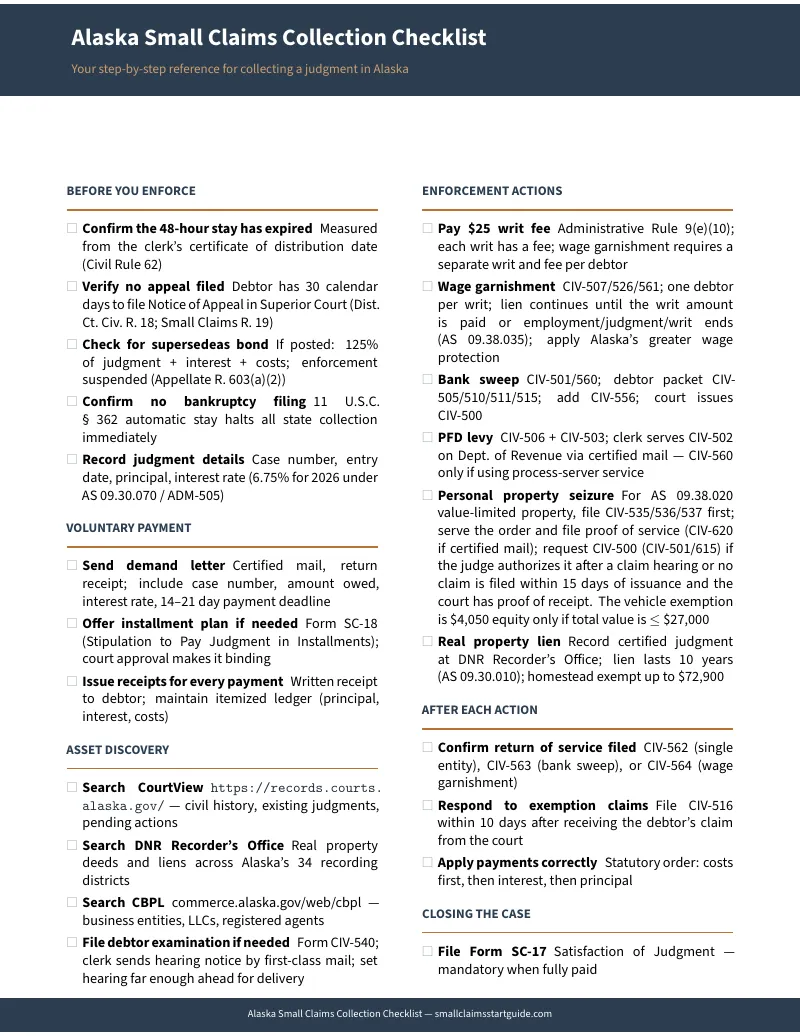
Download the free Alaska Small Claims Collection Checklist to see whether the guide fits your situation. It covers the five mandatory steps before filing any writ. Ready for the full roadmap? The complete guide — with every enforcement tool, form reference, process server instruction set and tracking ledger — is available for .
Frequently Asked Questions
What if the rules change after I buy?
We update the guide when the rules change. Email us any time, even years later, and we'll send you the current edition free.